Type 5 (105 mm)
Tank cannons
OLD‑WIKI.WARTHUNDER.COM (DEFUNCT)
| This page is about the Japanese Type 5 (105 mm) cannon. For other uses, see Type 5 (Disambiguation). |
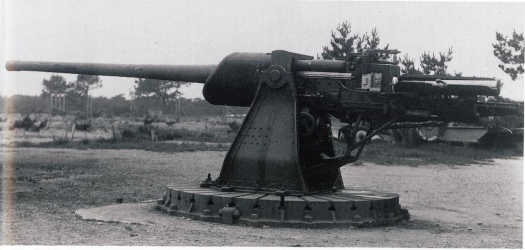
Description
The Type 5 is currently the most powerful gun mounted on an IJA tank in War Thunder. It draws parallels to the famed German 88 mm KwK43, sporting similar muzzle velocity and penetration, but with significantly increased explosive filler and improved angled armour penetration. Players who are used to the KwK43 will find themselves right at home when using the Type 5.
Vehicles equipped with this weapon
General info
As mentioned previously, the Type 5 is very similar to the widely used German KwK43, trading raw flat penetration in favour of explosive filler and improved angled armour penetration. However, the drop in penetration is quite minor at traditional combat ranges but becomes significantly more drastic beyond 1,000 m. Regardless of the drops in penetration, many players seem to say that the Type 5 is superior as a result of its significantly better angled armour penetration and its higher explosive filler. If a Type 5 penetrates, it will almost always destroys the target. The cannon itself favours a sniper playstyle, as it can shoot down enemies at range with little worry of follow up shots thanks to the high explosive filler.
However, the cannon is plagued by relatively poor penetration compared to other guns at its battle rating. During the shift into Rank V, most tanks will be running APDS or HEAT rounds with far superior penetration and muzzle velocity, and more tanks will be fitted with significantly better armour effectively thwarting most attempts at frontal penetration.
Available ammunition
- Type 2 APHE - The Type 2 one of the two standard rounds of the Type 5. This round can be used against nearly all kinds of medium or heavy tanks and is thank to its massive high-explosive filler capable of destroying most of its targets with only one shot.
- Experimental HE - Standard HE shell with higher than average penetration, useful to bring along to deal with lightly armoured vehicles such as the Italian APC's and American late light tanks.
| Penetration statistics | |||||||
|---|---|---|---|---|---|---|---|
| Ammunition | Type of warhead |
Penetration @ 0° Angle of Attack (mm) | |||||
| 10 m | 100 m | 500 m | 1,000 m | 1,500 m | 2,000 m | ||
| Type 2 APHE | APHE | 233 | 228 | 205 | 181 | 159 | 140 |
| Experimental HE | HE | 30 | 30 | 30 | 30 | 30 | 30 |
| Shell details | ||||||||||||
|---|---|---|---|---|---|---|---|---|---|---|---|---|
| Ammunition | Type of warhead |
Velocity (m/s) |
Projectile mass (kg) |
Fuse delay (m) |
Fuse sensitivity (mm) |
Explosive mass (TNT equivalent) (g) |
Ricochet | |||||
| 0% | 50% | 100% | ||||||||||
| Type 2 APHE | APHE | 1,000 | 16 | 1.2 | 19 | 200 | 47° | 60° | 65° | |||
| Experimental HE | HE | 920 | 16 | 0 | 0.1 | 2,520 | 79° | 80° | 81° | |||
Comparison with analogues
Give a comparative description of cannons/machine guns that have firepower equal to this weapon.
Usage in battles
The Type 5 should be primarily used as a sniper due to its high velocity and excellent penetration at range, but also due to its slower reload. The Type 2 should be the go-to shell for most targets, but it is important to bring a few HE shells to deal with the previously mentioned light tanks.
Pros and cons
Pros:
- High amount of explosive filler on its APHE shell results in a lot of instant knock-outs
- Very accurate with little shell drop
- Solid penetration
- HE shell has 30 mm of penetration all-around and a lot of explosive filler, easy to destroy light tanks with overpressure
- Arguably one of the best firing sounds in the entire game
- Not a lot of recoil, easy to follow up shots
Cons:
- Relatively slow reloading rate
- Penetration can be underwhelming when facing higher-ranked vehicles
- Cannon barrel and breech are quite fragile
- Fuse sensitivity on APHE leads to the shell going right through some lightly-armoured tanks
History
In 1942, Japan realized they were falling quite behind in terms of tank production as news of the American M6 and M26 heavy tanks reached the high command, leading them to redesign their tank production to become more like Germany's, meaning new tanks designed to be made with high powered tank guns. This lead to the 75 mm Type II cannon mounted on the Chi-To, Chi-Ri and variants of the Chi-Nu, and the 105 mm Type 5.
The Type 5 was designed off of the old Type 96 150 mm strategic artillery cannon, which was deemed to have the most potential for a downscaled tank gun. It was shortened, given a single piece barrel and was applied with a tank breech. The experimental cannon was completed in December 1944 with tests following in March of 1945. After showing promising performance outclassing most tank guns at the time, two prototype guns were made for the Ho-Ri, one for the tank itself and another for external testing until the next tank was completed. The end of the war terminated development but several promising designs were based around the gun; a development of the Na-To tank destroyer titled the Ka-To, a heavy-medium tank with the chassis of a Ho-Ri and the turret of a Chi-Ri with additional armour named the Chi-Se.
Media
Excellent additions to the article would be video guides, screenshots from the game, and photos.
See also
- Related development
- Similar cannons
- M3 (90 mm): American equivalent
- KwK43 (88 mm): German equivalent
- D-10T (100 mm): Soviet equivalent
- 20pdr OQF Mk.I (84 mm): British equivalent
External links
Paste links to sources and external resources, such as:
- topic on the official game forum;
- other literature.
| Japan tank cannons | |
|---|---|
| 37 mm | Type 94 · Type 100 · Type 1 |
| 47 mm | Type 1 |
| 57 mm | Type 90 · Type 97 |
| 70 mm | Type 94 |
| 75 mm | Type 90 · Type 99 · Type 3 · Type 5 (Type I Model II · Type II Model I · Type II Model II) |
| 90 mm | Type 61 |
| 105 mm | Type 5 (Experimental · Production) · JSW L/52 |
| 106 mm | Type 60 (B) |
| 120 mm | Taishō Type 10 · Navy short gun · Type 90 L/44 · Type 10 L/44 |
| 150 mm | Type 38 |
| 155 mm | NSJ L/30 · JSW L/52 |
| Foreign: | |
| 25 mm | Oerlikon KBA B02 (Switzerland) |
| 30 mm | Bushmaster 2 Mk.44 (USA) |
| 35 mm | Oerlikon KDE (Switzerland) |
| 75 mm | M6 (USA) |
| 76 mm | M1 (USA) · M32 (USA) |
| 88 mm | KwK36 (Germany) |
| 90 mm | M3A1 (USA) · M36 (USA) |
| 105 mm | L7A3 (Germany) |
| 120 mm | Schneider-Canet 1898 (France) |