Type 38 (150 mm)
Tank cannons
OLD‑WIKI.WARTHUNDER.COM (DEFUNCT)
Description
The 150 mm Type 38 was a 1905 German 15 cm howitzer design adopted in Japanese service in the 38th year of Emperor Meiji's reign (1905).
Initially, most units were imported from Krupp until 1911, when the Army’s Osaka Arsenal was allowed to produce them domestically under license.
While outdated after WW1 and technically replaced by the Type 4 15cm howitzer (1915) and later the Type 96 15cm howitzer (1936), it would still see common use in heavy artillery units until 1945 due to the number of cannons produced and available, even being used on the Type 4 Ho-Ro from 1944 onwards.
Vehicles equipped with this weapon
General info
Available ammunition
Mainly built as an infantry gun, the shells don't provide much anti-tank penetration, but pack a whole load of explosive mass that will put any medium to even heavy armoured vehicles dead in its tracks if fired under or on top of the tank.
| Penetration statistics | |||||||
|---|---|---|---|---|---|---|---|
| Ammunition | Type of warhead |
Penetration @ 0° Angle of Attack (mm) | |||||
| 10 m | 100 m | 500 m | 1,000 m | 1,500 m | 2,000 m | ||
| Type 95 APHE | APHE | 38 | 37 | 35 | 33 | 31 | 31 |
| Type 92 HE | HE | 55 | 55 | 55 | 55 | 55 | 55 |
| Shell details | ||||||||||||
|---|---|---|---|---|---|---|---|---|---|---|---|---|
| Ammunition | Type of warhead |
Velocity (m/s) |
Projectile mass (kg) |
Fuse delay (m) |
Fuse sensitivity (mm) |
Explosive mass (TNT equivalent) (kg) |
Ricochet | |||||
| 0% | 50% | 100% | ||||||||||
| Type 95 APHE | APHE | 290 | 36.1 | 1.2 | 19 | 2.6 | 47° | 60° | 65° | |||
| Type 92 HE | HE | 290 | 36 | 0 | 0.1 | 7.02 | 79° | 80° | 81° | |||
Comparison with analogues
- The German 150 mm S.I.G.33 has a higher penetration and comes with HEAT, but doesn't pack as much explosive mass and has a lower muzzle velocity.
- The Italian Cannone da 100/17 Mod.1914 has a higher velocity and more shell choice but doesn't come with much explosive mass either.
- The Swedish 150 mm Fsthaub m/02 has roughly the same performance with less explosive mass.
Usage in battles
Describe the cannon/machine gun in the game - its distinctive features, tactics of usage against notable opponents. Please don't write a "guide" - do not impose a single point of view, but give the reader food for thought.
Pros and cons
Pros:
- HE comes with a large amount of explosive mass, enough to destroy light or unarmoured vehicles from an indirect hit
- Low velocity can be used to shoot over cover
Cons:
- Lacks direct penetration
- Low velocity
- Extremely slow reload rate
History
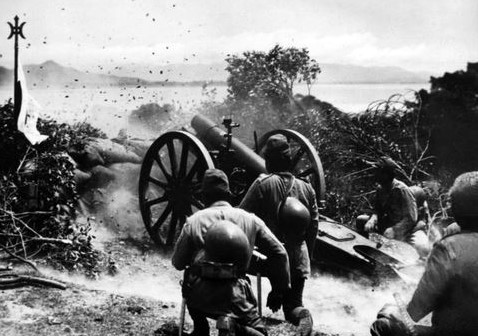
Imperial Japan, seeking out new artillery equipment, acquired 150 mm L/12 howitzers from Krupp in Germany in 1903. Starting by ordering a total of 36 from the manufacturer, Japan then acquired the license to manufacture the howitzers domestically. The resulting howitzer in Japanese service was called the 15 cm Type 38 field howitzer (for the 38th year of Emperor Meiji's reign (1905)).[1]
Essentially unchanged from the Krupp L/12 model, the gun retained rather modern features such as an open box trail and interrupted screw breech.[2] The weapon was rather lightweight at 2.09 tons.[3], due in part to a simple recoil mechanism needed for the small propelling charges for the shell. Consequently however, the 150 mm Type 38 suffered from a short effective range of less than 6,000 m. This led to future procurements of howitzers such as the 150 mm Type 4 that had a higher effective range than the Type 38.
Though replaced from front-line service with newer howitzers by the 1930s, the Type 38 were still used until the end of World War II.[3] The guns were notably used in the Second Sino-Japanese war,[4] and as the main armament of the Ho-Ro self-propelled gun, assembled at the Osaka Arsenal.[5]
Media
Excellent additions to the article would be video guides, screenshots from the game, and photos.
See also
Links to the articles on the War Thunder Wiki that you think will be useful for the reader, for example:
- reference to the article about the variant of the cannon/machine gun;
- references to approximate analogues by other nations and research trees.
External links
References
- Citations
- Bibliography
- Ness, Leland. Rikugun. Volume 2: Weapons of the Imperial Japanese Army & Navy Ground Forces. Helion and Company, 19 Dec. 2014.
- Taki "Type 38 15cm Howitzer" Imperial Japanese Army Page, Website. Accessed on 20 Apr 2021 (Archive).
- War Department Special Series No 25: Japanese Field Artillery United States Government Printing Offices, 15 Oct. 1944.
| Japan tank cannons | |
|---|---|
| 37 mm | Type 94 · Type 100 · Type 1 |
| 47 mm | Type 1 |
| 57 mm | Type 90 · Type 97 |
| 70 mm | Type 94 |
| 75 mm | Type 90 · Type 99 · Type 3 · Type 5 (Type I Model II · Type II Model I · Type II Model II) |
| 90 mm | Type 61 |
| 105 mm | Type 5 (Experimental · Production) · JSW L/52 |
| 106 mm | Type 60 (B) |
| 120 mm | Taishō Type 10 · Navy short gun · Type 90 L/44 · Type 10 L/44 |
| 150 mm | Type 38 |
| 155 mm | NSJ L/30 · JSW L/52 |
| Foreign: | |
| 25 mm | Oerlikon KBA B02 (Switzerland) |
| 30 mm | Bushmaster 2 Mk.44 (USA) |
| 35 mm | Oerlikon KDE (Switzerland) |
| 75 mm | M6 (USA) |
| 76 mm | M1 (USA) · M32 (USA) |
| 88 mm | KwK36 (Germany) |
| 90 mm | M3A1 (USA) · M36 (USA) |
| 105 mm | L7A3 (Germany) |
| 120 mm | Schneider-Canet 1898 (France) |