USS Moffett
OLD‑WIKI.WARTHUNDER.COM (DEFUNCT)
Description
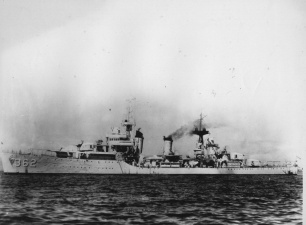
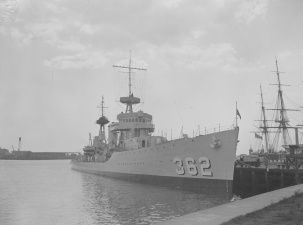
The Porter-class, USS Moffett (DD-362), 1942 is the 7th ship in the Porter-class of USN destroyers. Laid down in January 1934 and commissioned in August 1936, she would serve throughout WW2. She did not participate in any major battles, serving most of the war as an escort in the Atlantic theatre. She did however sink the German U-boat U-128 along with USS Jouett, and managed to sink another submarine, U-604, after drawn out battle over 3 days in August 1943. She would later defend convoy YN-78 from air attack in Tunisia, and be brought in for repairs afterwards. These would last until the end of the war, at which point they were halted. USS Moffett would be sold for scrap in May of 1947.
USS Moffett was introduced in Update "New Power", and with its battery of 8x 5-inch/38 rapid firing guns is one of the most powerful destroyers in the US bluewater fleet. The guns can get down to a 22 rounds-per-minute reload, allowing Moffett to easily dispatch most destroyers and even light cruisers, although the guns begin to struggle against more heavily armoured light cruisers such as the Brooklyn class. The anti-aircraft battery is respectable, and the main battery also has access to HE-VT shells to deal with aircraft as well. This allows Moffett to help protect ships with less anti-aircraft defences such as the USS Northampton easily.
General info
Survivability and armour
USS Moffett, like other American destroyers, is relatively well protected against destroyer calibre high explosive rounds. Her main belt and armour deck consists of a .5-inch anti-fragmentation armour belt. This will not protect against hits from any armour-piercing rounds, but significantly increases survivability when under fire from destroyer and light cruiser calibre HE rounds. This belt only covers the machinery spaces, the areas fore and aft of the hull are left unprotected. This includes the aft of the ships, where the vulnerable magazine is located.
USS Moffett's magazines lie underneath the aft two turrets, and critically are slightly above the waterline. Enemy captains that manage to score a hit in this location will almost certainly instantly destroy the ship. Therefore captains of Moffett should attempt to shield this vulnerable section, with natural cover if possible. If unable captains should attempt to make the rear of the ship as difficult as possible to hit; either from guns or torpedos. As for crew count, Moffett carries 194 crewmen, which is less that other contemporary destroyers such as the Fletcher-class, resulting in slightly lower survivability under fire than other American destroyers.
Mobility
USS Moffett has a flank speed of 37 kn, giving her, along with her Porter-class sisters the shared titles of fastest destroyers in the American tech tree. She responds to rudder commands within two seconds, so captains can expect good agility, allowing USS Moffett to reach areas inaccessible to larger vessels, contesting even coastal areas so long as the water doesn't become too shallow. While turning, her speed falls to 26 kn, which while still respectable, makes her a much easier target, so captains should be prudent to avoid sustained turns. USS Moffett takes approximately 29 seconds to accelerate to flank speed from stopped, and 33 to come to a halt.
| Mobility Characteristics | |||||
|---|---|---|---|---|---|
| Game Mode | Upgrade Status | Maximum Speed (km/h) | Turn Time (s) | Turn Radius (m) | |
| Forward | Reverse | ||||
| AB | Stock | 62 | 26 | ~131.28 | ~249.57 |
| Upgraded | ___ | ___ | |||
| RB/SB | |||||
| Upgraded | ___ | ___ | |||
Modifications and economy
Armament
Primary armament
The USS Moffett is equipped with 8 x 5 inch/38 (127 mm) SP gun mounts. All are built in a dual mount setup, allowing for more guns on target than single mounts. When using her first stage ammo storage, she can fire at a very fast 22 rounds per minute, decreasing to 15 rpm once the first stage storage is empty. This rate of fire is among the highest of any destroyer's main gun of any nation, and even the second stage ammunition reload is competitive. Each first stage ready rack can hold up to 40 rounds in total.
The turret traverse speed is 15 degrees per second, and gun elevation speed is 12 degrees per second. Both forward and rear turret groups have a 150-degree turning radius and can elevate 35 degrees and depress a total of 10 degrees. The range of fire and traverse speed for the turrets on the Moffett is not exceptional, but the high number of guns ensures that a fair amount of firepower is available in any direction. That being said, the level of AA that these guns can provide is limited by the elevation of 35 degrees; planes directly above the Moffett cannot be targeted.
The 5"/38 guns on the Moffett have access to a range of shell options, including HE, Common, SP Common, and HE-VT. These munitions are competent, being on par with foreign 127 mm guns. The HE and HE-VT shells have 3.2 kg of TNT filler and are excellent at disabling external components and bombers respectively. The very high rate of fire allows for rapid retargeting once a module has been disabled, further contributing to the incapacitating power of the 5"/38.
Looking at the use-cases for each of the shells:
- AAC Mk.34 (HE) - Ammunition of choice against heavy cruisers and other heavily-armoured targets where you can't do damage with any of the SAP shells. Use this to start fires, destroy secondary and anti-air guns, etc.
- Common Mk.32 (Common) - Functionally similar to a semi-armour-piercing shell, it is your default go-to ammunition against majority of destroyers, MBTs, or other soft-skinned targets
- SP Common Mk.46 (SP Common) - Functionally similar to a semi-armour-piercing shell with more penetration. It is an alternative against armoured destroyers (e.g. most of USSR designs) or a light cruisers. Trades damage output for a better penetration - still not enough enough of it to penetrate the citadel of a heavy cruiser, but there is a narrow group of targets and ranges where Mk.46 is superior. If you are in doubt when to use it - opt for Mk.32 or regular HE.
- AAVT Mk.31 (HE-VT) - One of the best anti-air options in its BR. A combination of the high rate of fire with a relatively good explosive filler on a proximity fuse make it a potent weapon that most players don't expect to encounter. But remember that the HE-VT fuse is arming after 457 m, in any distance shorter than that it works like a regular HE shell. If you have issues aiming at the airborne units - Select secondary weapon (default Alt+2 on PC), then hover over the enemy bomber/fighter and press Manual targeting of the primary calibre (default X+1 on PC) to have AI gunners aim for you. You can switch back to your main guns with Select primary weapon (default Alt+1 on PC).
| Penetration statistics | |||||||
|---|---|---|---|---|---|---|---|
| Ammunition | Type of warhead |
Penetration @ 0° Angle of Attack (mm) | |||||
| 1,000 m | 2,500 m | 5,000 m | 7,500 m | 10,000 m | 15,000 m | ||
| AAC Mk.34 | HE | 36 | 36 | 36 | 36 | 36 | 36 |
| Common Mk.32 | Common | 124 | 103 | 77 | 58 | 46 | 37 |
| SP Common Mk.46 | SP Common | 150 | 125 | 93 | 71 | 56 | 45 |
| AAVT Mk.31 | HE-VT | 36 | 36 | 36 | 36 | 36 | 36 |
| Shell details | ||||||||||||
|---|---|---|---|---|---|---|---|---|---|---|---|---|
| Ammunition | Type of warhead |
Velocity (m/s) |
Projectile mass (kg) |
Fuse delay (s) |
Fuse sensitivity (mm) |
Explosive mass (TNT equivalent) (g) |
Ricochet | |||||
| 0% | 50% | 100% | ||||||||||
| AAC Mk.34 | HE | 792 | 25 | 0 | 0.1 | 3,220 | 79° | 80° | 81° | |||
| Common Mk.32 | Common | 792 | 24.49 | 0.01 | 6 | 1,150 | 47° | 60° | 65° | |||
| SP Common Mk.46 | SP Common | 792 | 25 | 0.01 | 6 | 906.5 | 48° | 63° | 71° | |||
| Proximity-fused shell details | ||||||||||||
|---|---|---|---|---|---|---|---|---|---|---|---|---|
| Ammunition | Type of warhead |
Velocity (m/s) |
Projectile mass (kg) |
Fuse delay (s) |
Fuse sensitivity (mm) |
Arming distance (m) |
Trigger radius (m) |
Explosive mass (TNT equivalent) (g) |
Ricochet | |||
| 0% | 50% | 100% | ||||||||||
| AAVT Mk.31 | HE-VT | 792 | 25 | 0 | 0.1 | 457 | 23 | 3,220 | 79° | 80° | 81° | |
Secondary armament
The Moffett has only two 1.1 inch/75 Mk.1 "Chicago Piano" AA guns. They are slow to traverse and slow to fire, and as such the passive AA capacity of these guns are very low. Still, they do serve as a deterrent and are capable of destroying PT boats if the main armament is disabled.
Anti-aircraft armament
Instead of using the M2 Browning MG like its tech tree counterpart USS Porter, the Moffett features five Oerlikon autocannons, which is a beefy upgrade compared to the Porter. Along with Chicago Piano secondary, the Moffett has a competent level of AA, and can take down planes with an average level of consistency.
- Universal: HEF-T · HEF-I · AP-T
- 20 mm AP: AP-T · AP-T · AP-T · HEF-I
- 20 mm HE: HEF-T · HEF-I · AP-T · HEF-I
| Penetration statistics | |||||||
|---|---|---|---|---|---|---|---|
| Ammunition | Penetration @ 0° Angle of Attack (mm) | ||||||
| 10 m | 100 m | 500 m | 1,000 m | 1,500 m | 2,000 m | ||
| HEF-T | 2 | 2 | 2 | 2 | 2 | 2 | |
| AP-T | 34 | 32 | 24 | 17 | 12 | 8 | |
| HEF-I | 2 | 2 | 2 | 2 | 2 | 2 | |
| Shell details | ||||||||||||
|---|---|---|---|---|---|---|---|---|---|---|---|---|
| Ammunition | Velocity (m/s) |
Projectile mass (kg) |
Fuse delay (m) |
Fuse sensitivity (mm) |
Explosive mass (TNT equivalent) (g) |
Ricochet | ||||||
| 0% | 50% | 100% | ||||||||||
| HEF-T | 830 | 0.12 | 0 | 0.1 | 6.57 | 79° | 80° | 81° | ||||
| AP-T | 830 | 0.12 | - | - | - | 47° | 60° | 65° | ||||
| HEF-I | 830 | 0.12 | 0 | 0.1 | 11.17 | 79° | 80° | 81° | ||||
Additional armament
Moffett is equipped with 8 x 21 inch (533 mm) torpedo tubes, positioned into two quadruple mounts, one placed just behind the rear smokestack and the other between the two smokestacks. While it is not the most powerful in-game torpedo, it can still do its job well.
Usage in battles
Similarly to her sister ship USS Porter, the Moffett excels at hunting other destroyers with its eight 127 mm guns and anti-fragmentation armour. The high number of guns and great quality of the main armament allows the Moffett to gun down nearly any other destroyer faster than some early light cruisers. Even at its relatively high BR for a destroyer, the Moffett is capable of maintaining a damage output that is competitive, if not top of the class, at a BR where cruisers begin to enter the fray.
In the right hands, the USS Moffett is even capable of destroying light and heavy cruisers with relative ease.
Pros and cons
Pros:
- High rate of fire
- Twin quadruple torpedo tube mounts (totalling 8 tubes)
- Beefy AA armament
- Top speed of 37 knots (69 km/h)
- Utilizes anti-fragmentation armour to protect the crew and internal components
Cons:
- Poor survivability against larger ships
- Rear magazine is easy to hit and detonate
- Shorter torpedo distance compared to its contemporaries
- Low crew count of 194
- Carries only 8 torpedoes instead of 16 of its tech tree counterpart
History

USS Moffett was the fourth destroyer of the Porter-class to be commissioned and the third to be launched. She was an inter-war destroyer design built for the US Navy. Commissioned in late 1936, the Moffett was immediately put to service as a peacekeeper in the South American theatre. She escorted President Franklin D. Roosevelt to the Atlantic Charter Conference with Winston Churchill and saw active service as a convoy escort in the Atlantic theatre. During her time as a submarine escort, she contributed to the sinking of two U-boats. Moffett was decommissioned after the end of the war and scrapped in 1947.[1][2]
The USS Moffett received her namesake from the "Air Admiral" or "Architect of Naval Aviation", William Adger Moffett, and was sponsored by the late Admiral's daughter Beverly Moffett. W. Moffett is most noted for his in-depth involvement in American naval aviation tactics, supporting the Navy in building the USS Langley, USS Lexington, and USS Saratoga, and his advocacy of the development of lighter-than-air crafts (dirigibles) prior to his death on the USS Akron. [3]
No other US Naval ship has since borne the name Moffett.
Design and development
The Moffett was a member of the Porter class, a class of eight American destroyers intended to replace the preceding Farragut-class. Despite being initially designed in 1916, the ships were not built until the early 1930s. Intended to fit within the 1,850-ton displacement limit of the London Naval Treaty, Moffett ended up displacing almost 2,700 tons full as the design was improved.[1] She was 116 metres long, and with 50,000 shaft horsepower, could make 37 knots (69 km/h).[1] Her main armament consisted of eight 5-inch (127 mm) single-purpose guns in four double mounts.[1] She also carried various anti-aircraft defences and eight torpedo tubes in two quadruple mounts.
Moffett was laid down in 1934 by the Bethlehem Steel Shipyard and was launched in December of 1935.[1] After being completed, she was formally commissioned on August 28th, 1936.[1]
Operational History
After her commissioning, the Moffett was immediately put to use in peacekeeping operations. She sailed as part of the Southern Atlantic Neutrality Patrol in 1941, which was responsible for maintaining peace off Brazil's coast. During this time, she also escorted President Franklin D. Roosevelt to his conference with British Prime Minister Winston Churchill in Labrador, Canada.[2]
Following the American entry into World War II, Moffett served as a convoy escort in the Atlantic ocean.[2] It was during this time that she achieved her first submarine kill; this occurred when the Moffett sighted a U-boat that had been previously attacked by allied PBM Mariners. Along with the destroyer USS Jouett (DD-396), she successfully sank the submarine using gunfire.[2] Just three months later, Moffett was escorting another allied convoy when she encountered another submarine, U-604. Following a chase that lasted an entire week, the Moffett managed to severely damage the submarine using depth charges, which led to its scuttling.[2]
Moffett spent the remainder of the war as a convoy escort, defending allied convoys travelling from the Caribbean to Europe. She returned to the US in 1945 to receive a refit, but the war ended while she was still in the drydock. As a result, Moffett was decommissioned and scrapped in 1947.[1][2] She received two stars for her service during the war.
Media
- Skins
- Images

See also
External links
Paste links to sources and external resources, such as:
- topic on the official game forum;
- other literature.
References
- Citations
- Bibliography
- Willishaw, F. (1996). USS Moffett (DD-362). Retrieved November 29, 2020, from http://www.navsource.org/archives/05/362.htm
- The Tin Can Sailors. (1996). USS Moffett. Retrieved November 29, 2020, from http://www.destroyers.org/histories/h-dd-362.htm
| Bethlehem Steel Corporation | |
|---|---|
| Gun Destroyers (DD) | |
| Porter-class | USS Phelps · USS Moffett |
| Fletcher-class | USS Cowell |
| Destroyer Leaders (DL) | |
| Mitscher-class | USS Wilkinson |
| Cruiser, Light (CL) | |
| Omaha-class | USS Raleigh · USS Detroit |
| Heavy Cruisers (CA) | |
| Northampton-class | USS Northampton |
| Portland-class | USS Portland |
| Baltimore-class | USS Baltimore · USS Pittsburgh |
| Des Moines-class | USS Des Moines |
| USA destroyers | |
|---|---|
| Clemson-class | USS Welborn C. Wood · USS Barker · USS Litchfield |
| Farragut-class | USS Aylwin |
| Bagley-class | USS Bagley |
| Porter-class | USS Porter · USS Phelps · USS Moffett |
| Somers-class | USS Somers · USS Davis |
| Fletcher-class | USS Fletcher · USS Bennion · USS Cowell |
| Allen M. Sumner-class | USS Sumner |
| Gearing-class | USS Gearing · USS Frank Knox |
| Mitscher-class | USS Mitscher · USS Wilkinson |
| USA premium ships | |
|---|---|
| Motor torpedo boats | PT-3 · PT-109 · PT-174 · Thunderbolt (PT-556) · PT-658 · PT-811 |
| Motor gun boats | LCM(6) Zippo · USS Douglas · USS Flagstaff |
| Sub-chasers | Carmi (PC-466) |
| Destroyers | USS Welborn C. Wood · USS Wilkinson · USS Bennion · USS Cowell · USS Davis · USS Moffett · USS Phelps · USS Frank Knox |
| Light cruisers | USS Detroit · USS Helena |
| Heavy cruisers | USS Des Moines |
| Battleships | USS Arkansas |