PT-3
OLD‑WIKI.WARTHUNDER.COM (DEFUNCT)
Description
One of a few PT boats surviving to this day, the PT-3 was laid down on 18 April 1940 in Detroit for the United States Navy, Motor Torpedo Boat Squadron 1. In 1942 she was transferred to the Royal Canadian Air Force, designated Bras D'Or (M 413), serving in the rescue duty for the downed airplane pilots. In 1945 she was transferred to US Navy and stricken from the Naval Vessel Register in 1947. Currently it's stored by the Flanigan Brothers Boatyard in Fairton, New Jersey, undergoing restoration.
The 58 ft PT-3 was introduced in Update 1.83 "Masters of the Sea" as part of the release of fleet into open beta test. It is a premium rank American motor torpedo boat, making it easier to unlock the boats in rank I and early rank II. Featuring a good survivability and a decent weaponry it's a fair competitor against its peers, but it will struggle to survive against any of the higher Battle Rating vessels.
General info
Survivability and armour
The PT-3 has no external armour to protect it, and as such cannot sustain much fire before sinking. Its hull is 40 mm of wood, while the superstructure, also made of wood, is 15 mm thick. The most vulnerable sections of the ship are the bridge and the aft section housing the torpedo and depth charge racks as well as the main propulsion system. This is the area that is also the most likely to catch fire as well. When housed, the torpedo and depth charges can be detonated from sustained fire. The 12.7 mm AN-M2 machine guns cannot be knocked out separate to the ship itself. The small crew size of 12 means the PT-3 can take even less of a beating than the PT-6.
Mobility

| Mobility Characteristics | |||
|---|---|---|---|
| Game Mode | Upgrade Status | Maximum Speed (km/h) | |
| Forward | Reverse | ||
| AB | |||
| Upgraded | |||
| RB/SB | |||
| Upgraded | |||
The PT-3 has great mobility, and can achieve a top speed of 63 km/h. When compared to the PT-6, the PT-3 with its shorter length overall can turn much sharper and can navigate narrow waters more easily, however it is slower than PT-6. It takes 19 seconds for the boat to make a complete circle in a turn. From a stop, it accelerates to its top speed of 63 km/h in 13 seconds. From its top speed of 63 km/h, it takes roughly 14 seconds to come to a full stop using the auto stop feature. Compared to other vehicles at its BR, it is slower than the LS 3 and G-5, but is faster than the Type T-14 and the MTB-1(1).
Modifications and economy
Armament
Primary armament

The PT-3 is armed with 2 turrets containing a single AN-M2 12.7 mm machine gun located aft of the bridge. They are placed to overlap slightly when firing forward or aft, so as to ensure that all lateral angles can be covered from aircraft and surface threats. They are unable to target aircraft that are flying directly above the ship. The guns are suitable for taking down other similarly sized boats, yet may prove inadequate against more heavily armoured opponents.
AP rounds are a good recommendation since they do similar amounts of damage to unarmoured targets as Universal belts. Additionally, using AP means you will have a better chance at penetrating the armour of low tier Soviet boats and sub-chasers.
Three different ammo belts are available:
- Universal: API-T · AP · I · AP
- .50 AP belt: API-T · AP · AP · AP
- .50 APIT belt: API-T · API-T · API-T · I
| Penetration statistics | |||||||
|---|---|---|---|---|---|---|---|
| Ammunition | Penetration @ 0° Angle of Attack (mm) | ||||||
| 10 m | 100 m | 500 m | 1,000 m | 1,500 m | 2,000 m | ||
| AP | 29 | 28 | 25 | 20 | 17 | 14 | |
| I | 2 | 2 | 2 | 2 | 2 | 2 | |
| API-T | 28 | 27 | 23 | 19 | 15 | 11 | |
| Shell details | ||||||||||||
|---|---|---|---|---|---|---|---|---|---|---|---|---|
| Ammunition | Velocity (m/s) |
Projectile mass (kg) |
Fuse delay (m) |
Fuse sensitivity (mm) |
Explosive mass (TNT equivalent) (g) |
Ricochet | ||||||
| 0% | 50% | 100% | ||||||||||
| AP | 856 | 0.05 | - | - | - | 47° | 56° | 65° | ||||
| I | 944 | 0.04 | 0.02 | 0.3 | 1.2 | 47° | 56° | 65° | ||||
| API-T | 887 | 0.04 | - | - | - | 47° | 56° | 65° | ||||
Additional armament
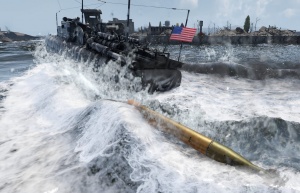
2 x 450 mm Mk.7 torpedoes are located in tube launchers aft of the ship. They are guided by the direction that the ship is facing. They can be fired while the ship is stationary or reversing and require 50 m to arm before they will detonate. They are powerful enough to sink any ship within the PT-3s BR range, and have a range of 3.65 km.
You can equip 4 x Mk.6 depth charges. They are located at the stern of the boat between the torpedo tubes.
Usage in battles
Sitting at the lowest BR it will occasionally fight bigger boats capable of destroying it in a single shot, but fairs pretty well against the other reserve vessels it faces off against. Compared to the PT-6, it has similar armament, yet is slower, and has a lower crew count of 12 sailors, meaning that it cannot take as much punishment as the PT-6 before sinking. In fact, the only advantages this ship has over the PT-6 is its smaller profile and tighter turn radius, making it able to easily navigate restricted waters.
There are 2 ways to play this vehicle.
- Aggressive: Keep the max speed and attempt to manoeuvre through enemy fire as you attempt to get close enough to launch torpedoes. Return fire constantly as you get closer. If you get close enough that you will cross the bow of the enemy ship, launch all depth charges with 5 (or more) second fuse delay to sink it instantly. Be mindful not to hold on to the torpedoes for too long, as they can detonate if hit and sink the ship instantly. During the reload period attempt to spin the ship around and activate smoke to retreat after firing off torpedoes.
- Reserved: This strategy is the preferred method and is more likely to keep you alive. Find a good spot on the map where you can take cover behind and have a clear line of sight on approaching vessels. Launch torpedoes at probable approaches of enemy ships. Slow yourself to a stop behind cover and attempt to point your nose in the direction of incoming enemies so as to use both .50 cals. Try to engage targets at as far away as you can reliably aim, as you do not have the armour to withstand much punishment at close quarters, especially against the German LS 3. Once you start receiving fire, or during the middle of a lengthy reload, activate your smoke and reverse into the smoke to cover you. Slightly alter your course while reversing to avoid incoming blind fire. Once the smoke has dissipated, your guns should have reloaded and you can fire again, and the smoke discharger should be mostly recharged as well. Try to pick a spot where you can ambush incoming ships, and be sure to wait for supporting allies before attempting to take cap zones.
Pros and cons
Pros:
- Main armament is effective at neutralizing both PT boats and aircraft
- Large ammo reserves for the primary armament
- Highly manoeuvrable
- Small profile
- Quick acceleration and deceleration
Cons:
- Low crew count
- Unarmoured
- Slow boat
- Machine guns take some time to reload
History
The PT-3 was laid down on August 1, 1939 by Fisher Boat Works in Detroit, Michigan. It was launched on April 18, 1940 and it was completed on June 20 of the same year. It entered service on July 24 and it was assigned to Motor Torpedo Boat Squadron ONE (PTRon 1) to be evaluated. PTRon 1 was the first squadron of its kind, and it was a squadron of experimental ships when it was created and was under the command of Lt. Earl S. Caldwell, USN.
It was to be given to the Royal Navy on April 19, 1942 and would have been re-designated as the HM MTB-273. However, the transfer was cancelled and was instead transferred to the Royal Canadian Air Force (RCAF) with the designation Bras D'Or (M 413). It was intended to be used as a high speed rescue launch boat. Following its service in the war, it was was returned to the US on April 10, 1945 and once again re-designated, this time as the B-119. The last transfer in its long and storied history was between the United States Navy (USN) to the War Shipping Administration on May 2, 1946.
It still survives today in rather poor condition and can be found at Flanigan Brothers Boatyard, Fairton, NJ, waiting to be restored.
The ship historically had a displacement of 25 t, a length of 58 ft, and a beam of 18 ft. It was powered by two 1,350 hp Packard gasoline engines, and had two shafts. The armament consisted of two .50 cal machine guns, two 18 inch Mk. 7 torpedoes, and two Mk. 6 depth charge racks.
Media
- Skins
See also
Links to articles on the War Thunder Wiki that you think will be useful for the reader, for example:
- reference to the series of the ship;
- links to approximate analogues of other nations and research trees.
External links
References
- Bibliography
- Radigan, Joseph M. PT-3. NavSource Naval History. http://www.navsource.org/archives/12/05003.htm
| Fisher Boat Works | |
|---|---|
| Motor Torpedo Boats (PT) | |
| 58’ Prototype PT | PT-3 |
| USA boats | |
|---|---|
| Motor torpedo boats | PT-3 · PT-6 · PT-20 · PT-71 · PT-103 · PT-109 · PT-174 |
| PT-200 · PT-314 · Thunderbolt (PT-556) · PT-565 · PT-658 · PT-810 · PT-811 · PT-812 | |
| Motor gun boats | Kim Qui · LCS(L)(3) · PT-59 · PTF-7 · USS Candid · USS Asheville · USS Douglas · USS Flagstaff · USS Tucumcari · USS Cyclone |
| Armoured gun boats | LCM(6) Zippo |
| USA premium ships | |
|---|---|
| Motor torpedo boats | PT-3 · PT-109 · PT-174 · Thunderbolt (PT-556) · PT-658 · PT-811 |
| Motor gun boats | LCM(6) Zippo · USS Douglas · USS Flagstaff |
| Sub-chasers | Carmi (PC-466) |
| Destroyers | USS Welborn C. Wood · USS Wilkinson · USS Bennion · USS Cowell · USS Davis · USS Moffett · USS Phelps · USS Frank Knox |
| Light cruisers | USS Detroit · USS Helena |
| Heavy cruisers | USS Des Moines |
| Battleships | USS Arkansas |