Type 10
OLD‑WIKI.WARTHUNDER.COM (DEFUNCT)
| This page is about the Japanese medium tank Type 10. For other versions, see Type 10 (Family). For other uses, see Type 10 (Disambiguation). |
Description
The Type 10 (10式戦車) , sometimes shorten as Hitomaru (Kun'yomi of 1 and 0 in Japanese) was the certified production variant of the 21st Century TK-X program accepted into service in 2010 (with effect in 2012) to complement and replace the existing Type 74 and Type 90 main battle tanks; in view of the end of Cold War and further improvements against potential foes with the most advanced possible technology available, JGSDF issued the development of new MBT for the 21st Century. Compared to its predecessors, there was a bigger emphasis on the C4I system, weight reduction, and modular armour.
It was introduced in Update "Winged Lions". Like the prototype before it (after in the tech tree: TKX), it comes densely armoured with a weaker engine compared to its heavier brother the Type 90; but provides an excellent end tier Type 10 APFSDS shell which it can fire every 4 seconds. It can brawl at CQC combat due to its fast fire-rate and excel at sniping with its enhanced Gen 3 thermal imaging, sight zoom, and LWS/LRF. The Type 10 is an MBT that can fulfill its role, with the only major downsides being the long first-ammo rack replenish rate and the armour not being on par with other end-tier MBTs.
General info
Survivability and armour
The Type 10 was designed to be a lighter yet more protected version of its predecessor, the Type 90 (Kyumaru); thanks to advances in technology during the two decades and its overall design, the Type 10 reaches a high level of protection with an detachable composite block on the front of the hull, the turret has also been designed to fit new composite armour blocks. The overall protection of the hull front can reach up to 575-580 mm against kinetic rounds on average, while the turret is another story - with only frontal arc protection and around 500 mm of KE protection, chances are most darts at the same BR range can penetrate the turret with relatively ease, and turret sidescraping is not an option as the inner part of the turret has very little protection.
The lower glacis is yet another story, with its fairly large area and very low protection, it can be the death sentence of the Type 10 if the spalling after penetration spreads in a wide area and does fatal damage to the crew.
The huge hull can mitigate some spalling from KE rounds thanks to its relatively hollow battle compartment, but having only 3 crew members like the Type 90 means that a loss of 2 crew will result in a knock out.
Armour type:
| Armour | Front (Slope angle) | Sides | Rear | Roof |
|---|---|---|---|---|
| Hull | 5 mm (35-85°) Upper glacis 40 mm (32°) Lower glacis |
30 mm Top 35 + 10 mm Bottom |
25 mm 15 mm Engine grille |
25 mm 10 mm Engine grille |
| Turret | 5 mm Turret front 20 mm Gun mantlet 77 mm Rear mantlet plate |
5 + 35 mm | 5 + 25 mm | 20 - 40 mm |
| Cupola | 50 mm | 50 mm | 50 mm | 30 mm |
Notes:
- Suspension wheels and tracks are 20 mm thick
- Turret ring is 50 mm thick and has additional 10 mm internal armour in front of it
- Belly armour is 25 mm thick
- Composite armour covers upper glacis and turret:
| Composite armour | Front (Slope angle) |
|---|---|
| Hull | Upper glacis __ - __ mm Kinetic __ - __ mm Chemical |
| Turret | Turret cheeks __ - __ mm Kinetic __ - __ mm Chemical Gun mantlet __ - __ mm Kinetic __ - __ mm Chemical |
Mobility
| Game Mode | Max Speed (km/h) | Weight (tons) | Engine power (horsepower) | Power-to-weight ratio (hp/ton) | |||
|---|---|---|---|---|---|---|---|
| Forward | Reverse | Stock | Upgraded | Stock | Upgraded | ||
| Arcade | Expression error: Unexpected * operator. | 1626 | Expression error: Unexpected round operator. | __.__ | |||
| Realistic | 1061 | Expression error: Unexpected round operator. | __.__ | ||||
Modifications and economy
Armaments
Main armament
Type 10 utilises a new domestic 120 mm smoothbore gun, developed by Nippon Steel Works; thanks to new alloy technology used on this gun, the new gun can fire rounds at even higher bore pressure, thus enhancing the penetration even more than Type 90. Another key feature is the 14 round autoloader that reloads every 4 seconds, located at the back of the turret, making Type 10 a very formidable opponent in battle.
The Type 10 is equipped with thermals for both gunner and commander and night-vision for the driver. these thermals have a resolution of 800x1200, this qualifies them as 3/2+ gen. thermals.
| 120 mm TKG | Turret rotation speed (°/s) | Reloading rate (seconds) | ||||||||
|---|---|---|---|---|---|---|---|---|---|---|
| Mode | Capacity | Vertical | Horizontal | Stabilizer | Stock | Upgraded | Full | Expert | Aced | Autoloader |
| Arcade | 35 | -7°/+10° | ±180° | Two-plane | 28.6 | 39.5 | 48.0 | 53.1 | 56.5 | 4.00 |
| Realistic | 17.9 | 21.0 | 25.5 | 28.2 | 30.0 | |||||
Ammunition
The stock shell that comes with the tank is very familiar to JGSDF players: JM12A1 HEATFS, equivalent of DM12A1 and M830 HEATFS of NATO guns. At top tier, it struggles to penetrate any modern MBTs with composite armour with up to 900 mm CE protection and its explosive filler is nowhere near enough to overpressure any MBTs as well, just enough to ruin the day for lighter vehicles or SPAAGs. However, thanks to the Type 10's above average mobility, taking the flanks is still achievable; and the reload rate is forgiving for misplaced shots, players might still have a second chance to knock out the enemy's gun or the whole tank right away with its 4-second reload.
The first kinetic round is another familiar shell as well: JM33 APFSDS, equivalent of DM33, at tier I modification. Players who have experienced the Type 90 duo knows how the shell struggles when facing the masses of Soviet/Russian MBTs with sturdy front arc protection; only well-placed shots on their weak spots or lower glacis can knock them out. This is still far superior to the stock JM12A1, and should be a priority for research.
The final researchable shell is the brand new Type 10 APFSDS, which is also the latest shell of JGSDF that came commissioned with Type 10 itself. New technologies on this dart boost both its penetration and velocity - delivering a whopping 615 mm of penetration every 4 seconds can certainly be the nightmare of any tank trying to break through the frontline.
| Penetration statistics | |||||||
|---|---|---|---|---|---|---|---|
| Ammunition | Type of warhead |
Penetration @ 0° Angle of Attack (mm) | |||||
| 10 m | 100 m | 500 m | 1,000 m | 1,500 m | 2,000 m | ||
| JM12A1 | HEATFS | 480 | 480 | 480 | 480 | 480 | 480 |
| JM33 | APFSDS | 481 | 478 | 470 | 461 | 450 | 440 |
| Type 10 | APFSDS | 615 | 613 | 604 | 592 | 582 | 571 |
| Shell details | ||||||||||||
|---|---|---|---|---|---|---|---|---|---|---|---|---|
| Ammunition | Type of warhead |
Velocity (m/s) |
Projectile mass (kg) |
Fuse delay (m) |
Fuse sensitivity (mm) |
Explosive mass (TNT equivalent) (kg) |
Ricochet | |||||
| 0% | 50% | 100% | ||||||||||
| JM12A1 | HEATFS | 1,140 | 13.5 | 0.05 | 0.1 | 2.15 | 65° | 72° | 77° | |||
| JM33 | APFSDS | 1,640 | 4.3 | - | - | - | 78° | 80° | 81° | |||
| Type 10 | APFSDS | 1,780 | 4.2 | - | - | - | 78° | 80° | 81° | |||
Ammo racks
| Full ammo |
1st rack empty |
2nd rack empty |
Visual discrepancy |
|---|---|---|---|
| 35 | 15 (+20) | 1 (+34) | No |
Notes:
- Hull empty: 15 (+20) shells.
- The autoloader contains 14 shells. Once these have all been fired, the autoloader must be replenished before being able to fire again.
Machine guns
The Type 10 mounts two machine guns; one pintle-mounted 12.7 mm and one coaxial mounted 7.62 mm. These can be used as deterrent for aircraft, clearing light obstacles or crew from open-top vehicles, or spotting enemy vehicles.
| 12.7 mm M2HB | ||||
|---|---|---|---|---|
| Mount | Capacity (Belt) | Fire rate | Vertical | Horizontal |
| Pintle | 1,000 (200) | 577 | -8°/+60° | ±180° |
| 7.62 mm Type 74 | ||||
|---|---|---|---|---|
| Mount | Capacity (Belt) | Fire rate | Vertical | Horizontal |
| Coaxial | 3,000 (250) | 701 | N/A | N/A |
Usage in battles
The Type 10 series of tanks are a sidegrade of the Type 90 supposed to supplement the latter by being lighter on Japanese infrastructure and improving on their electronic capabilities. With the main focus of the Type 10 being lighter than the Type 90, it swaps out the engine and transmission to a lighter model contributing the most to its weight re-distribution next to its smaller over profile. Next to that the armour on the Type 10 is modular with the overall armour package being more efficient yet slightly heavier than on the Type 90, the Type 10 comes in standard configuration at totalling 44 tons offering roughly the same armour equivalence to the Type 90. The improved FCS also includes the ability to fire the new Type 10 APDSFS shell through Gen 3 thermals.
The Type 10 is a highly mobile and fast-firing MBT that excels in flanking and sniping roles. However, its armour is not reliable and it is vulnerable to enemy fire, so it requires constant situational awareness and effective use of its hydropneumatic suspension, LWS, Laser Rangefinder and smoke grenades. The Type 10 should not engage in frontal assaults or close combat, but rather support allied MBTs from a safe distance and exploit its mobility and firepower to deal damage and relocate as needed. Getting early warnings of potential incoming fire thanks to its LWS, providing enough time and knowledge to retreat or dodge incoming shells.
- Notable Opponents
- T-80/T-72 - The Russian top-rank MBTs pose a dangerous opponent for the Type 10. They possess good firepower and frontal protection. Frontally, the player wants to aim at the lower plate or driver's port. If facing from the sides, be aware that the Russian ERA blocks may stop the shell (even one as powerful as the Type 10 APFSDS) and always note that it may take a follow-up shot to knock it out.
- M1 Abrams (Family) - The M1A2 possesses good straight-line mobility that rivals the Type 10 with superior protection and survivability. The player wants to aim at the massive turret ring, this will usually knock out or cripple the tank. Take a follow up shot if needed. If turret ring is not visible, the player wants to aim at the gun breech or mantlet to knock out the gun and kill
- Challenger 2 (Family) - The Challenger 2 is a slow, large target with subpar protection against top battle-rating kinetic munitions. Though players should still beware of its 5-second (with ace crew) reload that is almost as fast as the Type 10's (within its ready rack range). The player can aim at its lower plate, drivers port or breech area.
- Leopard 2 (Family) - Superior firepower and turret protection, these tanks have vulnerable hulls that are rather easy to penetrate with the Type 10 round. The player can aim lower plate. If the Leopard 2 is hull down - player can aim at the barrel or try to knock out the gun breech through a turret ring shot (Warning: Turret ring shots tend to be unreliable so be careful of the angle!)
- Leclerc (Family) - Mobile autoloaded tanks with decent protection, the Leclerc(s) have a large weak spot in the breech area that can disable the gun or possibly knock out the tank.
Pros and cons
Pros:
- Autoloaded 120 mm cannon, 4-second reload unaffected by crew or fire
- Has access to 3rd generation thermal sights for the gunner and commander
- Type 10 APFSDS round is competitive (Comparable to DM53, the 'improved' round on the Leopard 2A5)
- Quite mobile, high power-to-weight ratio and high reverse speed
- Fitted with hydropneumatic suspension, although this can only be operated when stationary
- Can lower the tank significantly, allowing you to hide behind relatively low hills and ridges
- Primary ammunition storage protected within blow-out containment in the rear of the turret
- Relatively small profile
Cons:
- Only three crew, a well-placed shot can easily cause a full crew knock-out
- Can only carry 15 rounds before additional ammo is stored in the unsafe hull racks
- Hydropneumatic suspension ceases to work when the engine is hit
- Relatively poor gun depression, unless the suspension is used
- Armour is very spread out in the front with the only well-defended places being the upper front plate, turret cheeks, and breech
- While fast in top speed, this tank is a bit slow to accelerate
- Slow elevation/depression speed for the main gun
- Slower turret traverse than most other MBTs
History
Challenges of New Millennium
In the mid-1990s, after the introduction of the previous TKX-1, Type 90 MBT, the Ministry of Defense soon realised that, despite its superior FCS even for NATO standards, further upgrading the Type 90 would be impractical (for the time being) due to its already heavy weight in Japan's standards; while the previous Type 61 Medium Tank had no chance when facing even the earliest MBTs and Type 74 MBT was too costly to be upgraded. The possible rivals of Japan, like Mainland China and the Russia Federation had already developed their new MBTs (PLAGF ZTZ96 and ZTZ99/Russian T-90A); in view of maintaining a team of tank designers as well as a part of national defense, JGSDF passed a new plan for a next-generation MBT with redundancy for further upgrades (modularity), thus inherited the project name: TKX-2.
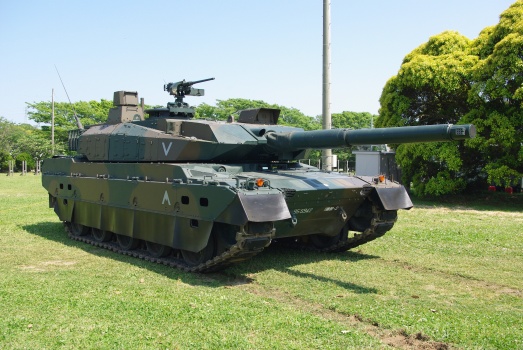
From Kyumaru to Hitomaru
The TKX-2 project aimed for the light weight of a Type 74 (at 40 tons, loaded) while being smaller than Type 90, equipping a domestic 120 mm smoothbore gun with latest C4ISR system, modular composite armour, and new engines paired with HMT transmission. TKX-2 was led by the TRDI with help from Mitsubishi Heavy Industries. The new smoothbore gun and its new APFSDS were developed by Nippon Steel Corporation and Daikin Industries respectively. These designs were tested on a Tank Test Bed (TTB) developed from the 6th prototype of Type 90 and was first shown in a booklet in the early 2000s; the result of TTB proved the designs and project TKX-2 started in 2002. The 1st prototype was assembled in November 2004 and tested at JGSDF Camp Higashi-Chitose; MHI built the 2nd prototype in 2005, while there were also 3 Type 90s converted as the test bed for tank platoon command systems.
Finally, with the evaluations from JGSDF Fuji School, Ordnance School, and leaked photos of the 2nd prototype, the TKX-2 was unveiled on 14 June 2010 to the public during the opening of JGSDF East Fuji Manoeuvre Area and it was then named Type 10 in October. It served as the most advanced MBT of the first decade of the 2000s, and is an icon of the JGSDF moving forward into the 21st century.
Media
- Skins
- Videos
See also
- Related Development
- Type 90 (Family) - (predecessor)
- Type 10 (Family)
- Other vehicles of similar configuration and role


External links
| Japan medium tanks | |
|---|---|
| Type 97 | Chi-Ha · Chi-Ha Kai · Chi-Ha Kai TD · Chi-Ha Short Gun |
| Type 1 | Chi-He · Chi-He (5th Regiment) · Ho-I |
| Type 3 | Chi-Nu · Chi-Nu II |
| Type 4 | Chi-To · Chi-To Late |
| Type 5 | Chi-Ri II |
| Type 61 MBT | ST-A1* · ST-A2* · ST-A3* · Type 61 |
| Type 74 MBT | ST-B2* · Type 74 (C) · Type 74 (E) · Type 74 (F) · Type 74 (G) |
| Type 90 MBT | Type 90 · Type 90 (B) · Type 90 (B) "Fuji" |
| Type 10 MBT | TKX (P)* · TKX* · Type 10 |
| Other | Ka-Chi |
| USA | ▅M4A3 (76) W · ▅M47 |
| *Prototype | |