SK-105A2
OLD‑WIKI.WARTHUNDER.COM (DEFUNCT)
Description
The SK-105 Kürassier A2 is the third variant of the SK-105 Kürassier light tank family. The initial prototype, developed by Saurer-Werk (now Steyr-Daimler-Puch) to fulfil the Austrian Army's operational needs for a light, mobile anti-tank vehicle, was completed in 1967, and deliveries of pre-production vehicles began in 1971. Over 700 units are estimated to have been produced. The SK-105 Kürassier A2 is based on the chassis of a heavily modified Saurer armoured personal carrier (APC). The hull is constructed of welded steel and is separated into three compartments: the driver sits in the front, the combat compartment is in the middle, and the engine is in the back. Given its light weight, the SK-105 can be airdropped to support paratroopers. The SK-105 Kürassier A2 is an improved variant of the SK-105 Kürassier A1. It has a modern fire control system and an automatic electrical loading system.
Introduced in Update "Ixwa Strike", the SK-105 Kürassier A2 shines as a long-range sniper due to its powerful 105 mm CN105G1 tank gun, low profile, and high mobility. Players ought to constantly check their surroundings for potential danger. An excellent strategy is to find an elevated position with a cover nearby. Rushing to the major battle zones should be avoided in general, and tactics such as flanking or sniping should be prioritized, as the SK-105 Kürassier A2 has little chance of winning in direct confrontations or close-quarter engagements. Along with its powerful primary armament, the 4-second autoloader will be an enormous advantage that should be exploited during combat.
General info
Survivability and armour
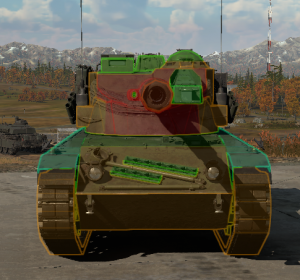
The hull armour of the SK-105A2, even though it is angled at 62°, is relatively weak. In most cases, it will stop 20 mm cannons but cannons with a bigger calibre will have no problems punching right trough the hull armour which in most cases leads to an instant death, as the crew is sitting tightly packed together. Rapid firing autocannons such as the ones mounted on the Gepard or the ZSU-37-2 will have no problems shredding the SK-105 in less than a second. It is highly recommend to not take more than 24 shells due to the fact that reserve shells pile up in the front most part of the tank, which might lead to even more frequent instant deaths. If the user can manage their rounds effectively, the safest ammo count would be 16. This way, only 4 extra rounds are placed into the turret and no rounds are in the front of the tank.
Armour type:
- Cast homogeneous armour (Front of the turret, Gun mantlet)
- Rolled homogeneous armour (Hull, Turret roof)
| Armour | Front (Slope angle) | Sides | Rear | Roof |
|---|---|---|---|---|
| Hull | 20 mm (62°) Front Glacis 20 mm (49°) Bottom Glacis |
14 mm Top hull side 14 mm Bottom hull side |
12 (1°) mm | 5-10 mm |
| Turret | 20 - 40 (16-69°) mm Turret front 40 mm (0-90°) Gun Mantlet |
20-40 mm | 10-20 mm | 10 mm |
| Cupola | 10 mm (60°) | 10 mm | 10 mm | 10 mm |
Notes:
- Suspension wheels and torsion bars are 15 mm thick
- Tracks are 20 mm thick
Mobility
| Game Mode | Max Speed (km/h) | Weight (tons) | Engine power (horsepower) | Power-to-weight ratio (hp/ton) | |||
|---|---|---|---|---|---|---|---|
| Forward | Reverse | Stock | Upgraded | Stock | Upgraded | ||
| Arcade | Expression error: Unexpected * operator. | 496 | Expression error: Unexpected round operator. | __.__ | |||
| Realistic | 283 | Expression error: Unexpected round operator. | __.__ | ||||
The SK-105 has an exceptional speed of about 59 km/h forwards on roads, and around -9 km/h in reverse while also being relatively manoeuvrable, as it is very similar to the AMX-13 light tank. It is powered by the Steyr 7FA/6-cylinder turbocharged diesel engine, which provides 320 hp (238 kW) for a power-to-weight ratio of 18 hp/ton. While it can go as fast as 59 km/h, one should expect to move at about 40 km/h off-road, however the reserve speed still stays at -9 km/h, and it takes roughly 12 seconds for the SK-105 to rotate 360° in neutral steering.
Modifications and economy
Armaments
Main armament
In terms of weaponry, the SK-105 carries the 105 mm PzK M57, which is very effective at dispatching almost every enemy tank with a well-placed shot. It possesses a 4-second autoloader with a magazine size of 12 rounds. After the 12 rounds were depleted, the user has to wait until the magazine houses at least one round. This can be quite problematic if one is too trigger-happy.
| 105 mm PzK M57 | Turret rotation speed (°/s) | Reloading rate (seconds) | ||||||||
|---|---|---|---|---|---|---|---|---|---|---|
| Mode | Capacity | Vertical | Horizontal | Stabilizer | Stock | Upgraded | Full | Expert | Aced | Autoloader |
| Arcade | 38 | -6°/+13° | ±180° | N/A | 28.6 | 39.5 | 48.0 | 53.1 | 56.5 | 4.00 |
| Realistic | 17.9 | 21.0 | 25.5 | 28.2 | 30.0 | |||||
Ammunition
| Penetration statistics | |||||||
|---|---|---|---|---|---|---|---|
| Ammunition | Type of warhead |
Penetration @ 0° Angle of Attack (mm) | |||||
| 10 m | 100 m | 500 m | 1,000 m | 1,500 m | 2,000 m | ||
| OCC 105 F1 | HEAT | 400 | 400 | 400 | 400 | 400 | 400 |
| OE 105 F1 Mle.60 | HE | 25 | 25 | 25 | 25 | 25 | 25 |
| OFL 105 G1 | APFSDS | 346 | 344 | 335 | 326 | 315 | 306 |
| Shell details | ||||||||||||
|---|---|---|---|---|---|---|---|---|---|---|---|---|
| Ammunition | Type of warhead |
Velocity (m/s) |
Projectile mass (kg) |
Fuse delay (m) |
Fuse sensitivity (mm) |
Explosive mass (TNT equivalent) (kg) |
Ricochet | |||||
| 0% | 50% | 100% | ||||||||||
| OCC 105 F1 | HEAT | 1,000 | 10.95 | 0.05 | 0.1 | 1.02 | 62° | 69° | 73° | |||
| OE 105 F1 Mle.60 | HE | 700 | 12.1 | 0 | 0.1 | 2 | 79° | 80° | 81° | |||
| OFL 105 G1 | APFSDS | 1,475 | 3.41 | - | - | - | 78° | 80° | 81° | |||
| Smoke shell characteristics | ||||||
|---|---|---|---|---|---|---|
| Ammunition | Velocity (m/s) |
Projectile mass (kg) |
Screen radius (m) |
Screen deploy time (s) |
Screen hold time (s) |
Explosive mass (TNT equivalent) (g) |
| OFPH 105 F1 | 700 | 11.4 | 20 | 5 | 25 | 50 |
Ammo racks
| Full ammo |
1st rack empty |
2nd rack empty |
3rd rack empty |
4th rack empty |
Visual discrepancy |
|---|---|---|---|---|---|
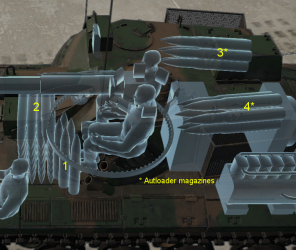
| 38 | 38 (+0) | 13 (+25) | 7 (+31) | 1 (+37) | Yes |
Notes:
- Shells are modelled individually and disappear after having been shot or loaded.
- The visual discrepancy concerns the number of rounds: 42 shells are modelled, but only 38 shells can be fired. Rack 1 is therefore always empty.
- Rack 3 and 4 (autoloader magazines) are first stage ammo racks. They total 12 shells.
- These racks get filled first when loading up the tank and are also emptied first.
- As the SK-105A2 is equipped with an autoloader, manual reloading of the gun is not possible.
- Once the autoloader magazines have been depleted, you can't shoot until the loader has restocked the autoloader. The restocking time is longer than the normal reload time of the gun. Take this into account when playing.
- Simply not firing when the gun is loaded will move ammo from rack 2 into rack 4 then 3. Firing will interrupt the restocking of the ready racks.
- The depletion order at full capacity is: 3 - 4 - 2.
Machine guns
The SK-105 has access to the MG3A1 (7.62 mm) machine gun. While it lacks any some sort of effective penetration, its high rate of fire can dispatch exposed crew members easily. The one, and only, belt houses 1,000 rounds with average velocity. It is largely inadequate against armour and should be used exclusively to dispatch exposed crew members or to destroy environmental objects such as fences with ease.
| 7.62 mm MG3A1 | ||||
|---|---|---|---|---|
| Mount | Capacity (Belt) | Fire rate | Vertical | Horizontal |
| Coaxial | 1,000 (1,000) | 1,200 | N/A | N/A |
Usage in battles
The SK-105A2 excels at filling the spot as a sniper, due to its very powerful 105 mm cannon, low profile and high mobility. This is all balanced out however by the fact that the SK-105 possesses little to no armour, so any kind of hit from a cannon more powerful than 20 mm, will dispatch the SK-105 quite easily. The user should always check their surrounding as much they can, and as frequently as they can. Finding a vantage point with cover nearby is an effective strategy. Brawls and rushes should generally be avoided and tactics like flanking or sniping should be focused upon, as the SK-105 will stand no chance in direct engagements or close quarter fights. However, if one does stumble into a brawl, the 4-second autoloader will prove to be a major benefit coupled with the amazing 105 mm cannon; although one should pay attention to their magazine as the user will not be able to shoot at all if the magazine runs dry completely. It is because of this reason that at least 2 spare rounds should be carried in the magazine in case of an ambush. One big thing to note is that the user also lacks a stabilizer, which may be a problem due to the light size of the tank and fast speed; as these properties will make the gun harder to stabilize on its own if the user decides to brake spontaneously.
Pros and cons
Pros:
- 12-round autoloader with a 4-second reload time
- Strong APFSDS shells
- Has a smoke grenade launcher with 2 salvos
- Has access to night vision device and 2nd generation thermal imager on gunner optics
- Has access to a laser rangefinder with automatic sight adjustment
- Commander gun controls, able to shoot back with an unconscious gunner
Cons:
- Has thin armour that can be penetrated even by .50 cal machine guns
- Lacks a stabilizer
- No roof-mounted MG for anti-air purposes
- Has only 3 crew members sitting close to each other
- Very unstable gun: high recoil and low accuracy while moving
- APFSDS is unlocked only at tier III
- Mediocre mobility for a light tank
- If the magazine runs out of rounds, the user has to wait until it is refilled to engage
History
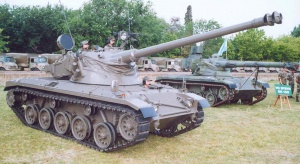
The SK-105 was developed by the company named Saurer-Werk, as the Austrian Army needed a reliable tank destroyer. The very first prototype was built in the year 1967 and the pre-production began in the year 1971. Around 286 were made for the Austrian Army and were in service until the 1990s, while the rest of the SK-105s were exported.
The hull of the SK-105 was based on the heavily armoured car, Saurer APC, which was used alongside Austrian units. This allowed the tank destroyer to be light and have above average mobility, something the Austrian Army wanted. While the hull of the tank was an easy choice to make, as the Saurer APC hull required just a few modifications to be adequate for the standards set by the Austrian Army, the debate now was which turret should the SK-105 use. Since the Austrian Army wanted a cannon that was light, reliable yet still powerful enough to fulfil its role of a tank destroyer, they turned their eyes towards France. Because of their massive success and mass production of AMX-13 light tank, the Austrian army decided to contact France in the hopes of designing a new turret. In the end, France agreed and came up with an oscillating turret that was light yet powerful enough to be used in an anti-tank role.
While Austria retired the SK-105, a substantial amount is still in service today in other countries: mainly in Brazil, Bolivia, and Argentina. Argentina created the "Patagón" variant by merging a brand-new hull with surplus AMX-13 (105) turrets, the result was a vehicle comparable to the SK-105 A1.
Media
- Skins
- Images
SK-105A2 in the garage
- Videos
See also
External links
| France light tanks | |
|---|---|
| AMC.34/35 | AMC.34 YR · AMC.35 (ACG.1) |
| H.35/39 | H.35 · H.39 · H.39 "Cambronne" |
| AMX-13 | AMX-13 (FL11) · AMX-13-M24 · AMX-13 · AMX-13 (SS.11) · AMX-13-90 · AMX-13 (HOT) |
| Wheeled | AML-90 · AMX-10RC · Vextra 105 |
| AMD.35 | AMD.35 · AMD.35 (SA35) |
| E.B.R. | E.B.R. (1951) · E.B.R. (1954) · E.B.R. (1963) |
| Other | FCM.36 · R.35 (SA38) · Char 25t · MARS 15 · VBCI-2 (MCT30) |
| Austria | SK-105A2 |
| Great Britain | ▄Crusader Mk.II |
| Netherlands | CV 9035NL |
| USA | LVT-4/40 · ▄M3A3 Stuart |