H.39
OLD‑WIKI.WARTHUNDER.COM (DEFUNCT)
| This page is about the French light tank H.39. For the premium version, see H.39 "Cambronne". |
Description
The Char léger modèle 1935 (Hotchkiss) H modifié 39 is a heavily upgraded Char léger modèle 1935 (Hotchkiss) H cavalry tank from 1939. Since cavalry units sought a faster tank, it was decided in October 1936 to modernize its current tanks by installing a more powerful engine. In 1937, a new prototype with a 120 hp engine was created in place of the 78 hp engine. The hull was stretched to provide enough space to accommodate it, resulting in a taller, nearly level engine deck. Aside from episcopes, tails, and various radio sets, this included the gradual introduction of a larger 37 mm SA38 L/35 tank gun with much improved anti-tank capabilities, providing 30 mm of armour penetration at 1 km.
Introduced in Update 1.75 "La Résistance", the Char léger modèle 1935 (Hotchkiss) H modifié 39 is vastly improved over its predecessor. It has a slightly superior main armament, thicker armour overall, and a substantially more powerful engine, which makes it surprisingly fast on flat ground. Nonetheless, as compared to adversaries from other nations, this vehicle remains below average. While it travels quickly in a straight line, it goes slowly over muddy terrain, and its narrow tracks considerably slow it cross-country. It is best employed as a close support tank in urban environments, following teammates while waiting for a good firing opportunity at the enemy.
General info
Survivability and armour
Armour type:
- Cast homogeneous armour (hull, turret, cupola)
- Structural steel (mudguards, trench-crossing tail, exhaust cover)
| Armour | Front (Slope angle) | Sides | Rear | Roof |
|---|---|---|---|---|
| Hull | 40 mm (8-33°) Upper plate 22 mm (74-79°)Upper glacis 40 mm (30°) Lower glacis |
40 mm (1-25°) Top 40 mm Bottom |
40 mm (26-29°) Top 40 mm (29-31°) Bottom |
22 mm (14-15°) Front glacis 22 mm (0-4°) Centre & rear |
| Turret | 45 mm (4-28°) Turret front 45 mm (28-30°) Left side 25 mm (10-11°) + 45 mm (4°) Gun mantlet |
40 mm (0-28°) | 40 mm (30°) | 25 mm (22°) Front 25 mm Centre and rear |
| Cupola | 40 mm (cylindrical) Base 40 mm (spherical) Dome | |||
Notes:
- Suspension wheels, bogies and tracks are 15 mm thick.
- Turret ring is 35 mm thick with a 5 mm protective collar.
- The trench-crossing tail is 5 mm thick and the mudguards are 4 mm thick.
With a rather constant 45-50 mm effective thickness from all sides, this tank can be a hard nut to crack if spotted at a good distance (500+ m), and can take a good beating up close if care is taken to properly angle and avoid tanks with especially potent guns. However, its armour should not be relied upon; most reserve tank guns are capable of penetrating its raw armour thickness and have faster reloads, so hard cover should be utilized generously. With only 2 crewmen, any penetrating shot could be your last.
Mobility
| Game Mode | Max Speed (km/h) | Weight (tons) | Engine power (horsepower) | Power-to-weight ratio (hp/ton) | |||
|---|---|---|---|---|---|---|---|
| Forward | Reverse | Stock | Upgraded | Stock | Upgraded | ||
| Arcade | Expression error: Unexpected * operator. | 130 | Expression error: Unexpected round operator. | __.__ | |||
| Realistic | 106 | Expression error: Unexpected round operator. | __.__ | ||||
Modifications and economy
Armaments
Main armament
| 37 mm SA38 L/33 | Turret rotation speed (°/s) | Reloading rate (seconds) | |||||||||||
|---|---|---|---|---|---|---|---|---|---|---|---|---|---|
| Mode | Capacity | Vertical | Horizontal | Stabilizer | Stock | Upgraded | Full | Expert | Aced | Stock | Full | Expert | Aced |
| Arcade | 76 | -13°/+20° | ±180° | Shoulder | 14.9 | 20.7 | 25.1 | 27.8 | 29.6 | 5.20 | 4.60 | 4.24 | 4.00 |
| Realistic | 9.3 | 11.0 | 13.3 | 14.8 | 15.7 | ||||||||
The 37 mm SA38 cannon has significantly better penetration and post-penetration damage than its predecessor, but has a longer reload rate than its peers. Know your enemies' insides well, target their gunners first or immobilize them by shooting at the engine, and take care to make every shot count. Avoid exchanging shots at long distances as your gun's penetration values decrease heavily.
Ammunition
| Penetration statistics | |||||||
|---|---|---|---|---|---|---|---|
| Ammunition | Type of warhead |
Penetration @ 0° Angle of Attack (mm) | |||||
| 10 m | 100 m | 500 m | 1,000 m | 1,500 m | 2,000 m | ||
| Mle1938 | APC | 54 | 50 | 36 | 24 | 16 | 11 |
| Shell details | ||||||||||||
|---|---|---|---|---|---|---|---|---|---|---|---|---|
| Ammunition | Type of warhead |
Velocity (m/s) |
Projectile mass (kg) |
Fuse delay | Fuse sensitivity (mm) |
Explosive mass (TNT equivalent) (g) |
Ricochet | |||||
| 0% | 50% | 100% | ||||||||||
| Mle1938 | APC | 705 | 0.7 | - | - | - | 48° | 63° | 71° | |||
Ammo racks
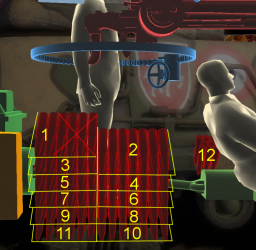
| Full ammo |
1st rack empty |
2nd rack empty |
3rd rack empty |
4th rack empty |
5th rack empty |
6th rack empty |
|---|---|---|---|---|---|---|
| 76 | 75 (+1) | 68 (+8) | 62 (+14) | 55 (+21) | 49 (+27) | 42 (+34) |
| 7th rack empty |
8th rack empty |
9th rack empty |
10th rack empty |
11th rack empty |
12th rack empty |
Visual discrepancy |
| 36 (+40) | 29 (+47) | 23 (+53) | 16 (+60) | 10 (+66) | 1 (+75) | Yes |
Notes:
- The visual discrepancy concerns the total number of shells as well as the number of shells in rack 1:
- 80 shells are modelled but you can only pack 76 shells, meaning some rounds are never present (crossed out in the picture).
- Rack 1 is modeled as 6 shells but contains only 2 shells.
- As they are modelled by sets of 6, 7, or 9, shells disappear from racks only after you've fire all shells in the set.
Machine guns
| 7.5 mm MAC 31 | ||||
|---|---|---|---|---|
| Mount | Capacity (Belt) | Fire rate | Vertical | Horizontal |
| Coaxial | 2,400 (150) | 551 | N/A | N/A |
The small calibre of the MAC 31 machine gun makes it largely ineffective against all armoured vehicles but the ones with an open compartment. It still can be used to ping targets as a rangefinding help or to mow down minor obstacles blocking your line of sight.
Usage in battles
- Offensive role
The H.39 was designed as a light infantry tank. It should be played as a support tank, taking advantage of its good cannon, armour and mobility. By playing as a support tank, you will help kill enemy tanks and thus turn the tide of engagements on the frontline. Once the enemy is destroyed, your mobility allows you to move forward together with frontline tanks and help capturing objectives. Stay close to the frontline to maximize penetration power and support spearheading tanks with it, all while staying away from the frontline to avoid being flanked or swarmed. When engaging enemy tanks, angle your tank to maximize your armour. Your cannon can take on most opponents but your only shell lacks post-penetration damage.
- Defensive role
In the event the spearhead tanks of your team get crushed by the enemy, you will then play a defensive role by containing enemy breakthrough attempts. Being at a (short) distance from the frontline will force enemy tanks to drive in the open to get to you. Play with a nearby obstacle you can use as cover if you get hit and need to repair. Have a planned escape plan as the enemy will try to use artillery or CAS to dislodge you from cover. Make good use of your gun depression and fire from the cover of a ridge. Aim precisely to immobilize enemy targets on your first shot. Get back into cover between reloads and pop out a few metres away from your last spot.
- Other roles
If you try to use the H.39 in a different role on the battlefield, you will quickly reach its limits:
- If you try to play as a frontline tank, you will take shots from long range tank destroyers that will disable your tank: your armour is sloped but not very thick and not enough for long guns. Your limited crew makes it easy to incapacitate you. You will also be easily flanked by light tanks or armoured cars, especially if they swarm you. Your reverse speed is too poor to get you out of hot spots quickly enough. Only 1-on-1 engagements should be performed in this role.
- If you attempt to play long range engagements, your good gun depression will be useful but your short gun will lack accuracy and your shell penetration will greatly drop over distance. Any successful enemy penetrating shot will disable your tank.
- Notable enemies
Many tanks are capable of easily disabling you. By order of lethality:
- Long range tank destroyers
- Howitzers with powerful HE shells
- Tanks with HEAT shells
- Frontline tanks with APHE shells
- Light tanks or armoured cars with autocannons
- Defeating a H.39
The H.39 has several weak spots:
- In a frontal encounter, the driver's hatch or the almost vertical hull below the turret are the easiest to target.
- When flanking, aim for the flanks right under the turret.
- In all situations the turret cupola is a sure way to knock out the gunner.
Pros and cons
Pros:
- Tiny tank with tiny profile
- -13° of gun depression
- Has a gun stabilizer mechanic, which makes stop-and-shoot tactics easier and faster
- Thick all-around armour that can be very strongly angled
- Moderately powerful engine that can keep it at its 41 km/h top speed on flat ground
- Decent reverse speed of -7 km/h
- Arguably the best French rank 1 tank
Cons:
- Only 2 crew members
- Only one choice of ammunition, which has no explosive filler
- Sub-par penetration
- Long reload for the calibre
- Slow turret rotation
- Driver's hatch is almost completely vertical
- Narrow tracks means poor ground flotation
History
The H.39 was an improved version of the H.35, with a modified suspension and more powerful engine. 700 were built before France fell. Originally armed with the same SA 18 short gun as the H.35 and R.35, it saw service with the 342nd Independent Tank Company in Norway (which went over to the Free French with their tanks and fought with them in 1941 in Syria), and equipped six of the tank battalions (14th, 25th, 26th, 27th, 42nd and 45th) in the three pre-war armoured divisions, and 12 cavalry squadrons. The SA 18-armed version is sometimes referred to (erroneously) as the H.38.
The poor anti-tank performance of the First World War-era 37 mm infantry gun (on which the SA 18 tank gun was based) during the Spanish Civil War led to the redesigned SA 38. In total 358 SA 18-armed tanks, mostly H.39 and H.35, would be rearmed with the new gun before the invasion of France, with several hundred more being produced as France fell. Up-gunned H.35s and H.39s were employed by the French as section- and platoon-leader vehicles.
After the fall of France, the Germans retrofitted some of their captured vehicles with the newer gun, and replaced the commander's cupola with their more customary split hatch for the tank commander. These vehicles, which the Germans called the 38H 735, fought in Finland in 1941, in the Balkans, and against the Allies in France. In December of 1944, 29 were still in German service. Another 24 were cut down to just the hull pan and nose armour and used as Geschützwagen (assault guns), and armed with the 75 mm PaK40 L46 gun, making them similar in appearance to the Marder I conversion from captured Lorraine Schlepper vehicles. These were actively employed against Allied forces in Normandy. Some recaptured H.39s served with Free French forces to the end of the war.
Media
- Skins
See also
- Vehicles equipped with the same chassis
External links
| Hotchkiss | |
|---|---|
| Tanks | |
| Light tanks | H.35 · H.39 · H.39 "Cambronne" |
| France light tanks | |
|---|---|
| AMC.34/35 | AMC.34 YR · AMC.35 (ACG.1) |
| H.35/39 | H.35 · H.39 · H.39 "Cambronne" |
| AMX-13 | AMX-13 (FL11) · AMX-13-M24 · AMX-13 · AMX-13 (SS.11) · AMX-13-90 · AMX-13 (HOT) |
| Wheeled | AML-90 · AMX-10RC · Vextra 105 |
| AMD.35 | AMD.35 · AMD.35 (SA35) |
| E.B.R. | E.B.R. (1951) · E.B.R. (1954) · E.B.R. (1963) |
| Other | FCM.36 · R.35 (SA38) · Char 25t · MARS 15 · VBCI-2 (MCT30) |
| Austria | SK-105A2 |
| Great Britain | ▄Crusader Mk.II |
| Netherlands | CV 9035NL |
| USA | LVT-4/40 · ▄M3A3 Stuart |