Mk.13-6 Case (2,216 lb)
Suspended armaments
OLD‑WIKI.WARTHUNDER.COM (DEFUNCT)
Description
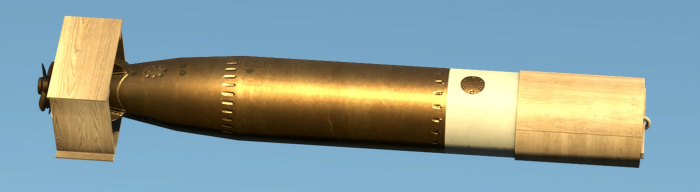
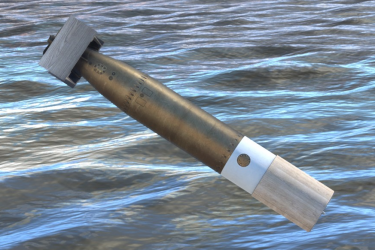
The Mk.13-6 Case (2,216 lb) torpedo was a guinea pig of a torpedo having been the subject of testing and modification since 1925. Used early in World War II, this torpedo failed to operate properly approximately 70% of the time with problems of running cold (propeller mechanism failed to start), sinking, not running true (deviating path), improper depth, running on the surface or porposing (continuous jumping out of the water) due to improper water contact. Aircraft were required to fly extremely slow and low when dropping the torpedo as to not damage it on impact with the water and to provide the most stable drop possible, unfortunately, this put the torpedo bomber in a bad position of being an easy target for anti-aircraft guns mounted on enemy ships.
Extensive testing in 1942 determined that the low and slow approach to the Mk.13 launch was actually counterproductive as it caused the torpedo to "belly-flop" on the water resulting in damage sustained to its internal components. New modifications were tested which replaced fragile parts and components which were susceptible to damage upon impact with the water. A new study also implemented the addition of frangible "drag rings" and box-shaped tail stabilizers. These devices served to stabilize the torpedo during higher drops, lower the nose for the initial impact and reduce the depth at which the torpedo dove after impact. The wood drag rings and stabilizers were obliterated on impact with the water which absorbed some of the impact, protecting the torpedo.[1] By 1944 the Mk.13 was essentially a brand new torpedo and was accepted as the best aircraft torpedo in the U.S. inventory at that time and was credited with the sinking of the Japanese battleship Yamato.[2]
Later after World War II, there came a need for river patrol boats to be outfitted with torpedo launchers. The Mk.13 was the ideal torpedo to fulfil this need due to its short stature (compared to other torpedoes) and excelled in a shallow launch and run which afforded it to operate in shallow waters without hitting the bottom. Opportunities for sea use on smaller vessels were available in shallow areas where larger ships and torpedoes could not operate.
Vehicles equipped with this weapon
| Vehicles equipped with this weapon | |
|---|---|
| Fighters | |
| Hellcat | F6F-5 · ▄F6F-5 · F6F-5N · ▄F6F-5N · ▄Hellcat Mk II |
| Strike aircraft | A2D-1 · AM-1 |
| AD | AD-2 · AD-4 · ▄AD-4 · ▄AD-4NA |
| Bombers | BTD-1 · TBD-1 |
| Avenger | ▄Avenger Mk II · TBF-1C |
| Catalina | PBY-5 Catalina · PBY-5A Catalina · ▄Catalina Mk IIIa · ▂PBY-5A Catalina · ▄PBY-5A Late |
| Helldiver | SB2C-1C · SB2C-4 · ▄SB2C-5 |
| Ventura | B-34 · PV-2D |
General info
The aircraft torpedo Mk.13 is typically carried on attack-type aircraft[1], however, there are a few light bombers which can also be outfitted with them. The design of the Mk.13 departed from conventional torpedo design for submarines and destroyers to accommodate being delivered by aircraft and being dropped.[2] Due to the short and stocky size of the torpedoes, they were also ideal to be outfitted on motor torpedo boats where they could either be launched from tubes or just rolled off the side of the boat for more stealthy approaches.
The appearance of this torpedo is similar to many others in that it has the appearance of a mini-submarine which contains an engine, fuel and steering devices. At almost one ton in weight, 600 lbs of it is the detachable warhead which is filled with the highly explosive Torpex.[1]
The Mk.13 torpedo was specifically designed to be used from an aerial platform with a range of 5.7 km with an in-water speed of almost 67 km/h. The Mk.13 designation applies to the entire torpedo assembly as a whole, however, portions of the torpedo (warhead, gyroscope and other sub-assemblies) will have their own mark and mod designations.
Implemented modifications
- Permanent modification
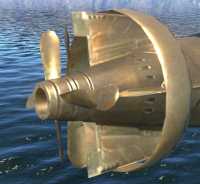
- Shroud Ring: The shroud ring (or "ring tail) is a metal cylindrical band, coaxial with the torpedo and mounted near the rear end of the tail vanes just fore of the propellers. The shroud ring does not provide any help with stability while the torpedo is airborne, however, it does provide a considerable amount of stability for the torpedo while it is in the water. In addition to providing stability in the water, the shroud prevents the torpedo from deep-diving, hooks, water roll or breaching the surface and keeps it on a steady course heading toward its target.[1][2]
- Frangible add-on parts for an aerial drop
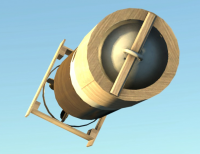
- Drag ring: The drag ring ( also known as the "pickle barrel") which covered the rounded nose of the torpedo and secured with a length of softwood pinning the drag ring into place through the torpedoes nose ring. It was found that the aerodynamics of the torpedo was such that it would oscillate during the fall causing the torpedo to impact and damage the tail section.[2] The drag ring stabilized the torpedoes drop eliminating the oscillations by reducing the aerodynamics, helping keep the nose pointed downwards to breach the surface instead of skipping on the surface. As the drag ring enters the water it breaks apart and falls away, but in the process creates a bubble around the torpedo which helps to absorb the shock of the impact, reducing potential damage to the warhead portion of the torpedo.[1]
- Box stabilizer: A plywood, box-shaped stabilizer has been built around the shroud ring of the torpedo and is held together with wooden pegs which shear during impact with the water. The wooden stabilizer acts to guide the torpedo to drop in a smooth curve and help the drag ring in pointing the torpedo nose-first into the water. After impact with the water and the box stabilizer has fallen away, the torpedo is free to make a clean run to the target.[1][2]
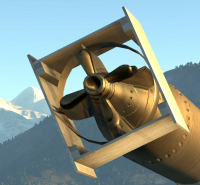
Effective damage
The Mk.13 torpedo had a large high-explosive warhead compared to the Mk.VII which was frequently used at the time. The Mk.13 had a 600 lb (270 kg) Torpex (Torpedo Explosive) warhead compared the Mk.VII's 466 lb (211 kg) warhead. Torpex was an explosive which was about 50% more powerful than TNT by mass alone as this mixture contained 40% TNT, 42% RDX and 18% powdered aluminium.[2] While not as fast nor had as long of range as other torpedoes, the Mk.13 was used effectively at night when stealthy operations from PT boats which took place requiring torpedoes to reach the target with the least amount of warning. Aerial operations took advantage of the slower torpedo by dropping it from a higher altitude, increasing its time in the air and getting it closer to the target before it entered the water.[1]
Comparison with analogues
- Mk.13-6 (2,216 lb) : This is the same torpedo as the Mk.13-6 Case (2,216 lb), however, it has not been outfitted with the frangible drag ring and box stabilizer to allow for higher drops at faster speeds. The Mk.13 is the culmination of upgrades and modifications prior to the addition of the drag ring and box stabilizer. This version of torpedo requires a lower and slower altitude to be released at than the Mk.13-6 Case (2,216 lb).[1]
Usage in battles
The upgraded Mk.13 torpedo can be utilised against any target which is in the water which can include ships, boats, tanks (at the water's edge), boat-planes or even structures. Due to the higher altitude in which it can be dropped from, the delivering bomber can make a safer approach, release and get-away avoiding ship-board anti-aircraft fire and fighters patrolling around ships.
Pros and cons
Pros:
- Ability to drop from a high altitude, at 731 m
- Ability to be dropped at very high speeds, up to 759 km/h
- High release altitude and speed allow pilots to release further away and in a more advantageous position
Cons:
- Aircraft typically only carry one or two at a time
- Slow, given enough distance a ship can avoid the torpedo
History
The Mark 13-6 Case is a further improvement of the Mark 13 Mod 6 based on the extensive testing of the United States Navy and the designs of their opponents, the Imperial Japanese Navy. The modification of the Mark 13 to the Mark 13-6 Case came from studies by the California Institute of Technology at the Morris Reservoir Naval Weapons Test Site in Los Angeles. By dropping the Mark 13 into the water from a 300-foot slide down the Morris Dam, into the reservoir to study all aspects of the torpedo’s drop into the clear water. The results of the test showed the “low and slow” doctrine of the US Navy’s torpedoes bombers was counterproductive as the flat angle of the torpedo entering the water would damage the mechanism. From these tests, the Mark 13 Mod 2A was created which was more reliable due to less fragile components along with the addition of a water trip delay valve to delay the torpedo from firing when dropped at an altitude higher than 300 feet. The Mark 13-6 uses the Mark 2A as a basis but adds another innovation: the shroud ring.
The idea of the shroud ring ironically came from the Imperial Japanese Navy. In order to get their Type 91 aerial torpedoes to enter at the proper angle, the IJN added a wood box-shaped tail design to shear off when the torpedo entered the water and ensure it fired at the correct depth. This modification was used to excellent effect during their attack on Pearl Harbor on December 7th, 1941, but the US Navy first observed it May 8th, 1942. On this date during the Battle of the Coral Sea, Captain Fredrick of the USS Lexington noticed the addition of the wooden shroud rings on Type 91 torpedoes from B5N “Kate” torpedo bombers. As the Mark 13’s planned replacement, the Mark 25 was still undergoing development, the Mark 13-6 was built as an interim solution to improve the aerial torpedoes of the US Navy. Further improvements to the design led to the later Mk. 13-6 Case.
The Mark 13-6 Case features the further addition of the nose ring to the torpedo design. Known in service as the “pickle barrel”, the nose rings provided drag the Mark 13 slowing down its descent in the air by 40% and allowing the torpedo to maintain its intended course. It also cushioned the impact of the Mark 13-6 hitting the water to prevent damage to the internal components, another innovation from the CIT tests at the Morris Reservoir. The Mark 13-6 uses a lanyard that shears off when it hits the water. When the lanyard breaks, fuel is fed into the combustion chamber. This modification, done to prevent the turbine from burning out, reduced the range by 4,000 yards, but it was balanced out by the increased reliability which kept the Mark 13 in service until 1951.
Media
- Images
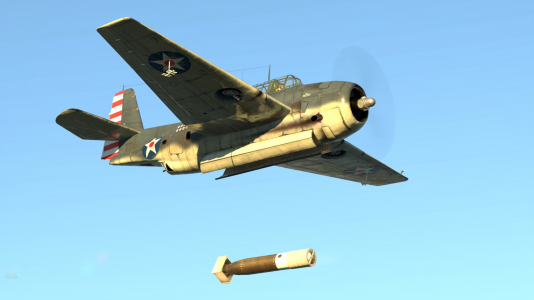
Mk.13-6 Case (2,216 lb) being dropped from a TBF-1C
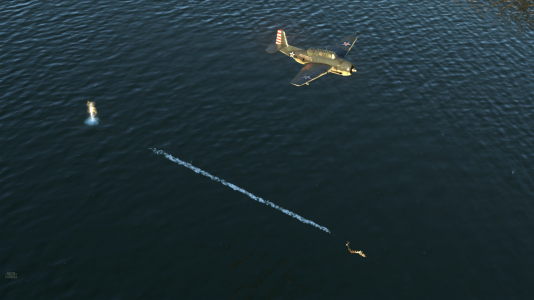
Successful drop of a Mk.13-6 Case (2,216 lb) from a TBF-1C naval bomber
See also
External links
- NavWeaps Website [World War II Torpedoes of the United States]
- Flight Journal Website [Iconic Firepower: The Outstandingly Bad Mark 13 Torpedo]
- Ordnance Pamphlet No. 629(A) [U.S. Navy Torpedoes Mark 13, B-1 & 2 July 1942]
- NAVPERS 10826 [Naval Airborne Ordnance], p. 153-166
- Mark 13, U.S. Torpedo [The Pacific War Online Encyclopedia]
References
 .
.