SET-40 (400 mm)
Naval special armaments
OLD‑WIKI.WARTHUNDER.COM (DEFUNCT)
Description
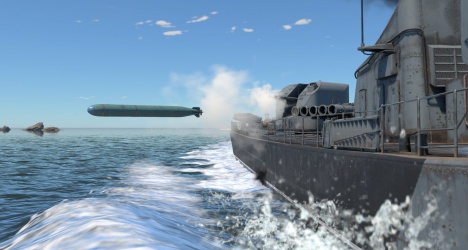
The SET-40 (Russian: "СЭТ-40") is a Soviet 400 mm torpedo for primary use against submarines. The designation "СЭТ" stands for "Самонаводящаяся Электрическая Торпеда" (Guided Electrical Torpedo) and 40 stands for the diameter.
Vehicles equipped with this weapon
General info
The SET-40 is an early Cold War-era ASW (anti-submarine warfare) torpedo of Soviet origin used by a few corvettes and frigates. One of the first Russian torpedoes having an active-passive acoustic homing system An improvement over the previous MGT-1 passive homing torpedo and a needed weapon due to the Soviet Navy's need for a torpedo with small dimensions that could be mounted on submarines as well as small ships and boats that could not carry the larger and many times heavier 533 mm calibre weapons.
Effective damage
The SET-40 has a rather small explosive charge mainly designed for use against submarines, only 80 kg (176 lb) which was well enough at the time.
Comparison with analogues
Torpedoes mounted on corvettes and frigates at a similar BR among other nations:
- Mark 35 (533 mm) - Used on the Köln, the Mark 35 has over 2 times the explosive charge (196 kg - 432 lb), close to the same speed (50 km/h - 31 mph), and a vastly better max range (13.7 km - 14,993 yd).
- 12.75 inch Mark 44 (324 mm) - Used on the Lübeck, the Mark 44 has close to half the explosive charge (54 kg - 120 lb), close to the same speed (56 km/h - 35 mph), and a worse range (5.4 km - 6,004 yd).
- SET-53M (533 mm) - Used on the Pr.1331M; the SET53M has slightly more explosive charge (100 kg - 220 lb), the same speed (54 km/h - 33 mph), and vastly better max range (14 km - 15,311 yd).
- SET-65 (533 mm) - Used on the Pr.1331M; the SET-65 has over 2 times the explosive charge (205 kg - 452 lb), better speed (74 km/h - 46 mph), and twice the max range (16 km - 17,498 yd).
- Type 54 model 3 (533 mm) - Used on the Ayanami and the Isuzu; the Type 54 has slightly more explosive charge (100 kg - 220 lb), a slower speed (44 km/h - 28 mph), and shorter max range (6 km - 6,562 yd).
Usage in battles
The SET-40 torpedo can be a very potent weapon in the right situations used against other bluewater ships and even larger coastal vessels. Due to the decent speed one can use them to surprise larger ships coming to coastal spawns in either MPK Pr.12412 or MPK Pr.12412P, or acting as a deterrent holding off certain choke points in the more deep areas while playing the SKR-1 or SKR-7.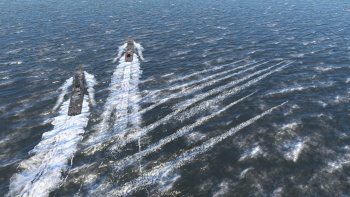
The torpedoes suffer from having a small calibre and a small warhead, which can lead to situations where hits on other larger ships may not do much damage if not around a ammo rack or engine room.
Pros and cons
Pros:
- Good travel range
- Effective at close range
Cons:
- Very small overall weight, size, and explosive charge
- Low top speed
- No torpedo mode
History
The SET-40 was developed at NII-400 (НИИ-400) under the leadership of the chief designer В. I. Senderikhina, taking into account the experience learned from creating previous ASW torpedoes SET-53 and MGT-1. Designed to the same external parameters as the previous passive acoustic homing MGT-1 lightweight torpedo, the MGT-1 was to be used against small surface vessels, the SET-40 is for use against submarines. The preliminary design of individual components of the active-passive sonar system began in 1959. Testing of the torpedo began on Lake Ladoga in 1961. The torpedo was put into service in 1962. Serial production was carried out at the Dagdizel (Russian: "Дагди́зель") plant (Kaspiysk, Dagestan).
The SET-40 torpedo was cigar-shaped and divided into 4 main compartments:
- Instrument compartment with an ASW homing system
- Combat charging compartment
- Battery compartment
- Tail compartment with an electric motor and a propeller-steering group
The combat charging compartment of the torpedo contained a acoustic proximity fuse, an ignition device, and an explosive.
Using a DP-11M engine powered by a M3-2 silver-zinc battery it was able to travel up to speeds of 54 km/h (33 mph) which was well enough to catch up to subs of that era at a maximum running range of about 8 km (8,749 yd). It weighs 550 kg (1,213 lb) and is 4.5 m (177 in) long.
The control and guidance system is an active-passive acoustic homing system (for the first time in the USSR) developed by Y. B. Naumova. The range of the active-passive homing system was 600-800 m (660-880 yd). According to some data, a single-beam active-passive acoustic homing system was installed on the torpedo, and according to others an antenna with three 24-degree acoustic beams deployed from each other in a horizontal plane by 40 degrees was used in the homing system.
Later on an improved modification, the SET-40U, a modernization was carried out in 1966 in order to increase the reliability of the torpedo. A new homing system was installed on the torpedo - the SSN "Sapphire".
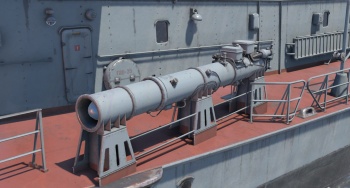
Several types of early to mid Cold War era Soviet submarines were fitted with 400 mm torpedo tubes. On surface vessels the SET-40 is launched from OTA-40 torpedo tubes. These are single deck mounted tubes, of which several can be fitted to small surface vessels. A powder charge would launch the torpedo from the tube. These where mounted on classes such as the Project 204 corvettes, Project 133.1M corvettes, Project 1241.2 and 1241.2P small patrol corvettes, Project 205P patrol boats, and Project 133 patrol boats.
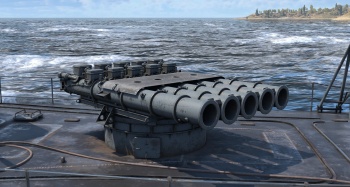
Larger ships had a quintuple mount PTA-40 mounted roughly amidships near their engine compliments. These where mounted on classes such as the Project 159 and Project 35 frigates.
Media
- Images
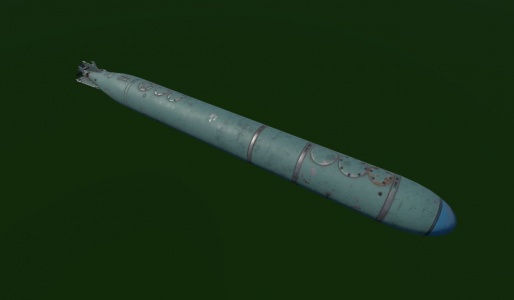
SET-40 as seen in the CDK
See also
- Related development
External links
- [NavWeaps] - Post-World War II Torpedoes of Russia/USSR
- [WeaponSystems] - SET-40
- [MilitaryRussia] - SET-40 / SET-40U (in Russian)
- [Wikipedia.de] SET-40 (in German)