I-16 type 5 (China)
OLD‑WIKI.WARTHUNDER.COM (DEFUNCT)
| This page is about the fighter I-16 type 5 (China). For other versions, see I-16 (Family). |
Description
The ␗I-16 type 5 is a rank Chinese fighter with a battle rating of (AB), (RB), and (SB). It was introduced in Update 1.91 "Night Vision".
General info
Flight performance
| Characteristics | Max Speed (km/h at 2,700 m) |
Max altitude (metres) |
Turn time (seconds) |
Rate of climb (metres/second) |
Take-off run (metres) | |||
|---|---|---|---|---|---|---|---|---|
| AB | RB | AB | RB | AB | RB | |||
| Stock | 425 | 410 | 15.9 | 16.7 | 14.6 | 14.6 | 210 | |
| Upgraded | 462 | 445 | 14.1 | 15.0 | 23.7 | 18.5 | ||
Details
| Features | ||||
|---|---|---|---|---|
| Combat flaps | Take-off flaps | Landing flaps | Air brakes | Arrestor gear |
| ✓ | ✓ | ✓ | X | X |
| Limits | ||||||
|---|---|---|---|---|---|---|
| Wings (km/h) | Gear (km/h) | Flaps (km/h) | Max Static G | |||
| Combat | Take-off | Landing | + | - | ||
| 700 | 700 | 700 | 700 | ~14 | ~6 | |
| Optimal velocities (km/h) | |||
|---|---|---|---|
| Ailerons | Rudder | Elevators | Radiator |
| < 200 | < 240 | < 280 | > 190 |
Survivability and armour
- No armour
- Self-sealing fuel tanks (1 in front of pilot)
Modifications and economy
Armaments
Offensive armament
The I-16 type 5 (China) is armed with:
- 2 x 7.62 mm ShKAS machine guns, wing-mounted (900 rpg = 1,800 total)
Like the I-16 Chung 28, the I-16 type 5 only has two 7.62 mm machine guns, although they are of the improved ShKAS type. While it is not uncommon to see only two machine guns at this rank, it is still fairly weak compared to other aircraft, many of which have four 7.62 mm (or similar) machine guns, or even 12.7 mm MGs in some cases. Like the I-16 Chung 28, the type 5 has 900 rounds per gun for its two machine guns, however the ShKAS guns have over twice the fire rate of the old guns so you will get through it far faster. The guns are wing-mounted so convergence is a concern.
Usage in battles
- Simulator
This model of I-16 can only be used in turnfighting. Its characteristics appear to be quite conflicting. It is excellent in turning tightly and continuously, yet when manoeuvring it easily gets into uncontrollable spins which isn't beginner friendly. Also the rather big nose blocks the visibility a lot, offering very poor over-the-nose visibility which is a disadvantage in a turn fight, because when leading a shot the enemy will always get obstructed by the engine, making you guess the shot. Plus, it has an awful telescope-like gunsight, so when zoomed in the I-16's nimbleness is magnified, making the aim super wobbly. You cannot see anything around which greatly reduces you situational awareness. More ever, there is no trim control available in a sim battle and the I-16 always pitch up and down. Although not a lot, it is still annoying when trying to get a precise aim.
It is recommended to set the convergence within 300 m, with vertical convergence on, because the majority of turnfights happen at that range or closer.
Sim is different from realistic, so discard the habit of bringing the least fuel. Bring at least 30 minutes of fuel, although it decreases the plane's performance a bit, it prevents constant refueling which saves time for patrolling and fighting.
As your I-16 roars down the runway, you will notice that it shifts severely to the side, and the nose will tip down. If you don't correct it it will eventually strike the ground, causing a failed takeoff. Thus you must put rudder input as opposed to the side it's shifting towards, and apply positive pitch to keep the propeller off the ground.
Before engaging a fight, it is better to have an altitude advantage first. When approaching the fight try to figure out which is your teammate and which is the enemy, to avoid going for a second pass, as the energy retention of the I-16 is rather slow. Also pick your target carefully. For easier aiming, you want to go for those unmanoeuvrable twin engine aircraft like Ju 88 or Ki-45, or bombers if there are any. Given the bad forward visibility of the I-16, these are the best options as they are quite slow and sluggish, and are a bigger target to hit. However getting hits on them tend to do nothing, as your MG has very bad damage. When dealing with fighters, it is way harder to aim. The elevator control of the I-16 is extremely sensitive, giving it good manoeuvrability, but at the same time, bad handling. The I-16 will respond in a very fast turn upon moving your stick / mouse by a little bit, which makes tracking nimble planes quite hard. But once you get used to it, try to lure every enemy into a turnfight, as that is where the I-16 shines. It requires lots of bullets to effectively damage even a fighter, so you have to be patient with this aircraft. If you find an enemy at your 6, utilise your great roll rate to do defensive manoeuvres like scissors to make them overshoot. Or you can simply do tight turns, most monoplanes won't be able to cut inside your turn and they might disengage. Important note: DO NOT put too much rolling and pitching input at once, as aforementioned the I-16 tend to enter spins easily.
Just like the SB 2M, the I-16 can still fly when it's extremely slow, causing it to bounce up during landing which can lead to a fatal crash. The trick is similar: slow it down more than other aircraft. Make sure you are around 1 km from the start of the runway and is no more than 300 m high. When the runway fills up your gunsight, drop speed to around 210 km/h and deploy landing flaps. The good thing is, the I-16 will not pitch up drastically upon using its flaps so you don't need to counter the extra lift. Make sure that you extend landing gears early as they move very slow (takes around 15 seconds to deploy). When you are about to touch down you should be flying at around 140 km/h. You must control your rate of descent (I-16's gears are fragile) and make sure that you are slightly pitching upwards with the nose obstructing the horizon. This way the I-16 should land gently without having to brake for too long. Once you are sliding on the ground, fully deflect your elevators upwards to counter the momentum that can push the nose into the ground. You must release brakes once every 4 seconds, because if you only release them as the nose dips down, it's too late.
- Enemies worth noting
- Ki-27, N1K1, He 51, Gladiator, etc. - Those commonly seen planes are equally good at turnfights and will be a hard target to down since they are very small and agile. To deal with them you need to practice leading and deflection shots, plus manoeuvres like barrel rolls and scissors. They still need plenty of bullets to get damaged, so these kind of targets are the hardest to kill and requires great skills from the player.
- Sunderland Mk IIIa - This flying boat's huge fuselage is very spacious and can absorb lots of bullets and shells. It also has lethal defensive firepower: two 7.7 mm in the nose, four forward-facing, two on the top and four at the tail, so attacking from behind, in front or above aren't the best options. If you must attack it, dive under it and suddenly pull up to shoot its defenseless underpart. Aim at the large wings and engines, avoid shooting the fuselage. What will generally happen is that your bullets sprinkle sparks all over it bu they barely do anything.
Manual Engine Control
| MEC elements | ||||||
|---|---|---|---|---|---|---|
| Mixer | Pitch | Radiator | Supercharger | Turbocharger | ||
| Oil | Water | Type | ||||
| Controllable | Not controllable Not auto controlled |
Not controllable Not auto controlled |
Controllable Not auto controlled |
Combined | Not controllable 1 gear |
Not controllable |
Pros and cons
Pros:
- Excellent turning ability: with combat flaps deployed it can outturn He 112, He 100, and even turn-fighters like the early Spitfire
- Extreme roll rate allows it to do offensive / defensive scissors easily, which is an advantage over the He 112 / 100 as their roll rates aren't as good
- 2 x ShKAS machine guns have good rate of fire, adequate velocity and accuracy, and plenty of ammo (900 rpg) allows for longer fights
- Suspended armament provides rockets and bombs which, to an extent, allows some ground attack ability
- It is a very short and small plane, offering the enemy a harder target to hit
- Good climb rate
Cons:
- Extremely poor level speed, dive acceleration and energy retention- will get outran, out-climbed and out-dived easily by Bf 109 E, He 100. It even struggles to keep up with bombers like He 111
- Weak MG is useless against most aircraft like Sunderland and Do 17 Z, or even early Bf 109.
- Engine tends to overheat when diving at more than 500 km/h
- Control surfaces are unresponsive over 450 km/h
- No manual trim controls in simulator which makes it hard to handle
- Although manoeuvrable, it can still get out-turned by the Ki-10 or biplanes like He-51
- Hard to fly in SB: very unstable in pitch, poor over-the-nose visibility and is prone to enter flat spins
History
On the 7th July 1937, fighting broke out between Chinese and Japanese forces, starting the Second Sino-Japanese War. When the war began, the Chinese air force was using many obsolete aircraft, such as the Hawk III, which were no match for the Japanese A5M fighters.[1] China rapidly signed the Sino-Soviet Non-Aggression Pact with the USSR, and as part of the agreement the Soviets began Operation Zet to secretly supply China with aircraft and pilots.
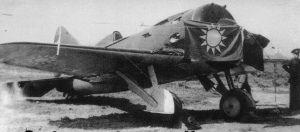
Between October 1937 and September 1939 the USSR delivered 885 aircraft (rising to 1,250 by 1941), including 216 Polikarpov I-16s, predominately Type 5s and Type 10s. At first the Soviet pilots would have to fly the aircraft over 1,500 miles across China to get them to their destination of Lanzhou, however this was a risky journey and so future batches of aircraft would be disassembled and transported to Hami (closer to Lanzhou), before final assembly and delivery to Lanzhou.[1] The first I-16s were delivered in November 1937, however rushed training of the Chinese pilots meant many were lost to crashes. In Chinese service the I-16 became known as the "Lastochka" or "Swallow".[1] In the early years of the war the I-16 was a capable fighter, however from 1939 onwards its performance was deemed to be lacking in comparison to newer fighters.
A number Chinese aces flew the I-16; among them Lo Ying-Teh who in 1938 shot down Japanese unit leader Lt Ryohei Ushioda's A5M2 in his I-16 Type 5. Another ace to fly the I-16 was Liu Chi-Sheng who achieved 3 of his 10 kills while flying the I-16 Type 5, along with another shared kill.[2]
Media
- Skins
See also
Links to the articles on the War Thunder Wiki that you think will be useful for the reader, for example:
- reference to the series of the aircraft;
- links to approximate analogues of other nations and research trees.
External links
- Official data sheet - more details about the performance
- [Wikipedia] Polikarpov I-16
- Biplane fighter aces China - General Lo Ying-Teh
- Biplane fighter aces China - Major General Liu Chi-Sheng
- Aviation during World War 2 - Major General Liu Chi-Sheng
References
- Citations
- Bibliography
- Cheung, R., & Davey, C. (2015). Aces of the Republic of China Air Force. United Kingdom: Bloomsbury Publishing.
- Maslov, M., & Postlethwaite, M. (2013). Polikarpov I-15, I-16 and I-153 Aces. United Kingdom: Bloomsbury Publishing.
| Polikarpov Design Bureau (Опытное конструкторское бюро Поликарпова) | |
|---|---|
| I-15 | I-15 WR · I-15 M-22 · I-15 M-25 · I-15bis · Krasnolutsky's I-15bis |
| I-153 | I-153 M-62 · Zhukovsky's I-153-M62 · I-153P |
| I-16 | I-16 type 5 · I-16 type 10 · I-16 type 18 · I-16 type 24 · I-16 type 27 · I-16 type 28 |
| I-180 | I-180S · I-185 (M-71) · I-185 (M-82) |
| ITP | ITP (M-1) |
| Twin-engine fighters | TIS MA |
| Bombers | Po-2 · Po-2M |
| Export | ␗I-15bis · ␗I-153 M-62 · ␗I-16 type 5 · ␗I-16 type 10 · ␗I-16 type 17 · ␗I-16 Chung 28 |
| China fighters | |
|---|---|
| British | ␗Gladiator Mk I |
| French | D.510C |
| Japanese | ␗A6M2 · ␗Ki-27 otsu · ␗Ki-43-III ko · ␗Ki-44-II hei · ␗Ki-61-I otsu · ␗Ki-84 ko |
| American | CW-21 · Hawk III · P-66 · ␗P-40E-1 · H-81A-2 · ␗P-43A-1 |
| ␗P-47D-23-RA · ␗P-47D-30 · ␗F-47N-25-RE · ␗P-51C-11-NT · ␗P-51D-20 · ␗P-51K | |
| Soviet | ␗I-15bis · ␗I-153 M-62 · ␗I-16 Chung 28 · ␗I-16 type 5 · ␗I-16 type 10 · ␗I-16 type 17 · ␗La-11 · ␗La-9 |