FlaK38 (20 mm)
Anti-aircraft guns
OLD‑WIKI.WARTHUNDER.COM (DEFUNCT)
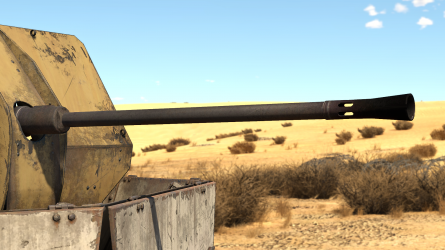
Description
The 20 mm FlaK38 is a German anti-aircraft cannon.
Vehicles equipped with this weapon
General info
The 20 mm FlaK38 is a very impressive autocannon, having an extremely good fire rate, and a good selection of belt types. It can be used to fight both air and ground target. The HEFI-T rounds will take planes down with a few shots, while HVAP-T has high penetrating power, enough to deal with most tanks at its BR. Although the HVAP-T rounds' post-penetration damage is poor, it makes up for that with its amazing fire rate.
Available ammunition
- Default: API-T · HEFI-T* · HEFI-T* · HEFI-T* - This mixed belt can be reliable against both aircraft and open-topped or lightly armoured vehicles like SPAA.
- Sprgr.: HEFI-T* - This belt is only useful for fighting planes or lightly armoured/open topped vehicles.
- PzGr.: API-T - This belt offers a good transition from the Default to the PzGr 40 APCR belt. The round offers decent use and damage against lightly armoured tanks, especially at close range. Due to lack of high-explosive filler however, it is better to focus on the PzGr 40 belt to maximize penetration power.
- PzGr.40: HVAP-T · API-T - This belt is best for fighting tanks. While the damage effects post-penetration are quite poor, the rapid-fire from the autocannon will wreck most tanks at this BR. In close combat, these shells should be used against modules and crew members to make the most of each shell. Against angled armour however, the APCR ammo may not be very effective.
| Penetration statistics | |||||||
|---|---|---|---|---|---|---|---|
| Ammunition | Penetration @ 0° Angle of Attack (mm) | ||||||
| 10 m | 100 m | 500 m | 1,000 m | 1,500 m | 2,000 m | ||
| HEFI-T* | 5 | 4 | 3 | 2 | 2 | 2 | |
| API-T | 37 | 34 | 23 | 14 | 9 | 6 | |
| HVAP-T | 48 | 45 | 31 | 20 | 13 | 8 | |
| Shell details | ||||||||||||
|---|---|---|---|---|---|---|---|---|---|---|---|---|
| Ammunition | Velocity (m/s) |
Projectile mass (kg) |
Fuse delay (m) |
Fuse sensitivity (mm) |
Explosive mass (TNT equivalent) (g) |
Ricochet | ||||||
| 0% | 50% | 100% | ||||||||||
| HEFI-T* | 900 | 0.12 | 0.1 | 0.1 | 10.2 | 79° | 80° | 81° | ||||
| API-T | 800 | 0.15 | - | - | - | 47° | 60° | 65° | ||||
| HVAP-T | 1,050 | 0.1 | - | - | - | 66° | 70° | 72° | ||||
Comparison with analogues
Usage in battles
The FlaK38 is a very versatile cannon. With its high fire rate and access to HEFI-T rounds, taking planes down will be an easy task. It can also be utilized to fight ground vehicles, as the HVAP-T can penetrate 48 mm of armour at point-blank range. Although the post-penetration damage is poor, the high fire rate makes up for this fault.
Pros and cons
Pros:
- Very high fire rate, will take down planes very quickly
- Can fight ground vehicles
- 48 mm of penetration with the HVAP-T round
Cons:
- Reloading rate is slow compared to other AA guns at its rank
- Magazine is emptied very fast when firing continuously
History
The Treaty of Versailles after World War I prevented Germany from developing anti-aircraft guns. As a result, German companies such as Rheinmetall bought shares or set up subsidiaries in Sweden or other nations to get around the restriction. The FlaK38 is a product of exploiting this loophole. Beginning life as the Swiss Solothurn ST-5 which was adopted by the Kriegsmarine (Germany Navy) as the 2 cm/65 C/30, it was prone to jamming and had only 20 rounds in a magazine. The Heer (German Army) would also adopt the C/30 as the FlaK30 that could be dropped off a two-wheeled carriage and leveled with cranks to serve in combat as an anti-aircraft weapon. The Heer also adapted the gun for the Pz.II C as the KwK30. Due to the low rate of fire of 120 rpm, the design was upgraded by Rheinmetall in 1938 creating the FlaK38. This variant was lighter but also fired at a rate of 220 rpm. This new model was accepted into service in 1939 and soon followed by a mounted variant for the Pz.II F called the KwK38. The FlaK38 would be the Heer's main anti-aircraft gun for most of the war and after the Battle of France, where the Germans recognized the need for a self-propelled anti-aircraft vehicle. They developed the Flakpanzer I and Flakpanzer 38 by mounting the FlaK38 on the chassis of obsolete tank designs in the form of the Panzer I and Pz.38(t) along with more modern designs based on half-tracks and Pz.IV designs such as the Modelwagen. One of the most unique variants of the FlaK38 called the Flakvierling was a quad-mount developed to counter the increasing speeds of enemy aircraft by volume of fire. Along with use on half-tracks and trucks and in the Kriegsmarine as the 2 cm/65 Flakvierling 38, it was the armament of the Panzer IV-based Wirbelwind. The Wirbelwind (German for Whirlwind) mounted the Flakvierling in an open-topped turret due to the gases produced by the guns. The Flakvierling 38 was also notably mounted on Hitler's private train.
Media
- Images
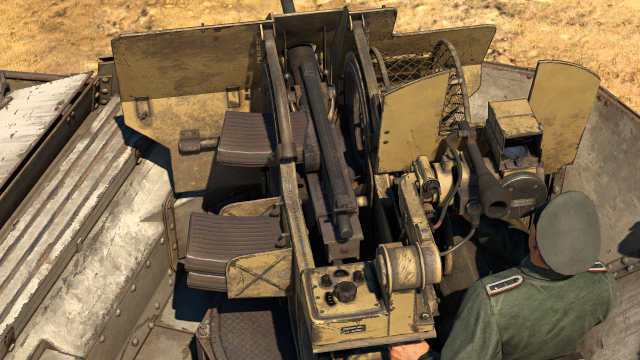
The FlaK38 (20 mm) breech in the Sd.Kfz.234/3.
See also
Links to the articles on the War Thunder Wiki that you think will be useful for the reader, for example:
- reference to the article about the variant of the cannon/machine gun;
- references to approximate analogues by other nations and research trees.
External links
Paste links to sources and external resources, such as:
- topic on the official game forum;
- other literature.
| Germany anti-aircraft guns | |
|---|---|
| 15 mm | MG 151 |
| 20 mm | FlaK38 · Rh202 |
| 30 mm | MK103/38 |
| 37 mm | FlaK36 · FlaK43 · FlaK44 |
| Foreign: | |
| 35 mm | Oerlikon KDA (Swiss) |