F-84F (Germany)
OLD‑WIKI.WARTHUNDER.COM (DEFUNCT)
| This page is about the German strike aircraft F-84F (Germany). For other versions, see F-84 (Family). |
Description
After an 11-year hiatus, the West German Air Force was revived after Germany was brought into NATO to counter the Soviet threat. As part of the initiative to further arm countries in NATO, multiple countries like West Germany and Italy received hundreds of F-84F Thunderstreaks. The Luftwaffe received over 400 F-84Fs in the late 1950s and early 1960s. JagdBomberGeschwader 31 (JBG31) would be the first air wing with the F-84Fs. As more air wings received the Thunderstreaks, the accident rate went up as well. Germany had a 25+% loss rate with the new Thunderstreaks and the public complained about it. This trend would continue with the F-104, the next plane the Luftwaffe ordered to replace the F-84F in 1966.
Introduced in Update "Hot Tracks", the ◄F-84F Thunderstreak is a decent strike aircraft that can carry 250 lb bombs up to 2,000 lb bombs along with rockets. The six centre-mounted M3 Browning machine guns are incredibly effective in taking out light pillboxes and other soft ground targets like anti-air or howitzers. However, the F-84F struggles with fighting other aircraft. The speed of the earlier F-84Gs is largely insignificant when it comes to the F-84F as many other planes in its BR bracket are much better in terms of performance. Ultimately, it's a good strike aircraft that suffers when it comes to defending itself or attacking other enemy players.
General info
Flight performance
| Characteristics | Max speed (km/h at 0 m - sea level) |
Max altitude (metres) |
Turn time (seconds) |
Rate of climb (metres/second) |
Take-off run (metres) | |||
|---|---|---|---|---|---|---|---|---|
| AB | RB | AB | RB | AB | RB | |||
| Stock | 1,090 | 1,067 | 29.7 | 30.9 | 30.7 | 28.8 | 2,000 | |
| Upgraded | 1,111 | 1,102 | 26.5 | 28.0 | 45.9 | 38.0 | ||
Details
| Features | |||||
|---|---|---|---|---|---|
| Combat flaps | Take-off flaps | Landing flaps | Air brakes | Arrestor gear | Drogue chute |
| ✓ | ✓ | ✓ | ✓ | X | ✓ |
| Limits | ||||||
|---|---|---|---|---|---|---|
| Wings (km/h) | Gear (km/h) | Flaps (km/h) | Max Static G | |||
| Combat | Take-off | Landing | + | - | ||
| 533 | 515 | 417 | ~11 | ~3 | ||
| Optimal velocities (km/h) | |||
|---|---|---|---|
| Ailerons | Rudder | Elevators | Radiator |
| < 630 | < 600 | < 650 | N/A |
Engine performance
| Engine | Aircraft mass | |||||
|---|---|---|---|---|---|---|
| Engine name | Number | Basic mass | Wing loading (full fuel) | |||
| Wright J65-W-7 | 1 | 6,667 kg | 279 kg/m2 | |||
| Engine characteristics | Mass with fuel (no weapons load) | Max Takeoff Weight | ||||
| Weight (each) | Type | 8m fuel | 20m fuel | 29m fuel | ||
| 1,260 kg | Axial-flow turbojet | 7,177 kg | 7,838 kg | 8,368 kg | 8,935 kg | |
| Maximum engine thrust @ 0 m (RB/SB) | Thrust to weight ratio @ 0 m (100%) | |||||
| Condition | 100% | WEP | 8m fuel | 20m fuel | 29m fuel | MTOW |
| Stationary | 3,470 kgf | N/A | 0.48 | 0.44 | 0.41 | 0.39 |
| Optimal | 3,470 kgf (0 km/h) |
N/A | 0.48 | 0.44 | 0.41 | 0.39 |
Survivability and armour
The F-84F has three armoured pieces protecting the pilot. There is a 38 mm pane of bulletproof glass angled at 61° directly in front of the pilot. An 8 mm steel plate angled at 15° sits directly behind the pilot's seat and almost entirely covers the pilot directly from the rear. Lastly, there is a 12.7 mm steel plate angled at 56° right above and behind the pilot's head. The F-84F has six self-sealing fuel tanks. Two of the tanks sit near the wingtips, and another two are placed at the wing roots. Lastly, one fuel tank sits directly beneath the pilot and the final tank is behind the pilot. Although the F-84F does have armour and self-sealing fuel tanks, it's ultimately futile when many of its opponents have high-powered cannons like DEFAs or NR-23s.
Modifications and economy
For modifications, as with almost all jets in the German tree, performance and survivability mods should be priority, except for the booster which really is not all that necessary and lends itself to more wing rips. G-Suit is a must. The six .50 calibre guns are accurate enough baselines as is the ammo, so go for the bombs and/or rockets next.
Armaments
| Ballistic Computer | |||
|---|---|---|---|
| CCIP (Guns) | CCIP (Rockets) | CCIP (Bombs) | CCRP (Bombs) |
 |
 |
|
|
Offensive armament
The F-84F (Germany) is armed with:
- 4 x 12.7 mm M3 Browning machine guns, nose-mounted (300 rpg = 1,200 total)
- 2 x 12.7 mm M3 Browning machine guns, wing-mounted (300 rpg = 600 total)
Suspended armament
The F-84F (Germany) can be outfitted with the following ordnance:
| 1 | 2 | 3 | 4 | 5 | 6 | 7 | 8 |  | |
|---|---|---|---|---|---|---|---|---|---|
| 250 lb LDGP Mk 81 bombs | 1 | 1 | 1 | 1 | |||||
| 500 lb LDGP Mk 82 bombs | 1 | 1 | 1 | 1 | |||||
| 1,000 lb LDGP Mk 83 bombs | 1 | 1 | 1 | 1 | |||||
| 2,000 lb LDGP Mk 84 bombs | 1 | 1 | 1 | 1 | |||||
| BLU-1 incendiary bombs | 1 | 1 | 1 | 1 | |||||
| FFAR Mighty Mouse rockets | 7 | 7 | 7 | 7 | 7 | 7 | |||
| HVAR rockets | 2 | 2 | 2 | 6 | 6 | 2 | 2 | 2 | |
| Maximum permissible loadout weight: 2,700 kg Maximum permissible wing load: 1,350 kg Maximum permissible weight imbalance: 700 kg | |||||||||
| Default weapon presets | |
|---|---|
| |
Usage in battles
The F-84F gets a bad rap, but it is a surprisingly fun aircraft to fly, more so once spaded. The air spawn is a big help in grinding up the aircraft modifications. Until the bombs are unlocked, use the advantage of the air spawn to climb and look for bombers. If no bombers are present, look for fighters engaging friendlies.
Keep the F-84F's speed around 700 km/h when climbing. The aircraft has relatively good dive acceleration and top end for its BR. This makes it a natural for Boom and Run tactics. Make sure the plane is set up so the run is either toward the airfield or friendlies so that any chasers will be picked off by allies and or the airfield's anti-air defenses. Try to engage at as close to 1,000 km/h as possible and do not try to turn if the target goes evasive. This aircraft has terrible acceleration, so it is important to keep the F-84F's speed up. Quite often the F-84F will get chasers with AIM-9Bs. Keep a look out for them and use occasional hard manoeuvres to break lock. Fortunately, it does not take much to break lock of the AIM-9Bs.
For the payload usage, the rockets, though inaccurate, are still fun to use en masse against targets, especially the Mighty Mouse rockets with a total of 42 rockets. However, the drag from the Mighty Mouse launchers is a problem. For bombs, the F-84F can effectively base bomb at the BR with the four 1,000 lb Mk 83s and be able to engage unsuspecting targets during the return to the airfield. Just remember, no turn fighting. When attempting to dive-bomb targets, use the air brakes to be able to adjust the planes better during its descent onto the target. When all bombs are expended and the F-84F begins their landing approach, use the air brake to help decelerate the plane to a manageable landing speed for the gears and flaps, then rely on the drogue chute to stop the plane on the airfield.
Radars
The F-84F is equipped with an AN/APG-30 rangefinding radar, located in the nose of the aircraft. It will automatically detect other planes within the scanning area and display the range to the closest target. It is linked with a gyro gunsight and can help with aiming at close range.
| AN/APG-30 - Rangefinding radar | |||
|---|---|---|---|
| Maximum Tracking Range |
Minimum Tracking Range |
Azimuth Tracking Angle |
Elevation Tracking Angle |
| 2,750 m | 300 m | ±9° | ±9° |
Pros and cons
Pros:
- 4 nose-mounted .50 cals plus 2 near the side of the airframe making accurate shots possible
- A lot of variety of choices for ground ordnance
- Good acceleration in a steep dive
Cons:
- Turning is below average so don't expect to last long in a dogfight with any aircraft
- While turning, speed is bled a lot so maintain your speed
- Will commonly face air-to-air missiles, any of which it has difficulty evading
- Most jets will catch up to you due to the poor acceleration
- The .50 cals are underpowered for its rank
- The FFAR rockets are placed at the wing tips, this will result in poor accuracy
History
Describe the history of the creation and combat usage of the aircraft in more detail than in the introduction. If the historical reference turns out to be too long, take it to a separate article, taking a link to the article about the vehicle and adding a block "/History" (example: https://wiki.warthunder.com/(Vehicle-name)/History) and add a link to it here using the main template. Be sure to reference text and sources by using <ref></ref>, as well as adding them at the end of the article with <references />. This section may also include the vehicle's dev blog entry (if applicable) and the in-game encyclopedia description (under === In-game description ===, also if applicable).
Devblog
In the late 1940's, the manufacturer 'Republic' sought to improve the performance of the F-84 in order to bring it closer in line with the F-86 Sabre. As a result, it developed a new variant of the Thunderjet, designated F-84F. The new aircraft featured, among other changes, a new swept wing and a more powerful engine than its predecessor. Although Republic initially intended the new aircraft to be an extensive modernization of the base F-84, possessing a high degree of part compatibility with preceding variants, in the end, only less than 20% of the parts were interchangeable, resulting in the F-84F Thunderstreak becoming its own independent design.
Following its maiden flight in the early 1950's, the F-84F was ordered into production. However, the USAF focus on strategic bombers at the time resulted in some critical component manufacturing processes being prioritized for bomber production, ultimately leading to a staggered production start of the new F-84F.
The Thunderstreak officially entered service with the USAF in 1954, but was quickly phased out of active service due to engine issues before being reactivated in the early 1960's as tensions between the two superpowers began to rise again. Ultimately, the F-84F kept flying under American colors well into the early 1970's before finally being retired as newer aircraft replaced the Thunderstreak in active service.
The F-84F was also widely exported to NATO members. Chiefly among them were Germany, France, Italy, Belgium, Greece, China, the Netherlands as well as others. In total, well over 2,100 F-84F Thunderstreaks were built, with the Greek Air Force being the last to retire their F-84Fs in 1991.
Media
- Skins
- Images
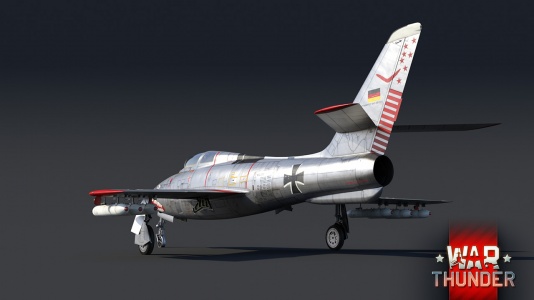
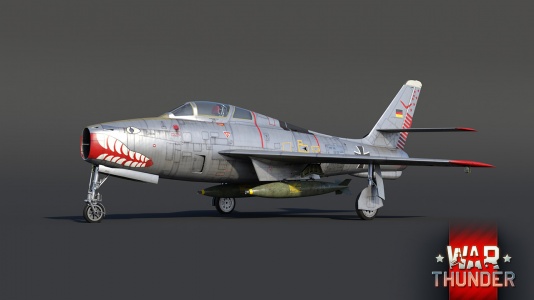
- F-84F (Germany) Devblog Images
See also
Links to the articles on the War Thunder Wiki that you think will be useful for the reader, for example:
- reference to the series of the aircraft;
- links to approximate analogues of other nations and research trees.
External links
| Republic Aviation Corporation | |
|---|---|
| Fighters | P-43A-1 |
| P-47D-22-RE · P-47D-25 · P-47D-28 · P-47M-1-RE · ⋠P-47M-1-RE · P-47N-15 | |
| Jet Aircraft | F-84B-26 · F-84F · F-84G-21-RE |
| F-105D | |
| Export | J9 Early* |
| ␗P-43A-1 | |
| ▄Thunderbolt Mk.1 · ▄P-47D-22-RE · ␗P-47D-23-RA · ▂P-47D-27 · ␗P-47D-30 · ▄P-47D-30 · ␗F-47N-25-RE | |
| ◄F-84F · ▄F-84F (Italy) · ▄F-84F (France) · F-84F IAF · F-84F | |
| ␗F-84G-21-RE · ▄F-84G-21-RE · ▄F-84G-26-RE · ␗F-84G-31-RE | |
| Captured | ▀P-47D-16-RE · ▀P-47D |
| *The company was named "Seversky Aircraft Company" before being renamed in 1939 | |
| Germany jet aircraft | |
|---|---|

|
Luftwaffe |
| He 162 | He 162 A-1 · He 162 A-2 |
| Me 163 | Me 163 B · Me 163 B-0 |
| Ho 229 | Ho 229 V3 |
| Ar 234 | Ar 234 B-2 · Ar 234 C-3 |
| Me 262 | Me 262 A-1a · Me 262 A-1a/Jabo · Me 262 A-1a/U1 · Me 262 A-1/U4 · Me 262 A-2a |
| Me 262 C-1a · Me 262 C-2b | |

|
LSK |
| Fighters | ◊MiG-15bis · ◊Lim-5P · ◊MiG-19S |
| ◊MiG-21MF · ◊MiG-21bis-SAU · ◊MiG-21 "Lazur-M" | |
| ◊MiG-29 | |
| Attackers | ◊MiG-23BN · ◊MiG-23MF · ◊MiG-23MLA |
| ◊Su-22UM3K · ◊Su-22M4 | |
| ◊IL-28 | |

|
Luftwaffe |
| F-84 | ◄F-84F |
| F-86 | ◄CL-13A Mk 5 · ◄CL-13B Mk.6 · ◄F-86K |
| F-104 | ◄F-104G |
| F-4 | ◄F-4F Early · ◄F-4F · ◄F-4F KWS LV |
| G.91 | ◄G.91 R/3 · ◄G.91 R/4 |
| Tornado | ◄Tornado IDS WTD61 · ◄Tornado IDS MFG · ◄Tornado IDS ASSTA1 |
| Other | Alpha Jet A · ◄Sea Hawk Mk.100 |
| Ex-LSK | ◄MiG-21 SPS-K · ◄MiG-29G · ◄Su-22M4 WTD61 |

|
Swiss Air Force |
| ◌Hunter F.58 · FFA P-16 | |