AMX-50 (TOA100)
OLD‑WIKI.WARTHUNDER.COM (DEFUNCT)
| This page is about the French medium tank AMX-50 (TOA100). For other versions, see AMX-50 (Family). |
Description
The AMX-50 project started life as a 30-ton weight class project requirement as NOM 141 (Project 141) in 1945, as the prospective next generation domestic French tank after the ARL-44. The familiar oscillating turret on all AMX-50s was introduced in 1949, equipped with a 90 mm gun (AMX M4) - however, at this stage, the French Army was no longer content with the 90 mm gun, and the AMX M4 was canceled to make way for a new turret that housed a 100 mm cannon instead. Two prototypes of this new standard were produced, one which was modified from an AMX M4 and one which was built from the ground up as an AMX-50 (TOA100). Unfortunately for the AMX-50 (TOA100), the tank's protracted development meant the Army now wanted a 120 mm cannon instead of the 100 mm, and as at this point the hull was grossly underarmoured and was lacking in many other technical areas as well, development of the AMX-50 shifted to what would now be known as the AMX-50 Surblinde instead.
Introduced in Update 1.75 "La Résistance", the AMX Char Moyen de 50 tonnes (TOA100) features the same armament and turret as the Lorraine 40t on a more robust chassis, similar to that of the AMX M4. The AMX-50 (TOA100) is functionally not too different from the Lorraine 40t in terms of gameplay - it's a mobile hull with a fast-reloading gun, which doesn't fire APHE but still spalls adequately due to the French AP shell cap. The vehicle, as it is an oscillating turret design with a drum-feed autoloader, cannot fire when it runs out of ammo in the ready rack, and also cannot elevate too high due to how the turret is placed on its oscillating hinge. Armour-wise, the vehicle isn't particularly well protected, with thin armour all around, but you may be able to survive some lower calibre shots or autocannon fire if you're lucky. Play around the flanks, preferably around slight hills or ridges you can peek around sideways, and you can penetrate most enemies without issue. If you see an enemy you can't penetrate frontally or aren't confident, you can always shoot the barrel then use the extra time to shoot a very specific weakspot. A good example would be seeing something like an IS-3 or IS-6, while you could simply shoot the weakspots such as the front armour weld on the IS-3 or the mantlet/unangled upper plate of the IS-6, you could shoot their barrels out then take a careful shot if you're not feeling it then.
General info
Survivability and armour
Armour type:
- Rolled homogeneous armour (hull, turret roof, cupola roof)
- Cast homogeneous armour (turret, cupola)
| Armour | Front (Slope angle) | Sides | Rear | Roof |
|---|---|---|---|---|
| Hull | 80 mm (55°) Front glacis 35 mm (61°) Lower glacis 60 mm (39°) Front cheeks |
40 mm (24°) Top 40 mm Bottom |
40 mm (0-30°) 30 mm (30°) Transmission hatch |
20 mm |
| Turret | 45 mm (39-56°) Turret front 30 mm (9-26°) Turret base 50 mm (7-82°) Barrel shroud |
30 mm (0-55°) Turret 30 mm (0-25°) Turret base |
30 mm (0-30°) Turret bustle 30 mm (6-22°) Pivot ball 20 mm (69-90°) Turret underside |
20 mm |
| Cupola | 30 mm (45°) | 30 mm (conical) | 20 mm | |
Notes:
- Suspension wheels and tracks are 20 mm thick. Suspension wheels are interleaved and thus overlap in some areas.
- Add-on tracks hang on the hull sides in the crew compartment area.
- Hull undersides above tracks are 20 mm thick.
- Belly armour is 20 mm thick.
- There is a 20 mm plate separating the crew compartment from the engine bay at the top of the hull.
- There is a 5 mm plate separating the crew compartment from the engine bay at the bottom of the hull.
- Overlapping wheels provide extra 20 mm to the hull's lower side.
The AMX-50 (TOA100)'s hull is very similar to that of the famous German medium tank, even in armour values. It is only slightly weak from the side, making angling quite ineffective. This armour should be able to deflect incoming shots from the weaker tanks it may encounter at its BR spread, notably the famous Soviet 85 mm D-5T. With its good slope, it can easily deflect APCR shots. The only negative point is the turret: it is very weak to incoming shots: with only 45 mm sloped at 52°, it is weaker than a T-34-85 (D-5T)'s hull. The turret armour is a noticeable downgrade from the AMX M4, so you will need to be more careful about taking hits. The only way to avoid being taken down too easily is to increase distance between the AMX-50 position and the enemy. Don't worry about that: the 100 mm gun is suited for that purpose.
Mobility
| Game Mode | Max Speed (km/h) | Weight (tons) | Engine power (horsepower) | Power-to-weight ratio (hp/ton) | |||
|---|---|---|---|---|---|---|---|
| Forward | Reverse | Stock | Upgraded | Stock | Upgraded | ||
| Arcade | Expression error: Unexpected * operator. | 1,550 | Expression error: Unexpected round operator. | __.__ | |||
| Realistic | 884 | Expression error: Unexpected round operator. | __.__ | ||||
While not the fastest tank, the AMX-50 (TOA100) certainly is capable of many feats of agility. This tank may be the slowest French rank IV tank, which is not a bad thing considering French tank's general dynamic gameplay at this BR. "Don't put the tank in nasty front-line situations" is the best advice to follow with this tank. As it is, this 800+ HP engine should be able to carry the tank to any location in good time.
Modifications and economy
Armaments
Main armament
| 100 mm SA47 L/58 | Turret rotation speed (°/s) | Reloading rate (seconds) | ||||||||
|---|---|---|---|---|---|---|---|---|---|---|
| Mode | Capacity | Vertical | Horizontal | Stabilizer | Stock | Upgraded | Full | Expert | Aced | Autoloader |
| Arcade | 50 | -8°/+15° | ±180° | N/A | 28.6 | 39.5 | 48.0 | 53.1 | 56.5 | 4.00 |
| Realistic | 17.9 | 21.0 | 25.5 | 28.2 | 30.0 | |||||
The SA47 L/58 is a very potent gun for a rank IV tank: it performs in a similar way to the Soviet 100 mm D-10T equipped on the T-54/55 (Family) series. While not having any HE filler in their AP rounds, the French engineers somehow managed to optimize armour spalling on penetrating shots and muzzle velocity, making these shells very good at long-range engagements. This gun is also mounted with an autoloader, which provides it with a solid 4 seconds reload time. It has good gun depression and a fast turret traverse, which enables this tank to react quickly to flankers and take solid hulled-down position, its high gun placement minimizes the tank's silhouette behind hills.
Ammunition
| Penetration statistics | |||||||
|---|---|---|---|---|---|---|---|
| Ammunition | Type of warhead |
Penetration @ 0° Angle of Attack (mm) | |||||
| 10 m | 100 m | 500 m | 1,000 m | 1,500 m | 2,000 m | ||
| Obus de rupture | APCBC | 273 | 270 | 257 | 242 | 228 | 215 |
| Obus explosif | HE | 30 | 30 | 28 | 26 | 24 | 22 |
| Shell details | ||||||||||||
|---|---|---|---|---|---|---|---|---|---|---|---|---|
| Ammunition | Type of warhead |
Velocity (m/s) |
Projectile mass (kg) |
Fuse delay (m) |
Fuse sensitivity (mm) |
Explosive mass (TNT equivalent) (kg) |
Ricochet | |||||
| 0% | 50% | 100% | ||||||||||
| Obus de rupture | APCBC | 1,000 | 15 | - | - | - | 48° | 63° | 71° | |||
| Obus explosif | HE | 1,000 | 14.8 | 0.2 | 0.1 | 1.4 | 79° | 80° | 81° | |||
Ammo racks
| Full ammo |
1st rack empty |
2nd rack empty |
3rd rack empty |
4th rack empty |
5th rack empty |
|---|---|---|---|---|---|
| 50 | 49 (+1) | 44 (+6) | 37 (+13) | 30 (+20) | 23 (+27) |
| 6th rack empty |
7th rack empty |
8th rack empty |
9th rack empty |
Visual discrepancy |
|
| 16 (+34) | 12 (+38) | 7 (+43) | 1 (+49) | No |
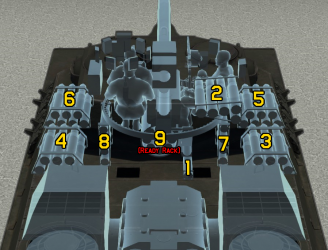
This tank features an auto-loading system that removes the need for a crew member to reload the main gun, although a loader is present to restock the autoloader. A large drum of seven rounds is found underneath the gun breech for rapid use. Once this drum is empty, rounds in the hull will need to be placed in the autoloader rack before it can be used by the autoloader, which takes about 14 seconds to perform for one round. Nine rounds are found in three racks near the bottom of the hull behind the driver and machine-gunner while the rest of the stowage is found in the side sponsons above the tracks, aside from a small rack of 5 rounds near the rear of the turret.
Notes:
- Ammo rack 9 is the autoloader drum and takes priority in being filled at the beginning of the battle, then fills racks 8 through 1.
- If the autoloader drum is empty, the main gun cannot fire until ammo is loaded into the autoloader drum.
- Simply not firing when the main gun is loaded will load ammo from racks 1-8 into the ready rack, as long as there is ammo present in racks 1-8. Firing the main gun will interrupt the loading of the ready racks.
Machine guns
| 7.5 mm MAC 31 | ||||
|---|---|---|---|---|
| Mount | Capacity (Belt) | Fire rate | Vertical | Horizontal |
| Coaxial | 4,800 (150) | 551 | N/A | N/A |
The small calibre of the MAC 31 machine gun makes it largely ineffective against all armoured vehicles but the ones with an open compartment. It still can be used to ping targets as a rangefinding help or to mow down minor obstacles blocking your line of sight.
Usage in battles
This medium tank performs good in its role, being versatile enough to take many battlefield roles: flanker, sniper and ambusher. The only thing it is insufficient at is absorbing damaging shots: there are too many weak spots on this tank to take anything bigger than HMG to the front. Don't stay too close to the front line since the reverse speed will not allow the tank to escape sufficiently fast and flanking manoeuvres will make the weak sides vulnerable.
Pros and cons
Pros:
- Impressive top speed, allowing for rapid movement across the battlefield
- Highly manoeuvrable, enabling quick and agile responses to changing situations
- Wide tracks provide excellent mobility on various types of terrain, maintaining good speed
- Equipped with a crew of 5 members, enhancing operational efficiency and allowing more hits to be taken
- Powerful 100 mm main gun with an autoloader, delivering high penetration capabilities and relatively fast reload
- Stock APCBC shells offer exceptional conical spread, ensuring deadly frontal hits
- Fast turret rotation speed, enabling swift target acquisition and engagement
- Sloped frontal armour has the potential to ricochet lower rank guns and APCR rounds
- Higher muzzle velocity than the Soviet 100 mm D-10T gun, easier to aim at range
- Well-suited for flanking manoeuvres, offering tactical advantages
Cons:
- Armour is insufficient to protect against higher rank guns
- Weak lower front plate (LFP), vulnerable to enemy fire
- Turret shares the same lightly-armoured design as the Lorraine 40t, posing a potential vulnerability
- Large, Panther-like hull, making it challenging to conceal and minimize exposure
- Limited shell choices, lacking APHE, HEAT, APDS, or APFSDS rounds
- Shells lack explosive filler, resulting in rare one-hit knockouts from the side
- Gun elevation speed is slow due to oscillating turret design
- Incapacitated loader hampers the tank's ability to utilize its coaxial MG
History
Design
In the late 1940s, the French Army was looking to replace the medium tanks Panther and ARL 44 that were becoming obsolete with a new 50t medium tank. The new tank was to be the future spearhead of French armoured divisions. The French company AMX started working on a proposal which was essentially an improved Tiger II on the drawing board. The project evolved and later resulted in the AMX-50 tank. The AMX-50 present in the game is the second prototype of the project.
Development
In order to save weight from the Tiger II's initial weight of 70 tons, the first AMX proposal was an underarmoured version of the Tiger II with only 30 mm armour plates. The French Army quickly indicated that such a thickness was too weak for the intended purpose. The armour of the hull was increased to 80 mm frontally and 40 mm for the sides and the weight-saving measures were then applied to other components. The original turret was changed for an oscillating turret whose design was already available and the suspension wheels were redesigned to get rid of the interleaving wheels. The new version was approved and a first prototype dubbed M4 was produced at the end of 1949 with a 90 mm SA 45 gun and a weight slightly above 50 tons. The second prototype called AMX-50/100 was produced 1 year later with the 100 mm SA 47 L/50 gun, a slightly modified turret and a weight close to 55 tons. After testing in 1952 and 1953, the French Army reclassified the AMX-50 as heavy tank as it could not reach more than 50 km/h on roads and 20 km/h off-road due to an insufficient output of the powerplant. The tank had a ratio of 15 hp/ton against the 20 expected. The availability of the more modern M47 medium tank through NATO cooperation made the need for the AMX-50 obsolete. Following its reclassification, there were several attempts to transform the AMX-50 in a real heavy tank like the AMX-50 Surbaissé or the AMX-50 Surblindé. But the need for heavy tanks would gradually disappear with the appearance of shaped charges (HEAT projectiles and missiles).
Combat usage
The AMX-50 never saw either service or combat action with the French Army.
Media
- Skins
- Videos
See also
- Related development
External links
| Ateliers de construction d'Issy-les-Moulineaux (AMX) | |
|---|---|
| Light tanks | |
| AMX-13 | AMX-13-M24 · AMX-13 (FL11) · AMX-13 · AMX-13 (SS.11) · AMX-13-90 · AMX-13 (HOT) |
| Armoured cars | AMX-10RC |
| Medium tanks | AMX M4 · AMX-50 (TOA100) |
| MBTs | |
| AMX-30 | AMX-30 · AMX-30 ACRA · AMX-30 (1972) · AMX-30B2 · AMX-30B2 BRENUS · AMX-30 Super |
| AMX-32/40 | AMX-32 (105) · AMX-32 · AMX-40 |
| Heavy tanks | AMX-50 Surbaissé · AMX-50 Surblindé |
| Tank destroyers | ELC bis · AMX-50 Foch |
| SPAAGs | AMX-13 DCA 40 · AMX-30 S DCA |
| Export | AMX-13 |
| France medium tanks | |
|---|---|
| M4 Derivatives | M4A1 (FL10) · M4A4 (SA50) |
| AMX-50 | AMX M4 · AMX-50 (TOA100) · AMX-50 (TO90/930) |
| AMX-30 | AMX-30 · AMX-30 (1972) · AMX-30B2 · AMX-30B2 BRENUS · AMX-30 ACRA · AMX-30 Super |
| AMX-32/40 | AMX-32 · AMX-32 (105) · AMX-40 |
| Leclerc | Leclerc · Leclerc S2 · Leclerc SXXI · Leclerc AZUR |
| Other | D2 · S.35 · Lorraine 40t |
| Germany | Panther "Dauphiné" |
| USA | ▄M4A1 · ▄M4A3 (105) · ▄M4A4 · ▄M26 |