AG-30 (30 mm)
Tank cannons
OLD‑WIKI.WARTHUNDER.COM (DEFUNCT)
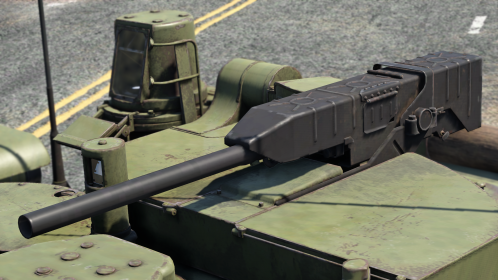
Description
The 30 mm AG-30 is a Russian grenade launcher.
Vehicles equipped with this weapon
General info
The 30 mm AG-30 has a slow muzzle velocity. The grenade's travel time can be ~1 second at 250 m, and ~3 seconds at 500 m, and expect even more time needed for targets beyond 500 m.
Available ammunition
Describe the shells that are available for the weapon and their features and purpose. If it concerns autocannons or machine guns, write about different ammo belts and what is inside (which types of shells).
| Penetration statistics | |||||||
|---|---|---|---|---|---|---|---|
| Ammunition | Type of warhead |
Penetration @ 0° Angle of Attack (mm) | |||||
| 10 m | 100 m | 500 m | 1,000 m | 1,500 m | 2,000 m | ||
| VOG-30 | VOG* | 3 | 3 | 3 | 3 | 3 | 3 |
| Shell details | ||||||||||||
|---|---|---|---|---|---|---|---|---|---|---|---|---|
| Ammunition | Type of warhead |
Velocity (m/s) |
Projectile mass (kg) |
Fuse delay (m) |
Fuse sensitivity (mm) |
Explosive mass (TNT equivalent) (g) |
Ricochet | |||||
| 0% | 50% | 100% | ||||||||||
| VOG-30 | VOG* | 185 | 0.28 | 0 | 0.1 | 64.68 | 79° | 80° | 81° | |||
Comparison with analogues
The M129, another AGL, is vastly superior to the AG-30 in every way, namely with better armour penetration, muzzle velocity, and a lighter shell. The only advantage the AG-30 has over the M129 is the explosive mass, but that's worth nothing because the explosive mass can't be utilized effectively.
Usage in battles
Despite having no infantry to fight, the AG-30 can be used to cripple critical enemy modules. Breaking their gun barrel and tracks will provide the time to either escape or time to aim for weak spots. The shells have less than 5 mm of penetration, so it is unlikely to destroy anything. The only things that the AG-30 might shred through are ATGM carriers and thinly armoured SPAAs, but then HMGs and high-calibre HE shells do a better job at destroying them. It might defeat helicopters though, because the 30 mm grenades don't have tracers at all so the helicopters won't notice them coming until it hits them.
Overall, the AG-30 is essentially a tool to buy time, and can't really do anything much more than disarming and demobilizing light tanks and MBTs. The AG-30 can be used to break through an enemy's ERA, which would help the player and teammates defeat the enemy more easily. However, the AG-30 shouldn't be the first weapon of choice in an engagement, as the BMP-2M has very useful ATGMs with tandem charges that can be fired in rapid succession. Again, don't think about actually destroying anything with the AG-30. Roofs and belly armour of even the earliest light tanks exceed 10 mm of RHA, which means penetration is nigh-impossible.
Pros and cons
Pros:
- Decent rate of fire (400 RPM) in terms of an automatic grenade launcher
- May damage and cripple modules that are important to the enemy, such as their gun barrel and tracks
- Can remove enemy armour plates, especially ERA plates, so that the primary armament has a better chance of penetrating
- If enemy compartment is open-back or open-top, the crew of the enemy will be eliminated within a single good burst
- Large belt capacity allows sustained fire for longer durations (300 grenades for the BMP-2M)
- Launcher has decent elevation angles
Cons:
- Grenades will almost never penetrate armour directly and hurt the crew inside
- Grenade's low muzzle velocity results in quite a delay from firing to grenade impact, making it a challenge to hit any moving targets beyond 200 m
- The explosion of the grenade can obscure vision if using thermal gunner sights
History
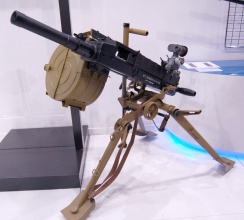
The AGS-17 adopted in 1971 was improved upon with the introduction of the AGS-30 grenade launcher.[1] The new launcher, which had development started in the early 1990s by the KBP Instrument Design Bureau, was introduced in 1999 as a lighter, more accurate, and farther-hitting grenade launcher compared to the AGS-17, [2] as well as constructed with 40% fewer parts.[3] This was possible due to changes in the operating mechanism that allows a lighter breech body for firing from an open bolt (compared to the AGS-17's blowback operated closed bolt system), which consequently makes the weapon lighter with a faster firing rate.[4]
The AGS-30 (Avtomatischeskyi Granatmyot Stankovyi Automatic Grenade Launcher - Mounted) was adopted for Russian Army service in 2002, firing the same 30x28B mm grenades as the AGS-17 in belts of 29 grenades. Due to its lightweight construction of 16 kg with tripod included (compared to the AG-17's weight of 18 kg alone, with the tripod weighing 12 kg), the weapon could be easily used and moved by a crew of two soldiers in the infantry support role.[4] The AGS-30 can also be found as vehicle mounts as the AG-30M on AFV and helicopters with a remote-controlled turret.[1]
The AGS-30 is still in service today, alongside the AGS-17 grenade launcher that it was intended to replace.[5]
Media
Excellent additions to the article would be video guides, screenshots from the game, and photos.
See also
- M129 (40 mm) - A similar vehicle-mounted grenade launcher
External links
- References
- Bibliography
- Army Recognition, "AGS-30 30mm automatic grenade launcher." Army Recognition, Army Recognition Group SPRL, 09 Oct. 2018, Website. Accessed 22 Apr. 2021 (Archive).
- Koll, Christian, Soviet Cannon: A Comprehensive Study of Soviet Guns and Ammunition in Calibres 12.7mm to 57mm. Self-published, PDF, 2009.
- Military-Today. "AGS-30" Military-Today, Website. Accessed on 22 Apr 2021 (Archive).
- Popenker, Maxim, "AGS-30." Modern Firearms, Website. Accessed 22 Apr. 2021 (Archive).
- TASS, "Russian arms manufacturer to launch production of AGS-30 grenade launchers in 2020." Russian News Agency TASS, 20 Aug. 2019, Website. Accessed 22 Apr. 2021 (Archive from 08 Nov 2020).
| USSR tank cannons | |
|---|---|
| 20 mm | TNSh |
| 30 mm | 2A42 · 2A72 · AG-30 |
| 45 mm | 20-K |
| 57 mm | AU-220 · Ch-51M · ZIS-2 · ZIS-4 · ZIS-4M |
| 73 mm | 2A28 |
| 76 mm | 1902/30 · 3-K · D-56TS · F-32 · F-34 · F-96 · KT-28 · L-10 · L-11 · ZIS-3 · ZIS-5 |
| 85 mm | D-5S · D-5T · D-58 · D-70 · F-30 · ZIS-S-53 |
| 100 mm | 2A48 · 2A70 · D-10S · D-10T · D-10T2S · D-50 · LB-1 · S-34 |
| 107 mm | ZIS-6 |
| 115 mm | U-5TS |
| 122 mm | A-19 · D-25-44T · D-25S · D-25T · D-25TS · D-30T · D-49 · M-30 · M-62-T2S |
| 125 mm | 2A26 · 2A46 · 2A46M · 2A46M-1 · 2A46M-4 · 2A46M-5 · 2A46MS · 2A75 · D-126 |
| 130 mm | B-13 · C-70 · M-65 |
| 152 mm | 2A33 · LP-83 · M-10T · M-64 · M-69 · ML-20S |
| Foreign: | |
| 37 mm | M5 (USA) |
| 50 mm | KwK L/42 (Germany) |
| 57 mm | 6pdr OQF Mk.III (Britain) · M1 (USA) |
| 75 mm | KwK42 (Germany) · M2 (USA) |
| 76 mm | M1 (USA) |
| 85 mm | Type-62-85-TC (China) |