6P49 (12.7 mm)
Tank machine guns
OLD‑WIKI.WARTHUNDER.COM (DEFUNCT)
Description
Write an introduction to the article in 2-3 small paragraphs. Briefly tell us about the history of the development and combat using the weaponry and also about its features. Compile a list of air, ground, or naval vehicles that feature this weapon system in the game.
Vehicles equipped with this weapon
General info
Tell us about the tactical and technical characteristics of the cannon or machine gun.
Available ammunition
Describe the shells that are available for the weapon and their features and purpose. If it concerns autocannons or machine guns, write about different ammo belts and what is inside (which types of shells).
Comparison with analogues
Give a comparative description of cannons/machine guns that have firepower equal to this weapon.
Usage in battles
Describe the cannon/machine gun in the game - its distinctive features, tactics of usage against notable opponents. Please don't write a "guide" - do not impose a single point of view, but give the reader food for thought.
Pros and cons
Summarise and briefly evaluate the weaponry in terms of its characteristics and combat effectiveness. Mark pros and cons as a list.
Pros:
Cons:
History
Development
The Soviet Union had used the NSV machine gun as its primary heavy machine gun armament since it came to service in the 1970s. However, the break-up of the Soviet Union in the 1990s caused the search for a new heavy machine gun as the "Metallist" factory producing the NSV was in the newly independent Kazakhstan since 1991.[1] As such, the new Russian government decided to design and produce a new heavy machine gun in Russia territory to fill in the NSV's role.
The development of the new machine gun was assigned to the Degtyarov plant in Kovrov, which was worked on by a team of arms designer consisting of A. A. Namitulin, N. M. Obidin, Yu. M. Bogdanov and V. I. Zhirokhin.[2] In 1997, the weapon design was tested by the Russian Army and put into series production. This was later upgraded to a mass production scale in 27 March 2001 at the Degtyarov plant. The weapon was given a GRAU index number 6P50, the weapon was also known as the KORD ("Konstruktsija ORuzheinikov-Degtyarovtsev" – Design of Degtyarov plant team).[1]
Design and variants
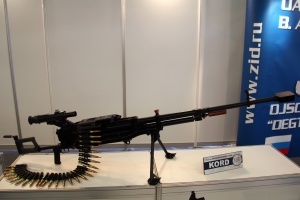
The KORD weapon is an automatic-only, gas-operated via long-stroke piston, belt-fed machine gun with a cyclic rate of between 650-750 rounds per minute. The KORD shares the same mounting interface as the NSV as well as uses the same 50-round non-disintegrating belt as the NSV. The designers implemented into the KORD a quick-change barrel for firing for extended period of time and a multi-baffle muzzle brake for recoil reduction, sufficiently so that the KORD could be fired from a shoulder stock attachment.[1] The weapon could be configured to feed the belt from either the left or right side. The KORD is also considered more accurate than the NSV, up to 1.5 times more so due to its mean deviation at a 100 m range being less than 300 mm.[2] The KORD comes with iron sights that can be adjusted up to 2,000 meter range, though a mounting slot on the receiver left side can accept optical or electro-optical sights.[2]
The KORD index number varies by the type of mounting installed on the weapon, with the 6P50 as the baseline
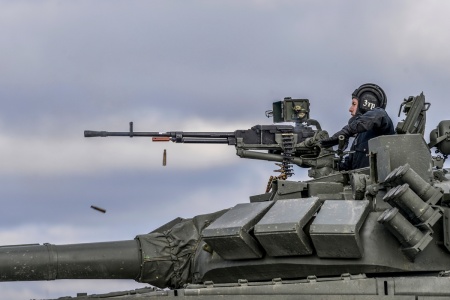
- 6P49: Use in a vehicle turret mountings with an electrically actuated solenoid sear[2][3]
- 6P51: Use in vehicle coaxial mountings with a left-side feeding.[2][3]
- 6P56: Use with 6U16 multi-purpose mount for engaging air or ground target.[4]
- 6P57: Use with infantry with the 6T19 bipod.[5]
- 6P58: Mounted on a 6U16 multi-purpose mount for use on helicopters and automobiles.[6]
- 6P59: Mounted on a 6U16 multi-purpose mount and pedestal stand for use on naval vessels, automobiles, or other stationary instlalations.[7]
- 6P60: Use with 6T20 tripod mount.[8]
An export variant of the KORD is also available, chambered in the American .50 BMG calibre.[2]
Usage in service
The KORD machine gun were used by Russian infantry and armoured fighting vehicles, sometimes in place of the older NSV machine gun due to the same mounting design. Infantry can use the KORD with a 6T7 tripod and a 6U6 anti-aircraft mount. One configuration used by the infantry is with the 6T19 bipod to be carried and used in the frontline, an ability that benefits from the light recoil the design puts on the user.[1]
Some of the more recent conflicts the KORD was used in is the Syrian Civil War[9] and the War in the Donbas region of Ukraine.[10]Media
Excellent additions to the article would be video guides, screenshots from the game, and photos.
See also
- NSVT (12.7 mm) - The preceding machine gun
External links
References
- Citations
- ↑ 1.0 1.1 1.2 1.3 Popenker, n.d.
- ↑ 2.0 2.1 2.2 2.3 2.4 2.5 Koll 2009, 70
- ↑ 3.0 3.1 V.A.Degtyarev Plant, n.d., 6P49 (6P51)
- ↑ Russian Combat Small Arms, n.d.
- ↑ V.A.Degtyarev Plant, n.d., 6P57
- ↑ V.A.Degtyarev Plant, n.d., 6P58
- ↑ V.A.Degtyarev Plant, n.d., 6P59
- ↑ V.A.Degtyarev Plant, n.d., 6P60
- ↑ Smallwood et al. 2014
- ↑ Gri 2014
- Bibliography
- Gri, Al. 2014. "The Kord Heavy Machine Gun found in Donbass: Another Russian military 'Flag' Item." Translated by Gennadiy Kornev and Christopher Garfield. Inform Napalm. Last modified December 17, 2014. Website (Archive)
- Koll, Christian. 2009. Soviet Cannon: A Comprehensive Study of Soviet Guns and Ammunition in Calibres 12.7MM to 57 MM. Austria: self-published.
- Popenker, Maxim. n.d. "Kord 12.7." Modern Firearms. Accessed December 05, 2021. Website (Archive).
- Russian Combat Small Arms. n.d. "«KORD» LARGE CALIBER MACHINE GUN." Accessed December 05, 2021. Website (Archive).
- Smallwood, Michael, and Yuri Lyamin. 2014. "Russian Kord and ASVK systems in Syria." Armament Research Services. Last modified November 30, 2014. Website (Archive).
- V.A.Degtyarev Plant. n.d. "12.7 mm Kord machine-gun on infantry mount 6Т20 (index 6P60)." Accessed December 05, 2021. Website (Archive)
- V.A.Degtyarev Plant. n.d. "12.7 mm Kord machine-gun on the bipod 6T19 (index 6P57)." Accessed December 05, 2021. Website (Archive)
- V.A.Degtyarev Plant. n.d. "12,7 mm Kord machine-gun on the mounting 6U16 (index 6P58)." Accessed December 05, 2021. Website (Archive)
- V.A.Degtyarev Plant. n.d. "12,7 mm Kord machine-gun on the mounting 6U16 and stand (index 6P59)." Accessed December 05, 2021. Website (Archive)
- V.A.Degtyarev Plant. n.d. "12.7 mm Kord tank mounted machine-gun (index 6P49 (6P51))." Accessed December 05, 2021. Website (Archive)
| Tank machine guns | |
|---|---|
| USA | |
| 7.62 mm | M37 · M60D · M73 · M240 · M1919A4 · Mk.52 |
| 12.7 mm | FN M3P · M2HB · M80 · M85 |
| Germany | |
| 5.56 mm | MG4 |
| 7.62 mm | C6 · MG3A1 |
| 7.92 mm | MG13 Dreyse · MG34 · MG37(t) · MG42 |
| 12.7 mm | S.MG.50 |
| USSR | |
| 7.62 mm | DT · PKMB · PKT · PKTM · RP-46 · SGMT |
| 12.7 mm | DK · DShK · 6P49 · NSVT |
| 14.5 mm | KPVT |
| Britain | |
| 7.62 mm | Browning MG4 · L3A1 · L8A1 · L8A2 · L37A1 · L37A2 · L94A1 |
| 7.7 mm | Vickers |
| 7.92 mm | BESA |
| 12.7 mm | L21A1 |
| Japan | |
| 6.5 mm | Type 91 |
| 7.62 mm | Type 74 |
| 7.7 mm | Type 97 |
| 12.7 mm | Type 60 (B) |
| China | |
| 5.8 mm | QJT |
| 7.62 mm | Type 55 · Type 59 · Type 86 |
| 12.7 mm | QJC88A · Type 54 |
| 14.5 mm | QJG02 |
| Italy | |
| 7.62 mm | Beretta MG42/59 · FN MAG 60-40 |
| 8 mm | 34/40M · Breda Mod. 38 |
| 13.2 mm | Breda Model 31 |
| France | |
| 7.5 mm | AAT-52 · MAC 31 |
| 7.62 mm | A-A-F1N |
| 8 mm | Hotchkiss Mle 1914 |
| Sweden | |
| 6.5 mm | ksp m/14-29 |
| 7.62 mm | ksp 39 C · ksp 58 · ksp 94 |
| 8 mm | ksp m/36 · ksp m/39B |
| 12.7 mm | ksp 88 |