Type 91 (6.5 mm)
Tank machine guns
OLD‑WIKI.WARTHUNDER.COM (DEFUNCT)
| This page is about the Japanese machine gun Type 91 (6.5 mm). For other uses, see Type 91 (Disambiguation). |
Description
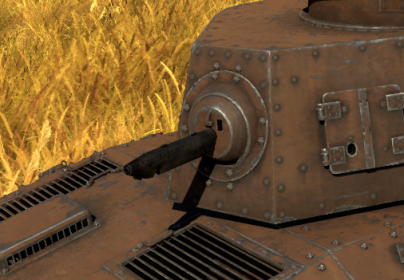
The Type 91 machine gun is a Type 11 light machine gun which was modified to be mounted in tanks and other armoured vehicles. Modifications included removal of the bi-pod and the addition of an angled pistol grip and brackets for mounting a 1.5x30 scope.
Vehicles equipped with this weapon
General info
The main doctrine of Japanese machine guns is more towards accuracy and mid-to-long range infantry engagement and hence the lower fire-rate and small clip-size.
In-game, the only Type 91 is usable on the Type 89 I-Go with the only working MG mounted in the hull, which can pretty much only be used for spotting on the map in RB or with very occasional unarmoured vehicles with unprotected crew such as on trucks. The Type 91 also doesn't have a 3D model in the game, the Type 97 (7.7 mm) machine gun model is in its place.
Available ammunition
- Default: Ball · T
| Penetration statistics | |||||||
|---|---|---|---|---|---|---|---|
| Ammunition | Penetration @ 0° Angle of Attack (mm) | ||||||
| 10 m | 100 m | 500 m | 1,000 m | 1,500 m | 2,000 m | ||
| T | 5 | 4 | 2 | 1 | 0 | 0 | |
| Ball | 5 | 4 | 2 | 1 | 0 | 0 | |
| Shell details | ||||||||||||
|---|---|---|---|---|---|---|---|---|---|---|---|---|
| Ammunition | Velocity (m/s) |
Projectile mass (kg) |
Fuse delay | Fuse sensitivity (mm) |
Explosive mass (TNT equivalent) (g) |
Ricochet | ||||||
| 0% | 50% | 100% | ||||||||||
| T | 743 | 0.01 | - | - | - | 47° | 56° | 65° | ||||
| Ball | 743 | 0.01 | - | - | - | 47° | 56° | 65° | ||||
Comparison with analogues
Give a comparative description of cannons/machine guns that have firepower equal to this weapon.
Usage in battles
Describe the cannon/machine gun in the game - its distinctive features, tactics of usage against notable opponents. Please don't write a "guide" - do not impose a single point of view, but give the reader food for thought.
Pros and cons
Summarise and briefly evaluate the weaponry in terms of its characteristics and combat effectiveness. Mark pros and cons as a list.
Pros:
Cons:
History
Type 11
The fighting experience in World War I showed the value of lightweight automatic weapon that could travel with the infantry's advance. Japan's doemstic machine gun during the era, the Type (Taisho) 3 machine gun designed by General Kijiro Nambu of the Tokyo Arsenal based off the French Hotchkiss machine gun,[1] was much too heavy for this role, weighing about 50.5 kg (~111 lb) when assembled with its tripod.[2] As such, the responsibility for the designing lightweight machine gun for Imperial Japan fell back to General Nambu who set to work on Japan's second domestic machine gun.
The Type (Taisho) 11 machine gun was adopted for service in 1922.[1] Its name, like to the Type (Taisho) 3, was based on the year of the emperor's reign, with Type 11 indicating its adoption in the 11th year of the reign of Emperor Taisho in 1922.[3] Nambu utilized the French Hotchkiss machine gun's gas-operating system, but the feeding system was changed into a unique hopper system that the Type 11 would be most notable for. The hopper was fed by 6.5x50 mmSR stripper clips, five rounds per clip and six clip within the hopper for a total of 30 rounds. This ideally allows the machine gunner's assistant to continually top off the weapon with stripper clips while the gunner fires the weapon. This system also allows the machine gun team to utilize the ammunition set used by the standard rifleman. The weapon was also relatively lightweight at 10.2 kg (~22.5 lb)[2]
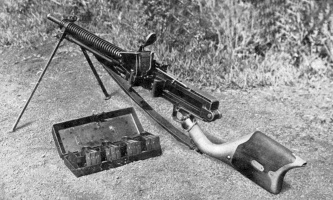
However, the weapon had problematic design issues that plagued its full potential. The barrel was not easily changeable, requiring essentially a full disassembly of the weapon's receiver before being able to detach the barrel.[2] This restricted the weapon's ability to perform sustained fire, with only cooling fins on the barrel to help with heat management. A number of features reduced the weapon's overall reliability. One was that the weapon had no primary extractor, which could cause issue with the extraction of spent ammo casings. In an attempt to solve this issue, a small oil injector was installed into the machine to lubricate the cartridge prior to being fed into the gun. However, the lubricant tended to attract dirt and dust, which could also cause stoppages and jams.[4] The open hopper could also allow dirt and dust to fall into the operating system, which further exacerbates the Type 11's reliability issue. Despite the idealized operation of utilizing the rifleman's stripper clips to feed the weapon, the 6.5 mm for the rifle was deemed too powerful for the machine gun, and a separate reduced load (marked with a letter "G" for "Gensou" — or "Reduced" in English — on the ammo cartons) had to be used to prevent cartridge case ruptures.[5][6]
The machine gun was produced at the Kokura and Nagoya Arsenal, as well as Tokyo Gas and Electric, Hitachi Manufacturing Company, and possibly the Hoten Arsenal in Manchuria. Up to 29,000 units of the machine guns were produced by these companies from 1922 to 1941.[6] The Type 11 saw service the 2nd Sino-Japanese war and in the Soviets-Japanese border conflicts of 1938-1939, the latter which saw an assortment of Japanese weapons falling into Soviet hands, who praised the hopper's logistical fitting with a rifleman's ammunition supply, but criticized the weapon's ergonomics for barrel changing and the complicated nature of the hopper feed and the reliability issues resulting from it. The weapon still made a favourable enough impression for the Soviets to attempt a version of the hopper feed in their own DP machine gun.[7] The Type 11, despite its issues and newer Japanese machine guns such as the Type 96 replacing it, would still be in the service when Japan joined the overall World War II conflict in 1941.
Type 91
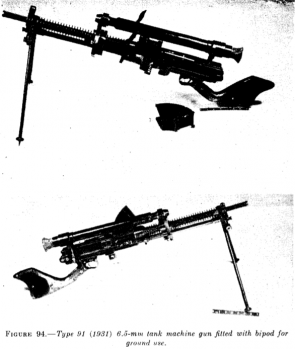
The Type 91 was a tank-mounted variant of the Type 11 that saw service in 1931.[8] The Type 91 designation is a product of the 1926 change in Japanese arms designation pattern, now coming from the Japanese empire's calendar (2591, or AD 1931) rather than the year of the emperor's reign.[3] The Type 91 is notable by its larger hopper design to fit ten clips at a time rather than the standard six for a total of 50 rounds[2] (though some source says the hopper can hold up to 60 rounds (12 clips))[9]. The weapon was typically mounted with a low magnification telescopic sight. A bipod was available for the tank crew or dismounted infantry to use the Type 91 when dismounted from the tank.
However, the weapons still suffer from issues that the infantry version has and so was later replaced by the Type 97 tank machine gun.[3]
Media
Excellent additions to the article would be video guides, screenshots from the game, and photos.
See also
Links to the articles on the War Thunder Wiki that you think will be useful for the reader, for example:
- reference to the article about the variant of the cannon/machine gun;
- references to approximate analogues by other nations and research trees.
External links
References
- Citations
- Bibliography
- McCollum, Ian. 2012. "Type 11 Nambu LMG." Forgotten Weapons. Last modified March 30, 2012. Website (Archive).
- Ness, Leland. 2014. Rikugun. Volume 2: Weapons of the Imperial Japanese Army & Navy Ground Forces. England: Helion and Company Limited. Kindle.
- Popenker, Maxim and Anthony G Williams. 2008. Machine Gun: The Development of the Machine Gun from the Nineteenth Century to the Present Day. Marlborough: The Crowood Press Ltd.
- Segel, Robert G. 2015. "Japanese Taisho Type 11 (Model 1922) Light Machine Gun (Juichinen Shiki Keikikanju)". Small Arms Defense Journal. Last modified January 16, 2015. Website (Archive).
- War Department. 1945. Special Series No. 34: Japanese Tanks and Antitank Warfare. Washington DC: United States Government Printing Office.
- Willbanks, James H. 2004. Machine Guns: An Illustrated History of Their Impact. Santa Barbara, CA: ABC-CLIO.
| Tank machine guns | |
|---|---|
| USA | |
| 7.62 mm | M37 · M60D · M73 · M240 · M1919A4 · Mk.52 |
| 12.7 mm | FN M3P · M2HB · M80 · M85 |
| Germany | |
| 5.56 mm | MG4 |
| 7.62 mm | C6 · MG3A1 |
| 7.92 mm | MG13 Dreyse · MG34 · MG37(t) · MG42 |
| 12.7 mm | S.MG.50 |
| USSR | |
| 7.62 mm | DT · PKMB · PKT · PKTM · RP-46 · SGMT |
| 12.7 mm | DK · DShK · 6P49 · NSVT |
| 14.5 mm | KPVT |
| Britain | |
| 7.62 mm | Browning MG4 · L3A1 · L8A1 · L8A2 · L37A1 · L37A2 · L94A1 |
| 7.7 mm | Vickers |
| 7.92 mm | BESA |
| 12.7 mm | L21A1 |
| Japan | |
| 6.5 mm | Type 91 |
| 7.62 mm | Type 74 |
| 7.7 mm | Type 97 |
| 12.7 mm | Type 60 (B) |
| China | |
| 5.8 mm | QJT |
| 7.62 mm | Type 55 · Type 59 · Type 86 |
| 12.7 mm | QJC88A · Type 54 |
| 14.5 mm | QJG02 |
| Italy | |
| 7.62 mm | Beretta MG42/59 · FN MAG 60-40 |
| 8 mm | 34/40M · Breda Mod. 38 |
| 13.2 mm | Breda Model 31 |
| France | |
| 7.5 mm | AAT-52 · MAC 31 |
| 7.62 mm | A-A-F1N |
| 8 mm | Hotchkiss Mle 1914 |
| Sweden | |
| 6.5 mm | ksp m/14-29 |
| 7.62 mm | ksp 39 C · ksp 58 · ksp 94 |
| 8 mm | ksp m/36 · ksp m/39B |
| 12.7 mm | ksp 88 |