Pvkv m/43 (1946)
OLD‑WIKI.WARTHUNDER.COM (DEFUNCT)
| This page is about the Swedish tank destroyer Pvkv m/43 (1946). For the other version, see Pvkv m/43 (1963). |
Description
The Pansarvärnskanonvagn m/43 (1946) was a tank destroyer developed during World War 2, drawing inspiration from German designs. It aimed to provide mobile anti-tank capability with protection, following the German model of using an anti-tank cannon in a casemate-structured tank hull. Its design, influenced by vehicles like the Marder III and StuG III, focused on supporting vehicles with lesser firepower and engaging heavily armoured targets at a distance. Initially planned with a shorter 7.5 cm L/28 gun, it was later equipped with a modified 7.5 cm Lvkan m/36 featuring a longer L/50 barrel for enhanced penetration. Despite being developed in 1942 and ordered for 1944, production delays meant the first deliveries didn't occur until 1946, with the last arriving in 1948. Until the introduction of the Centurion in 1953, the Pvkv m/43 (1946) remained the primary vehicle for neutralizing hostile tanks. In the 50s, plans were made for an upgrade of the Pvkv m/43 but only were put in effect in the 60s as the Pvkv m/43 (1963), extending its life until the 70s. After decommissioning, its cannons found further use in coastal artillery fortifications, defending Swedish coasts until 1995.
Introduced in Update 1.97 "Viking Fury", the Pvkv m/43 (1946) is a deceivingly well-armoured open-top tank destroyer, while it still poses a vulnerability to the crew, especially from overpressure and strafing aircraft. While the expected armour thickness of around 30 mm covers all sides except the front, the frontal protection is significantly stronger at 80 mm effective, capable of resisting most moderate penetrations. Coupled with the gun sight's high zoom and the gun's -15° depression, the tank excels as a long-range sniper.
General info
Survivability and armour
Survivability of this tank is bad for multiple reasons.
It's most likely that the Pvkv won't survive even one direct hit due to how the crew is allocated. Additionally, if the driver gets taken out, or even worse, an engine or transmission is damaged, the Pvkv m/43 (1946) can only shoot in a small area in front of the tank due to the turretless design.
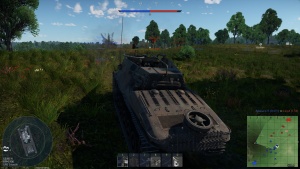
The frontal armour has a maximum effective thickness of around 80 mm of rolled homogeneous armour when fighting head-on, which won't save it from any shots at its BR. On the side, the SPG have 30 mm maximum protection, and on the rear 25 mm. Lower frontal plate armour is exactly the same as the Strv m/42 EH, since they both share the same hull. Because the vehicle is open topped, no matter what the user does it will always be very vulnerable to the aircraft and HE. Even 7 mm MGs can destroy it in one or two precise bursts.
To survive, the Pvkv m/43 (1946) must stay as far away from enemies as possible to reduce their shells' penetration power while also angling in both horizontal and vertical plane to increase its raw armour value. The easiest way to do that is to find a hill which still allows the gun to fire down, but angle the Pvkv as much as possible, then angle to the left as much as the gun allows the Pvkv to do so (since it can turn further to the right). At about 800 m range it becomes difficult for the light tanks to penetrate the frontal armour, at about 1,200 m range, when angled in both dimensions, armour will be able to sometimes deflect even German APHE (as long as it's not fired by a heavy SPG, which have incredibly high penetration).
In AB, an aggressive playstyle will put you at a disadvantage, it's a good idea to relocate between shots so that the enemy has problems aiming at the Pvkv. In RB, it's usually unnecessary as any enemy will have terrible zoom and will probably miss at least once before landing any kind of a hit.
| Armour | Front(Slope angle | Sides | Rear | Roof |
| Hull | 70(22-60°) mm Lower Plate
70(29°) mm Upper Plate 10-30(53-80°) Upper Glacis |
25(25-80°) mm Top
30 mm Bottom |
20(30°) mm | 5-9(80°) mm |
| Turret | 60-70(32-30°) Turret Front
70(0-72°) mm Gun shield |
25-30(11-25°) | 25(9°) mm | N/A |
Notes:
- Tracks,suspension bogies and wheels are 15 mm thick
Mobility
| Game Mode | Max Speed (km/h) | Weight (tons) | Engine power (horsepower) | Power-to-weight ratio (hp/ton) | |||
|---|---|---|---|---|---|---|---|
| Forward | Reverse | Stock | Upgraded | Stock | Upgraded | ||
| Arcade | Expression error: Unexpected * operator. | 582 | Expression error: Unexpected round operator. | __.__ | |||
| Realistic | 363 | Expression error: Unexpected round operator. | __.__ | ||||
The mobility of the Pvkv m/43 (1946) is nearly identical to the Strv m/42 EH. Driving forward, it can easily reach 40 km/h, even on rough terrain, so you will likely be one of the first vehicles at the cap. While shining when moving forward, the tank destroyer is slow in reverse, with a maximum speed of -5 km/h.
Modifications and economy
Armaments
Main armament
The main gun is the 75 mm pvkan m/43 cannon. While having excellent penetration and velocity, the reload is, considering the calibre and the open top, pretty long at 8.7 seconds with unskilled crew. In comparison, the German 75 mm guns only take about 6.5 seconds to reload.
The gun accuracy is pathetic until all accuracy modifications are researched, being reliable only up until ~600 m range until then.
The tank destroyer has no turret, it can only move the gun in about 33° arc in front of the tank, with 7 more degrees possible to the right. The gun depression of -15° is great, and the elevation of 20° is average.
The gunsight has an excellent magnification of 8x-16x, which is amazing. Most opponent will have around 1.5x-3x, making it well equipped for sniping.
| 75 mm pvkan m/43 | Turret rotation speed (°/s) | Reloading rate (seconds) | |||||||||||
|---|---|---|---|---|---|---|---|---|---|---|---|---|---|
| Mode | Capacity | Vertical | Horizontal | Stabilizer | Stock | Upgraded | Full | Expert | Aced | Stock | Full | Expert | Aced |
| Arcade | 43 | -15°/+20° | -13°/+20° | N/A | 7.0 | 9.8 | 11.8 | 13.1 | 13.9 | 8.71 | 7.70 | 7.10 | 6.70 |
| Realistic | 4.8 | 5.6 | 6.8 | 7.5 | 8.0 | ||||||||
Ammunition
The stock shell is the slpprj m/41 uncapped AP shot with decent penetration, but poor post-penetration values. Also, it tends to ricochet.
Once you unlock the slpgr m/43 APCBC shell, which is unfortunately a Tier IV modification, you have almost the best regular ammunition at the battle rating. The shell is similar to the one used by the Pvkv II, though it has slightly less penetration because of the lower muzzle velocity. Though its a bit slower, it still can penetrate any heavy tank within BR range on direct hit, and at point blank range it usually can penetrate tanks relying on angled armour (but not always). Also the shell does high post-penetration damage, because of the 110 g TNT filler.
The HE sgr m/38 is useful when dealing with open topped SPG at the rank, as they tend to sustain or bounce kinetic shots. Avoid using it on Sturer Emil or the likes of it without the element of surprise, as it has superior gun depression and will annihilate the Pvkv m/43 (1946) before it can even fire.
| Penetration statistics | |||||||
|---|---|---|---|---|---|---|---|
| Ammunition | Type of warhead |
Penetration @ 0° Angle of Attack (mm) | |||||
| 10 m | 100 m | 500 m | 1,000 m | 1,500 m | 2,000 m | ||
| slpprj m/41 | AP | 139 | 136 | 121 | 104 | 90 | 78 |
| sgr m/38 | HE | 18 | 17 | 16 | 14 | 13 | 12 |
| slpgr m/43 | APCBC | 149 | 146 | 132 | 116 | 102 | 89 |
| Shell details | ||||||||||||
|---|---|---|---|---|---|---|---|---|---|---|---|---|
| Ammunition | Type of warhead |
Velocity (m/s) |
Projectile mass (kg) |
Fuse delay (m) |
Fuse sensitivity (mm) |
Explosive mass (TNT equivalent) (g) |
Ricochet | |||||
| 0% | 50% | 100% | ||||||||||
| slpprj m/41 | AP | 815 | 6.63 | - | - | - | 47° | 60° | 65° | |||
| sgr m/38 | HE | 840 | 6.43 | 0.2 | 0.1 | 690 | 79° | 80° | 81° | |||
| slpgr m/43 | APCBC | 890 | 6 | 1.2 | 14 | 110 | 48° | 63° | 71° | |||
Ammo racks
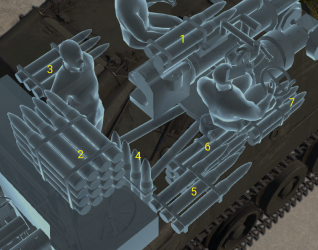
| Full ammo |
1st rack empty |
2nd rack empty |
3rd rack empty |
4th rack empty |
5th rack empty |
6th rack empty |
7th rack empty |
Visual discrepancy |
|---|---|---|---|---|---|---|---|---|
| 43 | 42 (+1) | 26 (+17) | 23 (+20) | 19 (+24) | 16 (+27) | 7 (+36) | 1 (+42) | No |
Machine guns
The Pvkv m/43 1946 has a 8 mm ksp m/36 machine gun mounted on a ring above the commander, where it can traverse 360°, and elevate 65°.
| 8 mm ksp m/36 | ||||
|---|---|---|---|---|
| Mount | Capacity (Belt) | Fire rate | Vertical | Horizontal |
| Pintle | 2,000 (250) | 648 | -20°/+65° | ±180° |
Usage in battles
The Pvkv m/43 (1946) is an excellent sniper due to its amazing gunsight zoom, great gun depression and deadly cannon. This tank destroyer unfortunately cannot perform as well when played as a regular tank, as it lacks the agility, gun traverse, and armour to flank or confidently take hits. Thus, to best utilise its sniper potential, the player must memorise various spots for sniping on different maps.
Good spots particularly for the Pvkv m/43 (1946) often have the following characteristics:
- The spot is at a good distance from the front line (around 800-1,200 m): obviously, the long range is to take full advantage of the superior gunsight zoom of 16x max. With this sight, the Pvkv m/43 (1946) is able to observe distant environment with unmatched clarity. The further it is from the target area, the harder it is for the enemies to effectively spot, aim and hit the player, while the player can still comfortably aim.
- The spot has a slope: hills or light inclines allow the Pvkv m/43 (1946) to perform hull-down when fighting. The Pvkv m/43 (1946) has -15° gun depression which is generally enough to depress the gun behind most hills. When hull-down, the tank destroyer presents a much smaller profile, increasing its concealment; it also significantly betters the frontal protection, as the frontal armour of angled 70 mm is now at a greater angle, allowing it to deflect more shells. When used in conjunction with range, the Pvkv m/43 (1946) will be able to resist certain cannons like the US 75 mm M3 and the Soviet's 76 mm F-34.
- The spot overlooks a crucial passageway: this is the key to success for not only the Pvkv m/43 (1946), but for all long-range snipers in general. Such spots that afford a view on popular passageways will most certainly guarantee target supplies and can even strategically cut off the opponents' supports, leading to a victory. If the player gets to battle position quickly, destroying passing enemies will prevent them from getting to good positions/cap points on time at the start of a match. In later stages of a match, a sniper at such position usually means that any enemies going to the frontline to support will most likely be destroyed before reaching their destination, allowing friendlies to push deeper and strengthen their defence. Of course, it is vital to practice gunnery -- the targets will usually be busy driving far away at full speed! Missing a shot due to poor lead can result in some allies being destroyed by the target you failed to destroy.
- The spot has vegetations and/or hard covers: plants can partially cover up the Pvkv m/43 (1946), delaying the time before enemies spot you in RB/SB. Hard covers give a safety shelter in case the player is being targeted. Vegetation can also sometimes prevent HE/HEAT from reaching the SPG, which is great, considering that the Pvkv m/43 (1946) is open-topped and would otherwise instantly explode.
There will often be situations where the player needs to either push forward with the team or to retreat under attack. This is when good map-reading skills come into play: the great spots you fought at earlier might become dangerous when the tide changes. For example, a corner at the friendly side can become quite menacing as a few enemy pushes to there. Therefore you must practice how to quickly find new spots at anywhere on the map, as well as to correctly identify which new area/passageway to ambush. The Pvkv m/43 (1946)'s mobility allows you to change position in time. Custom battles provide a great place to practice such skills.
As the match progresses, you might lose the opportunity to pick on targets far away and instead have to enter close quarter combat. Although the Pvkv m/43 (1946) is now more vulnerable, with the right ambush position you will still be able to fight. However, one aspect to note is that the high gunsight zoom can become a problem in a face-to-face standoff. Most players are likely to subconsciously enlarge the zoom after entering sniper mode, and due to the high zoom, you will only be able to see an extremely limited part of the target. It will be more awkward if the target is moving. Therefore you need to not always use 16x zoom to adapt CQC.
Enemies worth noting:
- R3 T20 FA-HS: this is a well known car, famous for its insane speed. It can appear at unexpected positions very early in the match and can be quite annoying to deal with. If an R3 charges at you from the front, your frontal armour can resist all its shells. Try your best to get your gun on target and finish it off before it can flank to your side. If, unfortunately, it gets to your flank, reverse and traverse the hull to aim your cannon to it while getting some separation. Note that the R3 is quite likely to get slowed down/stopped by obstacles like fences and trees due to its light weight, thus if you are at an urban/forest area the R3 may get stuck while circling, gifting you a few precious seconds to target it. In the worst case scenario, the R3 will tear through the Pvkv m/43 (1946)'s poor side/rear armour with its rapid firing autocannon and take out all your crew in an instant.
- KV-1E / ▀KV-IB: although the Pvkv m/43 (1946) carries a powerful cannon, there are still tougher nuts to crack, such as these two. They are uparmoured KV-1 models, featuring ~105 mm hull and turret armour on the front and parts of the sides. Armour of this thickness can be quite challenging to penetrate given that the Pvkv m/43 (1946) might usually be shooting over long distances. If the KV-1 is angling, hold your fire to avoid exposing your position. Only shoot if their armour is facing you without any angles, this is when you have the best chance to score successful penetrations. When shooting up close, try targeting the gun mantlet which is not covered by additional armour plates. Upon penetration, the KV-1 will often get crippled if not destroyed in one shot.
- Sturer Emil/Dicker Max (AB): These SPGs have better adaptability with terrain and generally it's impossible to attack them before they saw and attacked you. Their ammunition can breach even the strongest angled heavy tanks, let alone the pathetic armour of the Pvkv m/43 (1946). They also have a tendency to survive a single HE hit due to how they are constructed. Attack only if they look somewhere else, otherwise hide immediately and ask for an airstrike.
Pros and cons
Pros:
- Excellent gun for its BR once fully upgraded
- Very effective APCBC round with high velocity and adequate amount of explosive filler
- High magnification of x8.0-x16.1 - most tanks at the battle rating only have x1.5-x3.0
- Very good gun depression
- Machine gun can elevate to 90° and has a high ammo capacity of 2,000 rounds
- Trajectory of machine gun follows both APCBC and AP rounds trajectories close enough up to ~500 m
- Decent mobility
- Technically can survive SPG fire from 1.2 km if angled
Cons:
- Turretless design combined with poor reverse gear
- Low survivability and ineffective armour for head-on fights
- Machine gun performs poorly against lightly armoured vehicles and aircraft due to its low calibre
- Low versatility - the ultra high zoom can be annoying in close quarters and can make you vulnerable to flanking
- Long reload relative to its opponents
- Open top means enemy planes are able to strafe the vehicle and easily knock out the crew regardless of what you do
- Ridiculously bad stock experience due to the poor gun accuracy and poor stock shell, which tends to bounce off popular tanks even when it hits
History
During World War 2, the need for tank destroyers became evident, and Germany had great success with the StuG III and StuG IV. Because of the success of those platforms, Sweden decided to create a tank destroyer similar in concept to the StuG's. Landsverk created a design in 1942, based on the chassis of the Strv m/42. It was chosen by the Swedish military and was given the designation Pansarvärnskanonvagn m/43, or Pvkv m/43 for short.
The Pvkv m/43 used the chassis of the Strv m/42, but with a casemate superstructure replacing the turret. The superstructure was located at the front of the vehicle, and the glacis was sloped. It had an open tarp to keep the weight down, and used a tarp to protect the crew from the elements. The Pvkv m/43 had a crew of 4, and was initially armed with a 75 mm luftvärnskanonen m/36 antiaircraft gun, modified with a longer barrel for increased armour penetration. The gun could traverse 15 degrees to the left and right. It had a Ksp m/39 machine gun as the secondary armament. It was powered by a Volvo A8B engine producing 360 hp. The gearbox was different than the gearbox of the Strv m/42, and the drive wheels had to be reinforced to handle the increased weight of the vehicle. The Swedish military ordered 87 Pvkv m/43 in 1942, but deliveries were delayed and the last vehicle was delivered in 1948.
In 1954, the vehicle was given an armoured roof to better protect the crew. Other improvements included a muzzle brake, a gun rest, and a gas ejector. The Strv m/41 was retired from service in 1957, which allowed the two Scania-Vabis L603 engines per vehicle to be used in the Pvkv m/43. The two L603 engines produced less horsepower (320 hp) than the Volvo A8B, but were much more reliable. In 1970, the Pvkv m/43 was retired from service, and the guns were used in static fortifications until 1995.
Media
- Skins
See also
Links to the articles on the War Thunder Wiki that you think will be useful for the reader, for example:
- reference to the series of the vehicles;
- links to approximate analogues of other nations and research trees.
External links
References
- Bibliography
- Pansarvärnskanonvagn m/43. (2020, April 6). In Wikipedia. https://en.wikipedia.org/w/index.php?title=Pansarv%C3%A4rnskanonvagn_m/43&oldid=949440407
| AB Landsverk | |
|---|---|
| Light Tanks | |
| L-10 | Strv m/31 |
| L-60 | Strv m/38 · Strv m/39 · Strv m/40L |
| Pbil m/40 | Pbil m/40 |
| Strv 74 | Strv 74 |
| Unimog 404 | U-SH 405 |
| Medium Tanks | |
| Lago | Lago I · Strv m/42 EH · Ikv 73 · Strv m/42 DT |
| Tank Destroyers | |
| Ikv 72 | Ikv 72 · Ikv 103 |
| Pvkv m/43 | Pvkv m/43 (1946) · Pvkv m/43 (1963) |
| Pvkv II/III | Pvkv II · Pvkv III |
| SPAA | Pvlvv fm/42 · L-62 ANTI II |
| Sweden tank destroyers | |
|---|---|
| Strv m/41 derivatives | Spj fm/43-44 · Sav m/43 (1944) · Sav m/43 (1946) · Pvkv II · Pvkv III |
| Ikv 72/103 | Ikv 72 · Ikv 103 |
| Pvkv m/43 | Pvkv m/43 (1946) · Pvkv m/43 (1963) |
| ATGM | UDES 33 · Pbv 302 (BILL) · Pvrbv 551 |
| Other | SAV 20.12.48 · Bkan 1C |
| Norway | VIDAR |