Pe-3 (e)
OLD‑WIKI.WARTHUNDER.COM (DEFUNCT)
| This page is about the Soviet strike aircraft Pe-3 (e). For other variants, see Pe-3 (Family). |
Description
The Pe-3 Early is a rank Soviet strike aircraft with a battle rating of (AB), (RB), and (SB). It has been in the game since the start of the Open Beta Test prior to Update 1.27.
General info
Flight performance
As with all Pe-2s and Pe-3s, the roll rate is great, but turn time leaves much to be desired. It is quite fast, and can outrun most fighters if downtiered.
| Characteristics | Max Speed (km/h at 5,100 m) |
Max altitude (metres) |
Turn time (seconds) |
Rate of climb (metres/second) |
Take-off run (metres) | |||
|---|---|---|---|---|---|---|---|---|
| AB | RB | AB | RB | AB | RB | |||
| Stock | 517 | 502 | 27.4 | 28.7 | 7.5 | 7.4 | 326 | |
| Upgraded | 555 | 535 | 24.6 | 26.0 | 13.0 | 10.0 | ||
Details
| Features | ||||
|---|---|---|---|---|
| Combat flaps | Take-off flaps | Landing flaps | Air brakes | Arrestor gear |
| ✓ | ✓ | ✓ | X | X |
| Limits | ||||||
|---|---|---|---|---|---|---|
| Wings (km/h) | Gear (km/h) | Flaps (km/h) | Max Static G | |||
| Combat | Take-off | Landing | + | - | ||
| 500 | 470 | 320 | ~10 | ~5 | ||
| Optimal velocities (km/h) | |||
|---|---|---|---|
| Ailerons | Rudder | Elevators | Radiator |
| < 380 | < 380 | < 440 | > 307 |
Survivability and armour
- 4 mm steel behind the pilot's butt
- 6 mm steel beside and below gunner
- 12 mm steel in front of gunner*
- 13 mm steel below and behind pilot
- 45 mm bulletproof glass in front of pilot
- Self-sealing fuel tanks, with neutral gas pressurization system (3 in central fuselage, 4 in each wing)
*Note, the gunner is rear-facing
Modifications and economy
Armaments
Offensive armament
The Pe-3 (e) is armed with:
- 2 x 12.7 mm Berezin UB machine guns, nose-mounted (150 rpg = 300 total)
- 1 x 7.62 mm ShKAS machine gun, nose-mounted (450 rpg)
Suspended armament
The Pe-3 (e) can be outfitted with the following ordnance:
| 1 | 2 | 3 | 4 | 5 | 6 | 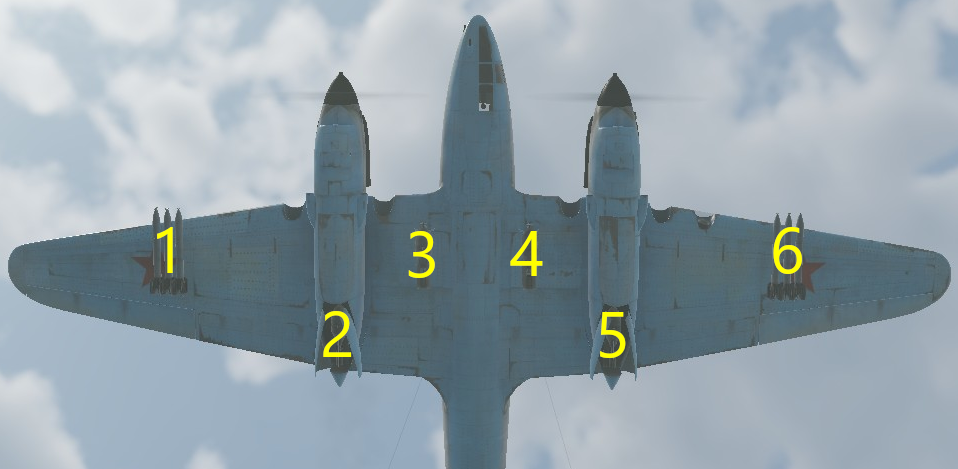 | |
|---|---|---|---|---|---|---|---|
| 100 kg FAB-100sv bombs | 1 | 1 | 1 | 1 | |||
| 250 kg FAB-250sv bombs | 1 | 1 | |||||
| M-13UK rockets | 3 | 3 | |||||
| RBS-132 rockets | 3 | 3 | |||||
| Maximum permissible loadout weight: 720 kg Maximum permissible wing load: 360 kg Maximum permissible weight imbalance: 280 kg | |||||||
| Default weapon presets | |
|---|---|
| |
Defensive armament
The Pe-3 (e) is defended by:
- 1 x 7.62 mm ShKAS machine gun, dorsal turret (750 rpg)
- 1 x 7.62 mm ShKAS machine gun, tail turret (250 rpg)
Usage in battles
The Pe-3 (e) can be used for a variety of roles, depending on what you are comfortable with. In Air RB, the aircraft can be used as a high-speed base bomber, or bomber interceptor. For base bombing, you can choose the heaviest payload (2 x 250 kg and 2 x 100 kg), and, once spawned in, go into a shallow dive towards the base you are going for. Once over the base, drop your payload and break away. Remember to set your bomb fuse to at least 2 seconds, or else you will blow yourself to bits. However, the Pe-3 (e) can also be used as a bomber interceptor, although this may be harder. While the Berezins and the ShKAS both have a high rate of fire, there is limited ammo, and you might not be able to down the bomber before your ammo runs out. Instead, rockets could be a much better choice. You can load 6 x RS-132 rockets, or 6 x RBS-132s. For bomber-hunting, the RS-132 will be better-suited, as it has more explosive filler (4.9 kg vs 1.5 kg). While it is harder to hit moving targets in the air with rockets, with practice, you will be able to down any bomber in your sights. Setting a rocket activation fuse can also help (recommended at leat 500m), as it will guarantee the detonation of the rocket even with a near miss, improving your chances of hitting your target.
The Pe-3 (e) can also be used as an attack aircraft in Ground battles. The RBS-132 rocket can penetrate 85 mm of armour, which is enough to penetrate all tanks at this BR form the sides or back. Or, you can load bombs, and dive onto your targets.
Manual Engine Control
| MEC elements | ||||||
|---|---|---|---|---|---|---|
| Mixer | Pitch | Radiator | Supercharger | Turbocharger | ||
| Oil | Water | Type | ||||
| Controllable | Controllable Not auto controlled |
Not controllable Not auto controlled |
Controllable Auto control available |
Separate | Controllable 2 gears |
Not controllable |
Pros and cons
Pros:
- High speed
- Great roll rate
- Quite manoeuvrable
- Can carry bombs and rockets ( including powerful anti-tank RBS-132 rockets that can penetrate 85 mm of armour!)
- Defensive ShKAS has a high rate of fire, and the Universal belt contains only incendiary tracers; can set any enemy on fire with careful aim
Cons:
- Low ammo count
- One 7.62 mm MG is rather ineffective against better-armoured fighters
- Turn time can't compete with anything
- Fuel tanks are scattered all over the wings and fuselage, allowing them to be easily hit by any attacking fighter
History
| Archive of the in-game description | |
|---|---|
|
Petlyakov Pe-3 Heavy Twin-Engine Fighter. When the Great Patriotic War began in the summer of 1941, the Air Force of the Workers' and Peasants' Red Army urgently needed a patrol/interceptor aircraft to fight the enemy's bombers and scouts. But with a war in progress, troops could only quickly receive a twin-engined fighter if it were based on some plane currently in production. The older Pe-2's fighter design fit this need perfectly. In August 1941, the Petlyakov Design Bureau was instructed to design a fighter version of the Pe-2. The first prototype Pe-3 fighter, redesigned from the production Pe-2 bomber, series 16, flew for the first time on August 7, 1941. Only seven days passed between the order for the aircraft and its delivery for trials. Structurally, the Pe-3 fighter differed from the Pe-2 in the layout of its forward and middle fuselage and its armament. Additional fuel tanks were put in the plane's fuselage, with one located in the bomb bay and two others replacing the gunner's cockpit. The plane was modified to be a two-seater. The fighter had increased offensive armament. The nose weapon mount of the prototype Pe-3 model consisted of two 12.7 mm Berezin BK machine guns with 150 rounds each and one 7.62 mm ShKAS machine gun with 450 rounds. The TSS-1 upper mount in the navigator's cockpit consisting of a 7.62 mm ShKAS machine gun with 750 rounds was kept unchanged from the Pe-2. Since there was no one to provide fire from the lower rear of the aircraft, a fixed tail mount with a 7.62 mm ShKAS machine gun with 250 rounds, which had been tested before on the VI-100 high-altitude fighter, was installed. The plane's bombing armament was drastically simplified. Only four bomb racks remained from the Pe-2: two in the engine nacelle bomb bays and two (external) under the fuselage. The total bomb capacity was reduced to 400 kg for standard load and 700 kg (two 250-kg bombs and two 100-kg bombs) when overloaded. The brake covers under the wings were removed together with the gears, and, as a result, the ability to perform dive bombing was gone. Production Pe-3s had the ShKAS nose machine gun removed, but the magazine capacity of the BK machine guns was increased up to 250 rounds each. During armament testing of the nose mount, it was found that the Plexiglas fuselage nose section could not withstand the muzzle gas pressure, resulting in its destruction. Plexiglas was first replaced with duralumin and then with steel. The aircraft glazing was reduced when large observation blisters and the upper glass hatch of the gunner's cockpit were removed. The heavy fighters were delivered from the factory to the front lines with equipment corresponding to the main production Pe-3 aircraft. The total number of Pe-3s built in 1941 was 196; 11 more planes were assembled from available stocks of parts in April 1942. | |
Media
- Skins
- Videos
See also
Links to the articles on the War Thunder Wiki that you think will be useful for the reader, for example:
- reference to the series of the aircraft;
- links to approximate analogues of other nations and research trees.
External links
Paste links to sources and external resources, such as:
- topic on the official game forum;
- other literature.
| V.M. Petlyakov Design Bureau (Опытное конструкторское бюро Петлякова) | |
|---|---|
| Fighters | Pe-3 (e) · Pe-3 · Pe-3bis |
| Bombers | Pe-2-1 · Pe-2-31 · Pe-2-83 · Pe-2-110 · Pe-2-205 · Pe-2-359 · Pe-8 |
| USSR strike aircraft | |
|---|---|
| IL-2 | IL-2 (1941) · IL-2 (1942) · IL-2M (1943) · IL-2M type 3 · IL-2M "Avenger" · IL-2-37 · IL-2 M-82 |
| IL-8 | IL-8 (1944) |
| IL-10 | IL-10 · IL-10 (1946) |
| Pe-3 | Pe-3 (e) · Pe-3 · Pe-3bis |
| Su-2 | BB-1 · Su-2 MV-5 · Su-2 TSS-1 · Su-2 (M-82) |
| Su-6 | Su-6 · Su-6 (AM-42) · Su-6 (M-71F) |
| Su-8 | Su-8 |
| Tandem MAI | Tandem MAI |
| TIS MA | TIS MA |
| Tu-1 | Tu-1 |
| Yak-2 | Yak-2 KABB |