PC1600 (1,600 kg)
Suspended armaments
OLD‑WIKI.WARTHUNDER.COM (DEFUNCT)
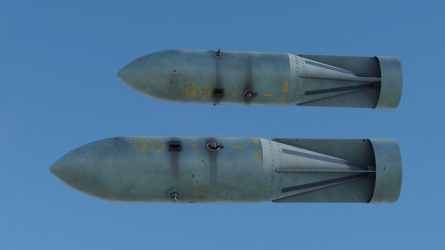
Description
Write an introduction to the article in 2-3 small paragraphs. Briefly tell us about the history of the development and combat using the weaponry and also about its features. Compile a list of air, ground, or naval vehicles that feature this weapon system in the game.
Vehicles equipped with this weapon
General info
| Bomb characteristics | |
|---|---|
| Mass | 1,600 kg |
| Explosive mass | 230.4 kg |
| Explosive type | RDX/PWX |
| TNT equivalent | 294.91 kg |
| HE max penetration | 96 mm |
| Armour destruction radius | 12 m |
| Fragment dispersion radius | 100 m |
Effective damage
Describe the type of damage produced by this type of bomb (high explosive, splash damage, etc)
Comparison with analogues
There are very, very few heavy armour-piercing bombs available, making it difficult to make a fair comparison, as most nations lack any bombs that could be thought of as an analogue. Still, among those few peers that exist, the PC1600 has an excellent explosive filler and penetration characteristics.
| Bomb | Mass (kg) |
TNT equivalent (kg) |
Penetration @ 30° @ 100 m (mm) |
Penetration @ 0° @ 2000 m (mm) | |
|---|---|---|---|---|---|

|
PC1600 (1,600 kg) | 1600 | 294.91 | 96 | 120 |

|
A.P. Mk.I (2,000 lb) | 877.2 | 70.78 | 75 | 126 |

|
Navy Type 3 Number 150 AP (1,500 kg) | 1498.6 | 94.3 | 78 | 121 |
Usage in battles
The PC1600 is a very specialised bomb, useful primarily against naval vessels, in particular the hull of the battleships and heavy cruisers, if dropped from a high altitude, level flight. Note, though, that in order to penetrate the top of the turrets of most of the battleships, the bomb needs to be dropped from over 3,500 m.
Against ground targets, it's basically an overweight equivalent of SC500 - still enough to kill every ground vehicle from a direct hit, but with the mass of 1.6 ton it makes your airplane a slower, less manoeuvrable target.
Pros and cons
Pros:
- Large explosive filler for armour-piercing bomb
- Excellent penetration
Cons:
- Very limited use against targets in the Ground Battles
History
Examine the history of the creation and combat usage of the weapon in more detail than in the introduction. If the historical reference turns out to be too long, take it to a separate article, taking a link to the article about the weapon and adding a block "/History" (example: https://wiki.warthunder.com/(Weapon-name)/History) and add a link to it here using the main template. Be sure to reference text and sources by using <ref></ref>, as well as adding them at the end of the article with <references />.
Media
Excellent additions to the article would be video guides, screenshots from the game, and photos.
See also
External links
| Armour-piercing bombs | |
|---|---|
| USA | |
| 1,000 lb | A.P. AN-MK 33 |
| 1,600 lb | AN-Mk 1 |
| Germany | |
| 10 kg | SD10C |
| 50 kg | SD50 |
| 70 kg | SD70 |
| 500 kg | PC500 |
| 1,000 kg | PC1000 |
| 1,045 kg | HS 293 A-1* |
| 1,400 kg | PC 1400 X* |
| 1,600 kg | PC1600 |
| USSR | |
| 220 kg | BRAB-220 (1930) |
| 250 kg | BRAB-250 |
| 500 kg | BRAB-500 (1938) · BRAB-500 |
| 1,000 kg | BRAB-1000 (1938) · BRAB-1000 |
| Britain | |
| 500 lb | S.A.P. Mk.II |
| 2,000 lb | A.P. Mk.I |
| Japan | |
| 500 kg | Number Type 2 50 Model 1 GP(SAP) |
| 800 kg | Navy Type 99 Number 80 AP |
| 1,500 kg | Navy Type 3 Number 150 AP |
| Italy | |
| 160 kg | A.P 160 |
| 630 kg | 630 P.D. |
| * Guided bomb | |
| See also | List of high-explosive, unguided, free-falling bombs · List of guided bombs · List of retarded bombs |