MiG-29G (Germany)
OLD‑WIKI.WARTHUNDER.COM (DEFUNCT)
| This page is about the jet fighter MiG-29G (Germany). For other versions, see MiG-29 (Family). |
Description
After the re-unification of Germany, the Luftwaffe liquidated or scrapped almost all of the Soviet-made NVA aircraft they had inherited. The notable exception were the MiG-29s, which not only were a valuable asset for NATO in dissimilar combat training, but as testing shortly afterwards showed, were superior to most fighters in service with NATO at the time. As such, it was decided to keep the MiG-29s in Luftwaffe service, and to extend their life by replacing parts and upgrading avionics to meet NATO standards and certifications. The resulting project was the MiG-29G. To integrate these aircraft into NATO operations, The MiG-29G had been upgraded with NATO-compatible communication and navigation systems, making it fully interoperable with NATO forces. The MiG-29G was also equipped with Western avionics. The aircraft was designed to operate in a multi-role capacity, capable of both air-to-air and air-to-ground missions. This German MiG-29 variant, with its blend of Eastern airframe prowess and Western technology, represented a unique fusion of capabilities that set it apart from its older Soviet counterparts and made it a valuable asset for NATO.
The ◄MiG-29 (9-12G), introduced in Update "Kings of Battle", is a major step in advancement from its counterparts in War Thunder. The main upgrade in this variant is the availability of the R-27ET1 and R-73E missiles which its older predecessor, the MiG-29 (9.12) lacked. The true advantage in this model lies in its airframe type; while the older East German MiG-29 and its Soviet counterpart, the MiG-29 (9.13) lack the advanced R-73 and R-27ET missiles in-game, the MiG-29G acts as a "next generation" equivalent (and direct sidegrade) to the Russian MiG-29SMT. While the MiG-29G lacks the upgraded ground ordnance, increased countermeasure count, expanded fuel capacity, and new radar system of the MiG-29SMT, it also lacks the main drawback of the SMT: the massive increase in weight turning the SMT into a "missile bus" compared to previous MiG-29s. The MiG-29G as such is essentially just the older 9.12 that players are already familiar with, but now with new and upgraded missiles to enhance its lethality in aerial combat.
General info
Flight performance
The MiG-29G is, like its predecessor, very manoeuvrable and fast, making it a lethal fighter to come across.
| Characteristics | Max speed (km/h at 14,000 m) |
Max altitude (metres) |
Turn time (seconds) |
Rate of climb (metres/second) |
Take-off run (metres) | |||
|---|---|---|---|---|---|---|---|---|
| AB | RB | AB | RB | AB | RB | |||
| Stock | 2,358 | 2,306 | 20.2 | 20.5 | 270.1 | 256.9 | 750 | |
| Upgraded | ___ | ___ | __._ | __._ | __._ | __._ | ||
Details
| Features | |||||
|---|---|---|---|---|---|
| Combat flaps | Take-off flaps | Landing flaps | Air brakes | Arrestor gear | Drogue chute |
| X | ✓ | ✓ | ✓ | X | ✓ |
| Limits | ||||||
|---|---|---|---|---|---|---|
| Wings (km/h) | Gear (km/h) | Flaps (km/h) | Max Static G | |||
| Combat | Take-off | Landing | + | - | ||
| ___ | ___ | ___ | ~__ | ~__ | ||
| Optimal velocities (km/h) | |||
|---|---|---|---|
| Ailerons | Rudder | Elevators | Radiator |
| < ___ | < ___ | < ___ | - |
Engine performance
| Engine | Aircraft mass | |||||
|---|---|---|---|---|---|---|
| Engine name | Number | Basic mass | Wing loading (full fuel) | |||
| Klimov RD-33 series 2 | 2 | _,___ kg | ___ kg/m2 | |||
| Engine characteristics | Mass with fuel (no weapons load) | Max Gross Weight | ||||
| Weight (each) | Type | _m fuel | __m fuel | __m fuel | ||
| 1,050 kg | Jet | _,___ kg | _,___ kg | _,___ kg | _,___ kg | |
| Maximum engine thrust @ 0 m (RB/SB) | Thrust to weight ratio @ 0 m (___%/WEP) | |||||
| Condition | 100% | ___%/WEP | _m fuel | __m fuel | __m fuel | MGW |
| Stationary | ___ kgf | ___ kgf | _.__ | _.__ | _.__ | _.__ |
| Optimal | ___ kgf (_ km/h) |
___ kgf (_ km/h) |
_.__ | _.__ | _.__ | _.__ |
Survivability and armour
The MiG-29G has no armour whatsoever thus making it very vulnerable to enemy shots, especially from the front. Due to this, head-ons should be avoided at all times since the pilot is not protected.
Modifications and economy
Armaments
| Ballistic Computer | ||||
|---|---|---|---|---|
| CCIP (Guns) | CCIP (Rockets) | CCIP (Bombs) | CCRP (Bombs) | EEGS |
 |
|
|
|
|
Offensive armament
The MiG-29G (Germany) is armed with:
- 1 x 30 mm GSh-30-1 cannon, cheek-mounted (150 rpg)
- 60 x countermeasures
Suspended armament
The MiG-29G (Germany) can be outfitted with the following ordnance:
| 1 | 2 | 3 | 4 | 5 | 6 | 7 | 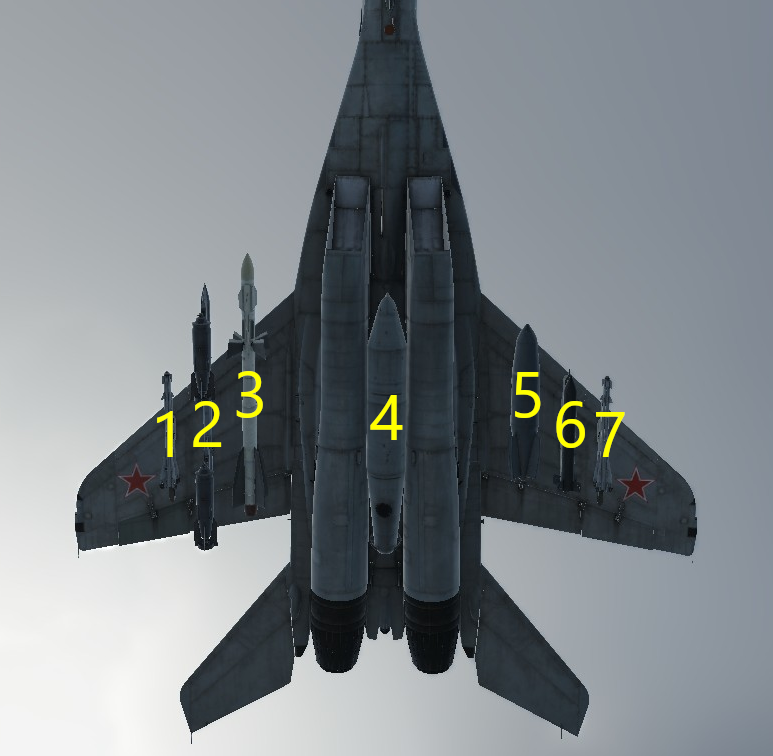 | |
|---|---|---|---|---|---|---|---|---|
| 100 kg OFAB-100 bombs | 4 | 4 | 4 | 4 | ||||
| 250 kg FAB-250M-54 bombs | 1, 2 | 1, 2 | 1, 2 | 1, 2 | ||||
| 250 kg FAB-250M-62 bombs | 1, 2 | 1, 2 | 1, 2 | 1, 2 | ||||
| 250 kg OFAB-250Sh bombs | 1, 2 | 1, 2 | 1, 2 | 1, 2 | ||||
| 500 kg FAB-500M-54 bombs | 1 | 1, 2 | 1, 2 | 1 | ||||
| 500 kg FAB-500M-62 bombs | 1 | 1, 2 | 1, 2 | 1 | ||||
| 500 kg FAB-500Sh bombs | 1 | 1, 2 | 1, 2 | 1 | ||||
| ZB-500 incendiary bombs | 1 | 1 | 1 | 1 | ||||
| S-8KO rockets | 20 | 20 | 20 | 20 | ||||
| S-24B rockets | 1 | 1 | 1 | 1 | ||||
| R-27R1 missiles | 1 | 1 | ||||||
| R-27T1 missiles | 1 | 1 | ||||||
| R-27ER1 missiles | 1 | 1 | ||||||
| R-27ET1 missiles | 1 | 1 | ||||||
| R-73E missiles | 1 | 1 | 1 | 1 | 1 | 1 | ||
| 1,520 l drop tanks | 1 | |||||||
| Maximum permissible loadout weight: 3,090 kg Maximum permissible wing load: 1,545 kg Maximum permissible weight imbalance: 1,200 kg | ||||||||
| Default weapon presets | |
|---|---|
| |
Usage in battles
The MiG-29G is a very efficient air superiority plane. It is based on the MiG-29A variants.The main difference between it and the early A variants is the addition of the R-73E and R-27ET missiles. The export R-73E is just an export of the R-73 with a few extra degrees of off-bore, and the R-27ET is the longer range variant of the R-27T, similar to how the R-27ER is to the R-27R. It is a direct upgrade, comprised of the best of all worlds.
In Air Realistic Battles, the MiG-29G has multiple possible playstyles, which it can easily fit into due to its overall versatility. It is not the best in Ground RB due to its non existent guided munitions. However it can be used as a superiority fighter in GRB, where the Stealth and Close range playstyles that are described below would work best, due to the nature of GRB where there are no markers.
- Long Range BVR - This play style uses the famous R-27ER missile, capable of hitting enemies at up to 40 km, and 30-35 km reliably in Air RB matches. This play style can also work identically on MiG-29A's due to their similar weight, thrust, radar and armament. If you want to play like this, you need to climb as much as you can during a match, and use your radar to find enemies high up and then fire the R-27ER upwards so it gains more speed. The MiG-29SMT would technically be better at this due to its radar, which can look directly left and right, meaning you can notch while guiding missiles, but the additional weight of the SMT makes it arguably worse, since it can't climb as high and as fast as the MiG-29A or G, limiting the range and speed of the R-27ER, or how early you can fire them. In general, this play style is quite hard to nail down because, for example, an enemy F-14B has powerful engines and can launch AIM-54s before you can even see him on the MiG-29's radar, not to mention they can also guide onto you without the F-14 locking you. After you have fired your R-27ER slightly upwards, you should start pulling to one side so the enemy missiles start turning and after around 5-10 seconds, you should pull the complete other direction, to further bleed the energy of enemy missiles coming at you. You need to do this while ensuring that the enemy remains locked. If you lose lock, it will be hard to re-acquire lock due to the slightly primitive nature of the MiG-29G's radar. After you hit the target or miss it, you should change direction again, and then continuing your match however you wish.
- Close quarters - This playstyle is quite simple. It means taking 6 x R-73E missiles, going straight into the furball and shooting missiles at enemies. There is not much theory or many tips about this one. You should always try to lead the R-73E's even though they have thrust vectoring. You should always fire them from the sides or rear aspects only to maximize your chance of scoring a hit. Front Aspect can work at extreme close range, but in general above 500 m, one flare in front aspect is too much for the R-73E's IRCCM. It works best at below 1 km in side aspect and 1.5 km in rear aspect, where the missiles become nearly unflareable. You should always check your surroundings and keep good situational awareness to survive in the furball. The amazing manoeuvrability of the MiG-29G also makes using guns on target quite easy. You should always try to use your gun wherever you can rather than missiles at extreme close ranges. The R-73's will have a very hard time hitting below 500 m at low speed during manoeuvring.
- Another variation of the Close quarters play style - Taking 2 x R-27ER missiles, and 4 x R-73E missiles. You still don't need to have the radar on alerting enemies of your existence, but you should keep it on the "HMD" setting, letting you lock players without using "SRC". Firing the R-27ER missiles at targets coming at you, which are not hugging the ground are generally free targets. Just remember you should fire the R-27ER between 4.5 km and 8 km so the enemy has no chance to escape. If used correctly this can grant you 2 targets destroyed.
- Stealth - This is more of a "fun" play style, which increases the difficulty of destroying the enemies. It involves using 2 x R-27ET, along with the standard 4 x R-73E missiles. In this play style you should only use the IRST of the MiG-29. Searching and Locking enemies with the IRST does not alert them, therefore you can find and sneak up on players who are flanking or are not paying attention. This "play style" involves flanking while using the IRST to find enemies before they find you on their flanks. Staying low ensures you won't be targeted by the enemies trying to do BVR (they can see you, but you are just not a good target). If they fire at you, staying low also ensures the proximity fuse of the enemy missile won't detonate due to being too close to the ground). Due to how spotting works in this game, enemies can see you at around 6.84 km for a level 75 expert pilot. Your IRST can see enemies in front aspect at a maximum range between 5 km and 12 km. 5 km for a non-afterburning target with low engine temperature, and about 12 for very hot targets, and up to 35 km in rear-aspect if their hot engines are in afterburners. After flanking the furball, you can climb to around 6 km, and start firing R-27ET's from above enemies that are not fighting. This ensures they are unlikely to look directly up at you, unlikely to drop flares (the IRCCM of the R-27ET is good, but is useless at long range due to the FOV nature if it). The missile is also unlikely to lock onto a friendly players that passes to close as well. Keep in mind the R-27ET has the same flight performance of the R-27ER, its range is limited by the seeker. This play style is generally for when you are bored of firing easy missiles and want a bit of a switch, requiring a more interesting approach. This is not efficient or recommended if you want to spade the plane, or want to get as much RP as possible.
The MiG-29G remains one very efficient and scary plane to face. It has a good arsenal of reliable weapons, along with good flight performance, an HMD, and IRST. It is a very fun plane to fly and a real apex predator that can fill most if not all air superiority roles.
*The MiG-29G is the only MiG-29 in game that has the English voice "Betty". There are situations where Betty can tell you of an approaching enemy, missile, or is telling you useful things, which can help you in battle, so it might be a good idea to keep the RWR voice enabled.
Pros and cons
Pros:
- Retains the flight model of the MiG-29 9.12A, which gives it the best MiG-29 airframe for flight performance
- Quick acceleration and high top speed thanks to the high Thrust to Weight ratio provided by the RD-33 engines and light airframe
- Effective sensor suite with potent radar and IRST coupled with HMD slaving
- Satisfactory amount of radar modes that allow the MiG-29G to track targets effectively at most closure rates and ranges
- HMD system which allows the MiG-29G to make high off-bore missile launches and utilise its radar/IRST suite at close range with ease
- Effective missile loadout with potent long range and short range options in the form of the R-27 and R-73E
Cons:
- IR missiles don't have any difficulty tracking the MiG-29G as the RD-33 engines burn very hot
- High fuel consumption due to the RD-33 Series 2 engines, as much as the fuel efficiency is slightly improved over the regular RD-33 it is still poor at full afterburner
- High energy bleed while turning and inability sustain a rate fight with other airframes at its BR like the F-16A, F-16C and even F-14B
- Only 60 countermeasures, which can be too restricting for top-tier battles
- The SPO-15 RWR found on the MiG-29G is very primitive and notably lacks sectors in the rear hemisphere. Additionally, the RWR does not display threat types and cannot detect J band radars. This leaves the MiG-29G particularly vulnerable to enemy MiG-23 aircraft as the RWR cannot detect any radar missile launches from them
History
The Mikoyan MiG-29G, a variant of the famed MiG-29 fighter jet, has a rich history marked by its development, deployment, and combat use, reflecting the evolving landscape of military aviation and geopolitical dynamics.
The MiG-29, developed by the Soviet Union's Mikoyan Design Bureau in the 1970s, was a direct response to the American F-15 and F-16 fighters. It was designed to be a highly manoeuvrable air superiority fighter, boasting advanced avionics and weapons systems for its time. With a twin-engine setup and a distinctive leading-edge root extension (LERX), the MiG-29 quickly became known for its agility and speed.
The MiG-29G variant emerged in a unique context. After the reunification of Germany in 1990, the Luftwaffe inherited several MiG-29s from the East German Air Force. These aircraft, which were originally the MiG-29A variant, underwent substantial modifications to meet NATO standards, resulting in the designation MiG-29G. This transition symbolized a significant moment in military aviation history, as it marked the integration of a quintessentially Soviet fighter jet into a Western military alliance.
The modifications included upgrading avionics, communication systems, and the integration of NATO-compatible Identification Friend or Foe (IFF) systems. These changes not only enhanced the aircraft's operational capabilities but also facilitated interoperability with NATO forces, a crucial aspect during joint exercises and missions.
In terms of combat usage, the MiG-29G's legacy is less about direct engagement in warfare and more about its role in fostering post-Cold War military collaboration. The aircraft participated in numerous NATO exercises, serving as a valuable tool for Western pilots to train against a platform that was once an adversary's frontline fighter. These exercises provided NATO pilots with a rare opportunity to understand the capabilities and limitations of Soviet-era aircraft, contributing immensely to tactical knowledge and combat preparedness.
Moreover, the MiG-29G played a significant role in diplomatic and defense relations, symbolizing a bridge between former rivals. The jet's presence in NATO air forces represented a tangible outcome of the political thaw following the Cold War, showcasing how erstwhile adversaries could collaborate in a new world order.
In conclusion, the story of the MiG-29G is not just about a fighter jet's technical evolution; it's a narrative that intertwines with the broader historical context of the late 20th century. It reflects the transition from Cold War tensions to an era of cooperation and mutual understanding, illustrating how military technology can transcend its original intent and become a symbol of changing times.
Media
- Skins
See also
- Related development
External links
Paste links to sources and external resources, such as:
- topic on the official game forum;
- other literature.
| Mikoyan-Gurevich Design Bureau (Микоя́н и Гуре́вич Опытное конструкторское бюро) | |
|---|---|
| Fighters | MiG-3-15 · MiG-3-15 (BK) · MiG-3-34 |
| I-225 | |
| Jet fighters | MiG-9 · MiG-9 (l) |
| MiG-15 · MiG-15bis · MiG-15bis ISh | |
| MiG-17 | |
| MiG-19PT | |
| MiG-21F-13 · MiG-21PFM · MiG-21S (R-13-300) · MiG-21SMT · MiG-21bis | |
| MiG-23M · MiG-23ML · MiG-23MLD | |
| MiG-27M · MiG-27K | |
| MiG-29 · MiG-29SMT | |
| Export/Licensed | ␗MiG-9 · ␗MiG-9 (l) |
| ◊MiG-15bis · ◔MiG-15bis · J-2* | |
| MiG-17AS · ◔MiG-17PF · J-4* · Shenyang F-5* | |
| ◊MiG-19S · J-6A* | |
| ◄MiG-21 SPS-K · ◊MiG-21MF · ◔MiG-21MF · ▄MiG-21bis · ◔MiG-21bis-SAU · ◊MiG-21bis-SAU · ◊MiG-21 "Lazur-M" · ▄MiG-21 Bison · J-7II** | |
| ◊MiG-23BN · ◊MiG-23MF · ◔MiG-23MF · ◊MiG-23MLA | |
| ◔MiG-29 · ◊MiG-29 · ◄MiG-29G | |
| *Licensed and domesticated with Chinese designations. | |
| **Unlicensed, reverse-engineered and domesticated with Chinese designations. | |
| See Also | Shenyang · Chengdu |
| Germany jet aircraft | |
|---|---|

|
Luftwaffe |
| He 162 | He 162 A-1 · He 162 A-2 |
| Me 163 | Me 163 B · Me 163 B-0 |
| Ho 229 | Ho 229 V3 |
| Ar 234 | Ar 234 B-2 · Ar 234 C-3 |
| Me 262 | Me 262 A-1a · Me 262 A-1a/Jabo · Me 262 A-1a/U1 · Me 262 A-1/U4 · Me 262 A-2a |
| Me 262 C-1a · Me 262 C-2b | |

|
LSK |
| Fighters | ◊MiG-15bis · ◊Lim-5P · ◊MiG-19S |
| ◊MiG-21MF · ◊MiG-21bis-SAU · ◊MiG-21 "Lazur-M" | |
| ◊MiG-29 | |
| Attackers | ◊MiG-23BN · ◊MiG-23MF · ◊MiG-23MLA |
| ◊Su-22UM3K · ◊Su-22M4 | |
| ◊IL-28 | |

|
Luftwaffe |
| F-84 | ◄F-84F |
| F-86 | ◄CL-13A Mk 5 · ◄CL-13B Mk.6 · ◄F-86K |
| F-104 | ◄F-104G |
| F-4 | ◄F-4F Early · ◄F-4F · ◄F-4F KWS LV |
| G.91 | ◄G.91 R/3 · ◄G.91 R/4 |
| Tornado | ◄Tornado IDS WTD61 · ◄Tornado IDS MFG · ◄Tornado IDS ASSTA1 |
| Other | Alpha Jet A · ◄Sea Hawk Mk.100 |
| Ex-LSK | ◄MiG-21 SPS-K · ◄MiG-29G · ◄Su-22M4 WTD61 |

|
Swiss Air Force |
| ◌Hunter F.58 · FFA P-16 | |