L'Obusier de 155 Modèle 1950 (155 mm)
Tank cannons
OLD‑WIKI.WARTHUNDER.COM (DEFUNCT)
Description
The Obusier de 155 mm Modèle 50 is a French 155 mm 30 calibre howitzer first introduced in the 1952. It was the first artillery piece designed by the French Army since the World War II, around 980 of them were manufactured by France but also under license by Sweden and its Swedish Armed Forces. They were replaced by the TRF1 in the 1980s, but reserves were being made up until the end of 1990s.
Vehicles equipped with this weapon
General info
The Obusier de 155 mm Modèle 50 is a 155 mm howitzer which was fitted onto the Lorraine 155 Mle.50. The cannon is devastating at any range, due to only being restricted to using HE shells which do not lose penetration power with increasing range, although using it at long ranges will prove to be an issue due to the relatively slow velocity. The projectile are loaded separately from the charges, which also leads to pretty high reload times, being roughly under half a minute.
Available ammunition
| Penetration statistics | |||||||
|---|---|---|---|---|---|---|---|
| Ammunition | Type of warhead |
Penetration @ 0° Angle of Attack (mm) | |||||
| 10 m | 100 m | 500 m | 1,000 m | 1,500 m | 2,000 m | ||
| M107 | HE | 61 | 61 | 61 | 61 | 61 | 61 |
| Shell details | ||||||||||||
|---|---|---|---|---|---|---|---|---|---|---|---|---|
| Ammunition | Type of warhead |
Velocity (m/s) |
Projectile mass (kg) |
Fuse delay (m) |
Fuse sensitivity (mm) |
Explosive mass (TNT equivalent) (kg) |
Ricochet | |||||
| 0% | 50% | 100% | ||||||||||
| M107 | HE | 563 | 43.1 | 0.3 | 0.1 | 9.14 | 79° | 80° | 81° | |||
| Smoke shell characteristics | ||||||
|---|---|---|---|---|---|---|
| Ammunition | Velocity (m/s) |
Projectile mass (kg) |
Screen radius (m) |
Screen deploy time (s) |
Screen hold time (s) |
Explosive mass (TNT equivalent) (g) |
| M110 | 563 | 40.8 | 21 | 5 | 30 | 50 |
Comparison with analogues
| Comparable cannons to the Obusier de 155 mm Modèle 50 | |||||
|---|---|---|---|---|---|
| Nation | Name | Year of Production | RPM | Ammunition | Maximum Penetration (mm) |
| ▅ | NSJ L/30 (155 mm) | 1975 | 6 RPM | M107 M107 (PF) Type 75 |
61 61 54 |
Usage in battles
Since it is a 155 mm howitzer which solely relies on chemical energy to cause damage, as is the case with other large calibre cannons, one should try to hit the belly armour of a tank which will bring very reliable one hit kills. This can however prove to be a very hard task to pull off in some maps or against some tanks. Side shots are way more easier to hit and will cause as much damage as a belly shot would. Another way of reliably destroying tanks would be to aim for their roof mounted MGs or their cupolas, albeit not every tank has a roof mounted MG or a cupola that is easy to hit.
The slow rate of fire is inadequate to be used in closed spaces as it leaves you vulnerable for almost half a minute, but it also isn't very effective at long ranges due to the slow velocity of the shell. User should maintain a medium distance between them and the enemy as it is the most effective range at which the 155 howitzer can engage targets reliably. Another good way of playing it is to find a vantage point or to hide behind a small hill. Because of the somewhat slow velocity of the round, the user can hide behind a small hill and engage targets without the targets seeing them.
But one should avoid trying to scale hills, as the gun depression of -5° will leave them vulnerable and without the option of returning fire.
Pros and cons
Pros:
- Powerful 155 mm howitzer with an HE shell similar to that of the KV-2
- Reliable penetrates the belly armour and the sides of a tank
Cons:
- Slow reload rate; which can be even slower if the loader is knocked out
- The gun only has -5° of depression
- Restricted to HE shells
- Low velocity of the rounds
History
The 155 mm howitzer was manufactured by France and it was the first artillery piece that the French have designed since the second World War. It was carried around on a carriage in the shape of a double-arrow. It was equipped with a muzzle brake with gills and a variable recoil that can perform vertical shooting. Its maximum range was approximately 17.7 km with the French Mle 1965 shell.
Its mass was about 8,500 kg when it was deployed, but it was roughly 8,155 kg when set in a battery position.
In 1950, Lorraine came up with two prototypes of a self-propelled vehicle, which had the 155 mm howitzer mounted in a fixed casemate. The second one had its howitzer mounted in the front of the vehicle, rather than the middle of the vehicle as was the case with the first prototype. This project was however abandoned in 1955 and only the two prototypes were made.
The US was interested in the Obusier de 155 mm Modèle 50, so after a collaboration between France and Israel in the 1960s, a gun was made to be used with the M-50 which was an open structured self-propelled artillery piece, mounting a single French 155 mm Modèle 50 howitzer at the back of the hull, which was based on the "long" hull of M4A4 fitted with Continental engine. Probably about 120 of these guns were built.
Media
- Images
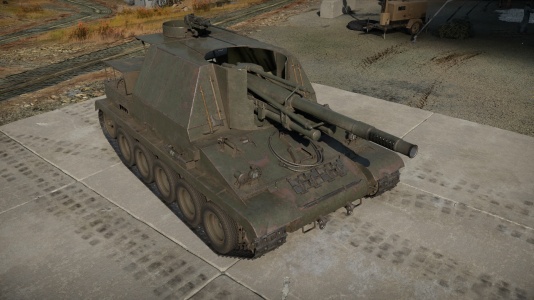
Obusier de 155 Modèle 50 mounted on a Lorraine 155
See also
- NSJ L/30 (155 mm) - A similar Japanese 155 mm howitzer
External links
- [Wikipedia] Obusier de 155 mm Modèle 50
- [Chars-francais.net] Lorraine Automoteur 155 mm
- [artillerie.asso.fr] L'Obusier de 155 mm, modèle 1950/1963
| France tank cannons | |
|---|---|
| 20 mm | 20F2 |
| 25 mm | SA35 L/72 |
| 37 mm | SA18 L/21 · SA38 L/33 |
| 47 mm | SA34 L/30 · SA35 L/32 · SA37 |
| 75 mm | APX · APX Canon de 75 mm modèle 1897 · SA35 L/17 · SA44 · SA49 · SA50 L/57 |
| 90 mm | D.911 APX · CN90 F2 · CN90 F3 · CN90 F4 · D915 · DEFA F1 · SA45 · SA47 |
| 100 mm | SA47 L/58 |
| 105 mm | CN-105-F1 · Giat 105 G2 · Modele F2 · PzK M57 |
| 120 mm | GIAT CN120-25 G1 · GIAT CN120-26 F1 · SA46 |
| 142 mm | ACRA |
| 155 mm | GCT F1 · Schneider 155 C · L'Obusier de 155 Modèle 1950 |
| Foreign: | |
| 15 mm | MG 151 (Germany) |
| 20 mm | MG 151 (Germany) |
| 30 mm | Bushmaster 2 Mk.44 (USA) |
| 37 mm | M6 (USA) |
| 40 mm | Bofors L/60 · QF 2-pounder (Britain) |
| 75 mm | KwK42 (Germany) · M3 (USA) · M6 (USA) |
| 76 mm | M7 (USA) |
| 90 mm | M3 (USA) |
| 105 mm | M4 (USA) |