5,000 kg FAB-5000 bomb
Suspended armaments
OLD‑WIKI.WARTHUNDER.COM (DEFUNCT)
Description
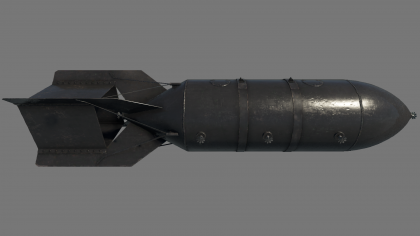
The FAB-5000 is a Soviet high explosive (HE) bomb. It was the largest bomb of the Soviet arsenal during WW2.
Vehicles equipped with this weapon
General info
| Bomb characteristics | |
|---|---|
| Mass | 5,080 kg |
| Explosive mass | 3,361 kg |
| Explosive type | TGA-16 |
| TNT equivalent | 5,041.5 kg |
| HE max penetration | 351 mm |
| Armour destruction radius | 105 m |
| Fragment dispersion radius | 374 m |
Effective damage
With a huge destruction radius of 105 m, nothing that stands near the FAB-5000 is likely to survive. Simply aiming the bomb near a capture zone will guarantee destruction of anything inside of it (this also applies to teammates so be careful!). The fragment dispersion is very effective even past 200 m thanks to almost 2 tons of steel surrounding the TGA-16 explosive filler, more than enough to kill lightly armoured vehicles such as SPGs and SPAA or at least damaging crew. It is important to set a fuse of at least a couple of seconds or to bomb from high altitudes as any planes near the bomb are likely to take critical damage.
Comparison with analogues
The British 12,000 lb H.C. Mk.I "Blockbuster" bomb carries ~1,000 kg TNTe more explosive mass and has a slightly larger explosion radius.
Usage in battles
The FAB-5000 is commonly used for destroying airfields in Air battles, however this requires other bombers in the team to take out bases first. Since the Pe-8 can only carry a single bomb it would be a waste to just use it on a single base.
The FAB-5000 shows its strength best in Ground battles where it is commonly referred to as the "Nuke" due to its large explosive mass. The Pe-8 is easy to shoot down when at low altitude as it is a heavy strategic bomber, and it's safer to bomb from high altitudes where the Pe-8 is far enough away to not be damaged by the bomb's splash damage, even without a fuse. The easiest targets to aim for are capture points as these are the most important areas for tanks to be inside, unfortunately for the tanks by being near the capture point they are very visible from above. Once there are multiple tanks inside of the capture point, the FAB-5000 is the perfect weapon for taking them all out in a single strike as the explosive mass is enough to kill everything inside of it. Meanwhile, the Pe-8 can stay at high altitudes where it is safe from enemy fighters.
Pros and cons
Pros:
- Massive explosive mass means precision is not needed
- 105 m lethal radius
- Fragment dispersion radius is large enough to kill un-armoured targets from way beyond the lethal range for armoured targets
- Even the fastest vehicles don't have time to get away from the explosion once the bomb lands
Cons:
- Due to the bomb being so heavy the Pe-8 carrying it is unable to accelerate to high speeds or climb very high
- The Pe-8 is vulnerable to SPAA
- Low altitude bombing is almost impossible due to the explosion being enough to kill the Pe-8 if it is too close.
- Due to being restricted to high altitude bombing enemies have to stay in the same place for a long time
- The FAB-5000 can be shot down by planes and tanks leading to the bomb to explode mid-air
- Without proper communication, teammates are at high risk of being killed by the bomb
History
Historically the FAB-5000 was developed to target infrastructure like bridges and factories.
Media
- Images
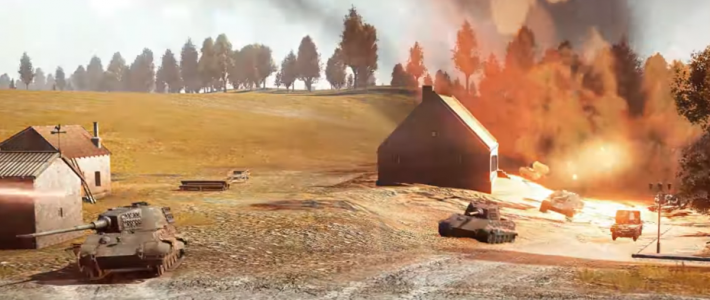
The impact of the FAB-5000 bomb
- Videos
See also
External links