CN-105-F1 (105 mm)
Tank cannons
OLD‑WIKI.WARTHUNDER.COM (DEFUNCT)
Description
The 105 mm Modèle F1 (or CN-105-F1) is a 105 mm rifled tank gun used by the AMX-30 and its variants. The gun is made from steel with a magnesium thermal sleeve to protect against damage such as bending. One of the unique features of the gun was the ability to shoot the Obus à Charge Creuse de 105 mm Modèle F1 or OCC for short.
Vehicles equipped with this weapon
General info
The Modèle F1 is fitted with a semi-automatic vertical sliding wedge breechblock but it is lacking a muzzle brake. As opposed to the British L7A1, the F1 cannon uses a compressed air scavenging system instead of a bore evacuator. The recoil mechanism uses two symmetrically opposed hydraulic brake cylinders with a single hydropneumatic recuperator cylinder.
Available ammunition
- OCC 105 F1 - The OCC projectile is the default HEAT round the user starts out with. It consists of two parts, the outer shell with a suspended inner shell connected by ball bearings. This allowed the HEAT round to be spin stabilized unlike other modern HEAT rounds which are fin stabilized. It weighs 10.95 kg and the warhead contains 780 g of RDX. Its speed is 1,000 m/s with the penetration force of up to 400 mm.
- OE 105 F1 Mle.60 - The OE 105 projectile is a default HE round the user stats out with. It consists of a steel body with an explosive filling of the TNT type. There is a sensitive impact fuse at the end of the projectile which detonates upon contact with any surface. The projectile weighs 12.1 kg and the explosive mass is 2 kg worth of TNT. Its speed is 700 m/s with the penetration force of 25 mm.
- OFPH 105 F1 - The OFPH 105 projectile is a smoke round that creates a full smoke screen after 5 seconds upon impact. The smoke screen itself lasts 25 seconds and has 20 m radius. It weighs 11.4 kg and has a muzzle velocity of 700 m/s.
- OFL 105 F1 - The OFL 105 projectile is an APFSDS round that relies on kinetic energy and spalling to damage enemy vehicles. It weighs 3.45 kg but drops to 1.6 kg in-flight due to the SABOT discarding. It moves at the speed of 1,525 m/s with the penetration force of up to 361 mm.
| Penetration statistics | |||||||
|---|---|---|---|---|---|---|---|
| Ammunition | Type of warhead |
Penetration @ 0° Angle of Attack (mm) | |||||
| 10 m | 100 m | 500 m | 1,000 m | 1,500 m | 2,000 m | ||
| OCC 105 F1 | HEAT | 400 | 400 | 400 | 400 | 400 | 400 |
| OE 105 F1 Mle.60 | HE | 25 | 25 | 25 | 25 | 25 | 25 |
| OFL 105 F1 | APFSDS | 361 | 358 | 350 | 341 | 332 | 322 |
| Shell details | ||||||||||||
|---|---|---|---|---|---|---|---|---|---|---|---|---|
| Ammunition | Type of warhead |
Velocity (m/s) |
Projectile mass (kg) |
Fuse delay (m) |
Fuse sensitivity (mm) |
Explosive mass (TNT equivalent) (kg) |
Ricochet | |||||
| 0% | 50% | 100% | ||||||||||
| OCC 105 F1 | HEAT | 1,000 | 10.95 | 0.05 | 0.1 | 1.02 | 62° | 69° | 73° | |||
| OE 105 F1 Mle.60 | HE | 700 | 12.1 | 0 | 0.1 | 2 | 79° | 80° | 81° | |||
| OFL 105 F1 | APFSDS | 1,525 | 3.8 | - | - | - | 78° | 80° | 81° | |||
| Smoke shell characteristics | ||||||
|---|---|---|---|---|---|---|
| Ammunition | Velocity (m/s) |
Projectile mass (kg) |
Screen radius (m) |
Screen deploy time (s) |
Screen hold time (s) |
Explosive mass (TNT equivalent) (g) |
| OFPH 105 F1 | 700 | 11.4 | 20 | 5 | 25 | 50 |
Comparison with analogues
| Comparable cannons to CN-105-F1 | ||||||
|---|---|---|---|---|---|---|
| Name | Year of Creation | Mass | Rounds Per Minute | Rounds | Calibre | |
| ▄ | Royal Ordnance L7A1 | 1956 | 1,282 kg | 10 RPM | Shot L28A1 Shell L35 |
105 mm |
| ▄ | Royal Ordnance L7A3 | 1957 | 1,287 kg | 6 RPM | DM12 DM13 DM33 |
105 mm |
| ▃ | M68 | 1958 | 1,128 kg | 6 RPM | M728 M456 M393A2 |
105 mm |
| ▄ | OTO Melara 105/52 | 1977 | _,___ kg | 7 RPM | M456 M393A2 M735 DM33 |
105 mm |
Usage in battles
Thanks to its very powerful HEAT round and average velocity, one might prefer to fight at longer ranges as opposed to brawling, due to the AMX-30's lack of stabilizers (the only exception is the AMX-30 Super, which does in fact possess a stabilizer). As the HEAT round does not lose its penetration power over distance, one might find themselves reliably one hit killing enemies at longer distances.
If one is using the AMX-30B2, AMX-30B2 BRENUS or the AMX-30 Super, they'll have access to the OFL 105 F1 APFSDS round. This is purely a kinetic energy shell so it can not overpressurize light vehicles, unlike the OCC 105 F1. If compared to the OCC 105 F1, penetration drops by around 40 mm but the velocity will be increased from 1,000 m/s to 1,525 m/s. This makes the round even more reliable at longer ranges. However, one should not instantly forget about the HEAT round as compared to the APFSDS round, the damage is far greater. The APFSDS creates little to no spalling, forcing the player to either hit the hostile's tank ammo rack or try to knock out the whole crew. As mentioned earlier, this round can not overpressurize certain vehicles, and due to the round creating little spalling, light vehicles can very easily survive an encounter against an OFL 105 F1 round. Taking a few HEAT rounds is recommended for this exact situation.
Pros and cons
Pros:
- Very powerful HEAT round, reliably one hit kills due to the 400 mm penetration value and above average spalling
Cons:
- AMX-30 and the AMX-30 (1972) lack the OFL 105 F1 round
- OFL 105 F1 does not produce reliable spalling, one hit kill is inconsistent
- HEAT round is very sensitive, a simple bush might stop it
History
The 105 mm Modèle F1 first entered service in the year 1966. It was designed at the Établissement central de l'armement terrestre (Central Establishment of Land Armament) in Saint-Cloud and developed by the atelier de Bourges (Bourges Arsenal) towards the end of 1950. A shortened version of the gun was also used on the M-51 'Super Sherman', which was an improved Israeli version of the American M4 Sherman tank.
Its design is based on that of the CN-105-57, used by the AMX-13. The length of the barrel is 5.9 m and its official designation is "Cn 105 Mle 622". It weighs 2,470 kg and it requires 2 crew members to operate efficiently.
The AMX-30 with its spin stabilized HEAT round, was considered as an "ideal round" for its time. The Modèle F1 was also designed to fire the OCC F1 Mle.60 high explosive projectile, but also the SCC F1 training round and the OFUM PH-105 F1 smoke round.
Media
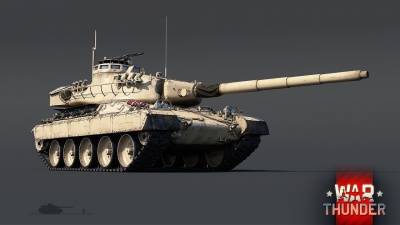
AMX-30 Super equipped with the CN-105-F1
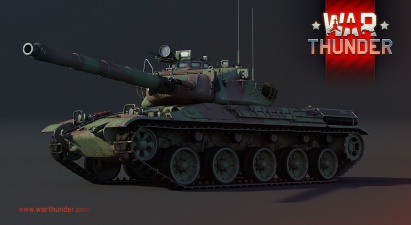
AMX-30 (1972) equipped with the CN-105-F1
See also
- Royal Ordnance L7A1 (105 mm) - British 105 mm cannon
- L7A3 (105 mm) - British 105 mm cannon. Identical to the L7A1, the only exception is that it can load HEATFS and APFSDS rounds
- OTO Melara 105/52 (105 mm) - Italian 105 mm cannon
- M68 (105 mm) - American license-produced version of the Royal Ordnance L7, the only difference is that the cannon is secured to the breech by a tapered pin and interrupted breech threads which allow the barrel to be removed from the tank shield without having to dismantle the mantlet.
External links
- [Wikipedia] 105 mm Modèle F1
- [Kotsch88] Ammunition for the Modèle F1
- [Angelfire] Comparison of tank cannons
| France tank cannons | |
|---|---|
| 20 mm | 20F2 |
| 25 mm | SA35 L/72 |
| 37 mm | SA18 L/21 · SA38 L/33 |
| 47 mm | SA34 L/30 · SA35 L/32 · SA37 |
| 75 mm | APX · APX Canon de 75 mm modèle 1897 · SA35 L/17 · SA44 · SA49 · SA50 L/57 |
| 90 mm | D.911 APX · CN90 F2 · CN90 F3 · CN90 F4 · D915 · DEFA F1 · SA45 · SA47 |
| 100 mm | SA47 L/58 |
| 105 mm | CN-105-F1 · Giat 105 G2 · Modele F2 · PzK M57 |
| 120 mm | GIAT CN120-25 G1 · GIAT CN120-26 F1 · SA46 |
| 142 mm | ACRA |
| 155 mm | GCT F1 · Schneider 155 C · L'Obusier de 155 Modèle 1950 |
| Foreign: | |
| 15 mm | MG 151 (Germany) |
| 20 mm | MG 151 (Germany) |
| 30 mm | Bushmaster 2 Mk.44 (USA) |
| 37 mm | M6 (USA) |
| 40 mm | Bofors L/60 · QF 2-pounder (Britain) |
| 75 mm | KwK42 (Germany) · M3 (USA) · M6 (USA) |
| 76 mm | M7 (USA) |
| 90 mm | M3 (USA) |
| 105 mm | M4 (USA) |