AML-90 (Israel)
Wheeled ground vehicles
OLD‑WIKI.WARTHUNDER.COM (DEFUNCT)
| This page is about the light tank AML-90 (Israel). For other versions, see AML-90 (Family). |
Description
The AML-90 was developed by the French company Panhard in the late 1950s, as a response to a commission by the French Ministry of Defense. It was based on the earlier AML-60, which mounted a 60 mm mortar as its main weapon. The AML-90 replaced the mortar with a DEFA low-pressure 90 mm rifled gun capable of firing high-explosive and high-explosive anti-tank shells. The AML-90 was used by several countries in Africa, Asia, and Latin America, but one of its most notable users was Israel. Israel acquired about 23 AML-90s from France in the early 1960s, and used them extensively in the Six-Day War of 1967 and the Yom Kippur War of 1973, amongst others.
Introduced in Update "Wind of Change", relies heavily on its speed and good positioning to avoid getting killed, since the lack of armour of the AML-90 makes it so that any shot would result in death, even .50 cal can penetrate the armour of the AML-90. Therefore, it should be used in flanking manoeuvres, harassing enemies, capturing points, and supporting allies. It features a very powerful 90 mm cannon with good penetration and decent reload speed. Since it is a wheeled vehicle, it may get stuck in some terrains, and as such using it in flat areas should be prioritized.
General info
Survivability and armour
The AML-90 was designed to be fast, agile, and air-transportable, making it suitable for various terrains and climates. However, these traits came at the cost of the AML-90's armour, as the AML-90 (Israel) lacks protection against heavy machine gun fire and is susceptible to damage by light machine gun fire. The crew is located in a rather small compartment, making the armoured car prompt to being knocked out by a single shot from almost any direction. It is also vulnerable to overpressure, meaning chemical energy ammunition will take out your vehicle regardless of where they impact. A kinetic energy ammunition can damage your AML through the projectile itself or the spalling generated but the inflicted damages are lesser and has a higher chance to knock out the crew members or critical modules than to destroy the vehicle. It should be noted that the thin armour has a chance to not activate fused shells like APHE, APCBC, etc, although it will trigger HEAT, HEATFS, HE and ATGM.
Armour type:
- Rolled homogeneous armour (hull, turret)
- Structural steel (mudguards, storage boxes)
- Wheel (tires)
| Armour | Front (Slope angle) | Sides | Rear | Roof |
|---|---|---|---|---|
| Hull | 10 mm (51°) Upper glacis 10 mm (17°) Upper glacis |
10 mm (4°) Front half 10 mm (6°) Rear half |
10 mm Upper plate 10 mm (46°) Upper glacis 10 mm (20°) Lower glacis |
10 mm (40°) Front glacis 10 mm (44°) Rear glacis |
| Turret | 12 mm (30°) Turret front 12 mm (8°) Gun mantlet |
10 mm (17-21°) 10 mm Viewports |
10 mm (16°) | 10 mm (16°) Front part 10 mm Rear part 8 mm Gunner hatch |
| Cupola | 8 mm (spherical) | |||
Notes:
- Wheels are 10 mm thick and a spare wheel covers the left side of the hull.
- Storage boxes and mudguards are 5 mm thick.
- The belly is 8 mm thick.
- The gun barrel is 20 mm thick.
Mobility
| Game Mode | Max Speed (km/h) | Weight (tons) | Engine power (horsepower) | Power-to-weight ratio (hp/ton) | |||
|---|---|---|---|---|---|---|---|
| Forward | Reverse | Stock | Upgraded | Stock | Upgraded | ||
| Arcade | Expression error: Unexpected * operator. | 139 | Expression error: Unexpected round operator. | __.__ | |||
| Realistic | 80 | Expression error: Unexpected round operator. | __.__ | ||||
The AML-90 has very good top speed while on flat and stable surfaces like roads and ice. Mobility however in irregular terrain may result in the AML-90 getting stuck or having very bad speed, sometimes only being capable of reaching 20-30 km/h. The acceleration is a little inferior compared to MBTs and other armoured vehicles at the battle rating, however it has very good reverse speed compared to most MBTs that will save your life in the battlefield.
Modifications and economy
Tankers should prioritize upgrades to improve the traction and survivability of the vehicle, as well as mobility upgrades as late modifications. Priority upgrades listed below:
- Improved Parts
- Tires
- Smoke Grenades
- Crew Replenishment
- Improved Optics
- Suspension
After this upgrades, going for the mobility upgrades would compensate somehow the lacking of acceleration while going for the rest of firepower would improve the turret performance.
Armaments
Main armament
The 90 mm DEFA F1 cannon is a very solid choice for its BR, since it features very good penetration with its HEAT ammunition with decent reload rate when stock. The post penetration damage may feel insufficient, thus careful aiming is very important.
| 90 mm DEFA F1 | Turret rotation speed (°/s) | Reloading rate (seconds) | |||||||||||
|---|---|---|---|---|---|---|---|---|---|---|---|---|---|
| Mode | Capacity | Vertical | Horizontal | Stabilizer | Stock | Upgraded | Full | Expert | Aced | Stock | Full | Expert | Aced |
| Arcade | 20 | -8°/+15° | ±180° | - | 23.8 | 32.9 | 40.0 | 44.2 | 47.1 | 8.71 | 7.70 | 7.10 | 6.70 |
| Realistic | 14.9 | 17.5 | 21.3 | 23.5 | 25.0 | ||||||||
Ammunition
| Penetration statistics | |||||||
|---|---|---|---|---|---|---|---|
| Ammunition | Type of warhead |
Penetration @ 0° Angle of Attack (mm) | |||||
| 10 m | 100 m | 500 m | 1,000 m | 1,500 m | 2,000 m | ||
| OCC 60-62 | HEATFS | 350 | 350 | 350 | 350 | 350 | 350 |
| OE 90 F1 | HE | 13 | 13 | 13 | 13 | 13 | 13 |
| Shell details | ||||||||||||
|---|---|---|---|---|---|---|---|---|---|---|---|---|
| Ammunition | Type of warhead |
Velocity (m/s) |
Projectile mass (kg) |
Fuse delay (m) |
Fuse sensitivity (mm) |
Explosive mass (TNT equivalent) (g) |
Ricochet | |||||
| 0% | 50% | 100% | ||||||||||
| OCC 60-62 | HEATFS | 800 | 3.65 | 0.05 | 0.1 | 877.7 | 65° | 72° | 77° | |||
| OE 90 F1 | HE | 640 | 5.27 | 0.2 | 0.1 | 945 | 79° | 80° | 81° | |||
| Smoke shell characteristics | ||||||
|---|---|---|---|---|---|---|
| Ammunition | Velocity (m/s) |
Projectile mass (kg) |
Screen radius (m) |
Screen deploy time (s) |
Screen hold time (s) |
Explosive mass (TNT equivalent) (g) |
| OFUM PH90-F2 | 640 | 5.4 | 9 | 5 | 20 | 50 |
Ammo racks
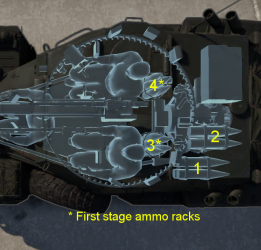
| Full ammo |
1st rack empty |
2nd rack empty |
3rd rack empty |
4th rack empty |
Visual discrepancy |
|---|---|---|---|---|---|
| 20 | 17 (+3) | 11 (+9) | 6 (+14) | 1 (+19) | No |
Notes:
- Shells are modelled individually and disappear after having been shot or loaded.
- Racks 3 and 4 are first stage ammo racks. They total 10 shells and get filled first when loading up the tank.
- These racks are also emptied early: the rack depletion order at full capacity is: 3 - 4 - 1 - 2.
- Simply not firing when the gun is loaded will move ammunition from rack 1 then 2 into ready rack 4 then 3. Firing will interrupt the restocking of the ready racks.
Machine guns
The 7.62 mm MG of the AML-90 is only useful against low-flying helicopters lacking armour. Most targets are invulnerable to this calibre at all points and tracks are also usually strong enough to hold many shots of this MG.
| 7.62 mm A-A-F1N | ||||
|---|---|---|---|---|
| Mount | Capacity (Belt) | Fire rate | Vertical | Horizontal |
| Pintle | 800 (100) | 900 | -10°/+40° | ±120° |
| Coaxial | 2,200 (100) | 900 | - | - |
Usage in battles
The AML-90 relies on speed to survive in the battlefield. Positioning is very important, flanking since the start of the game, picking apart slow enemies from the sides. Use in frontline combat is highly not advised since it can be penetrated by even .50 cal fire.
When flanking, the AML-90 needs to shoot and change position quickly, while staying hidden. The gun of the AML-90 takes some time to stabilize when stopping and as such, rushed shots may result in a miss, and the play style of the AML-90 is not very friendly. Prioritize heavy targets and shoot from hidden positions like forest or hills, often from relatively close range due to the lack of a rangefinder. While flanking, players can also scout enemies, and only target opponents that can be taken out easily.
Pros and cons
Pros:
- Very short and narrow, can effectively hide itself and squeeze in-between tanks , shrubs and bushes while fighting in a city
- High speed on road (~50-80 km/h), faster than tracked light tanks like M41A1, can sometimes rush through enemy fire while taking superficial damage
- Generous speed off road (~40-50 km/h), allowing to be faster most medium tanks such as the T-54 and Leopard 1 although it may lag behind some tracked light tanks such as the Wiesel 1A4.
- 90 mm HEATFS is lethal thanks to its high penetration. Can go through almost all common tanks like Leopard 1 or T-44
- -18 km/h reverse speed can pull it out of a dangerous situation rather quickly
- Smoke grenades can conceal the vehicle when needed
- Stable hull, driving at maximum speed on flat terrain does not affect accuracy too much
Cons:
- Cannon itself isn't stabilised in any way, needs significant amount of time to aim after driving over a hill or any slope (particularly with the low "targeting" crew skill)
- Must be used without expert crew against elite crews of other nations, making it instantly inferior to the same tank of other nations at first
- Armour is so poor that even German 7.92 mm can penetrate it at close range, laughably easy to destroy with HMG even over long range, especially from the side
- HEATFS has limited post-penetration damage especially against spacious tanks like M60 and may fail to damage tanks like the T32E1
- HEATFS of AML-90 is slightly slower than general tank ammunition and thus its trajectory is quite curved, long range shots require practice
- Wheeled design and low mass makes it extremely sluggish when turning or driving through obstacles
History
The AML-90 is a variant of a light armoured car developed by the French company Panhard in the late 1950s. It was designed to replace the older and less capable scout vehicles that the French Army had used during World War II, such as the AMD 35 and the Laffly S15. The AML family of cars had a had a four-wheel drive chassis, a three-man crew, and the AML-90 had a 90 mm low-pressure gun that could fire high-explosive anti-tank (HEAT) shells. The AML-90 was also very agile and compact, making it suitable for reconnaissance and raiding missions in various terrains.
One of the most notable users of the AML-90 was Israel, who were impressed by the vehicle's mobility and compact size. Israel received their first batch of 29 vehicles by the end of 1963, where they were assigned to the reconnaissance units of the IDF, where they performed scouting, screening, and raiding missions. The AML-90s saw action in several conflicts with Israel's Arab neighbours, such as the Six-Day War in 1967[1], the War of Attrition[2] from 1967 to 1970, and the Yom Kippur War in 1973, where the AML-90 demonstrated their mobility, firepower, and reliability in the harsh desert terrain. They often engaged enemy tanks and armoured vehicles at long distances, using their 90 mm HEATFS shells to penetrate their armour.
Of particular note is the the Arab–Israeli conflict , where the AML-90 achieved some of the highest armour-to-armour kill ratios achieved with the AML platform to date, which included the destruction of 13 Jordanian and Egyptian T-54s[3].
However, the AML-90s also faced many challenges and limitations in these wars. They were vulnerable to enemy anti-tank missiles, such as the Soviet-made 9M14 Malyutka, which could hit them from longer ranges than their guns. They also lacked adequate protection against mines and artillery fire, which caused many casualties among their crews. Moreover, they were outnumbered by the larger and more modern tanks and armoured vehicles of the Arab and Jordanian armies, such as the T-54, T55, and M48 Patton. As a result, the AML-90s suffered heavy losses in some battles, such as the Battle of Karameh in 1968 and the Battle of Chinese Farm in 1973.
The AML-90s continued to serve in the IDF until the late 1980s, when they were gradually replaced by more advanced vehicles, such as the M113 APCs and the Merkava tanks. They were also sold or donated to some of Israel's allies, such as South Lebanon Army and Ethiopia.
Media
- Skins
See also
- Related development
External links
References
- ↑ Nachum Baruchy: The Hare'l (10th) Armoured Brigade In The Six Day War. Ariel Publishing, Jerusalem. 2010 (In Hebrew).
- ↑ Defence Update (International). Defence Update G.m.b.H., 1984, 1984–85 Volume Collected Issues 48–58
- ↑ Armed Forces. Contributions by the Royal United Services Institute for Defence Studies. Allan Limited and the Royal United Services Institute for Defence Studies. 1986.
| Panhard | |
|---|---|
| Armoured Cars | AML-90 |
| AMD.35 | AMD.35 · AMD.35 (SA35) |
| E.B.R. | E.B.R. (1951) · E.B.R. (1954) · E.B.R. (1963) |
| Export | AML-90 |
| Israel light tanks | |
|---|---|
| Tracked | AMX-13 · Namer 30 |
| Wheeled | AML-90 |